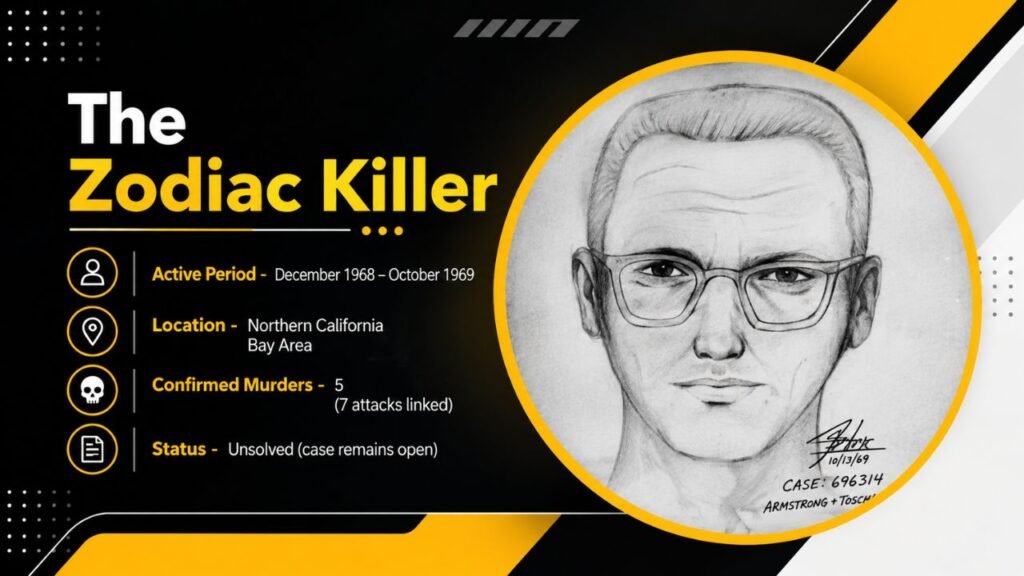
It’s been more than fifty years since the first shots rang out on a dark, gravel road outside Benicia, California, and the Zodiac Killer is still, somehow, a mystery. Books have been written about him. Movies have been made. Cryptographers have spent whole careers picking apart his codes. And yet the question people keep typing into search bars – who is the Zodiac Killer? – still doesn’t have a real answer. Not a proven one, anyway. Here’s what’s actually known about the case, stripped of the speculation that’s crept in over the decades.
Who Is the Zodiac Killer?
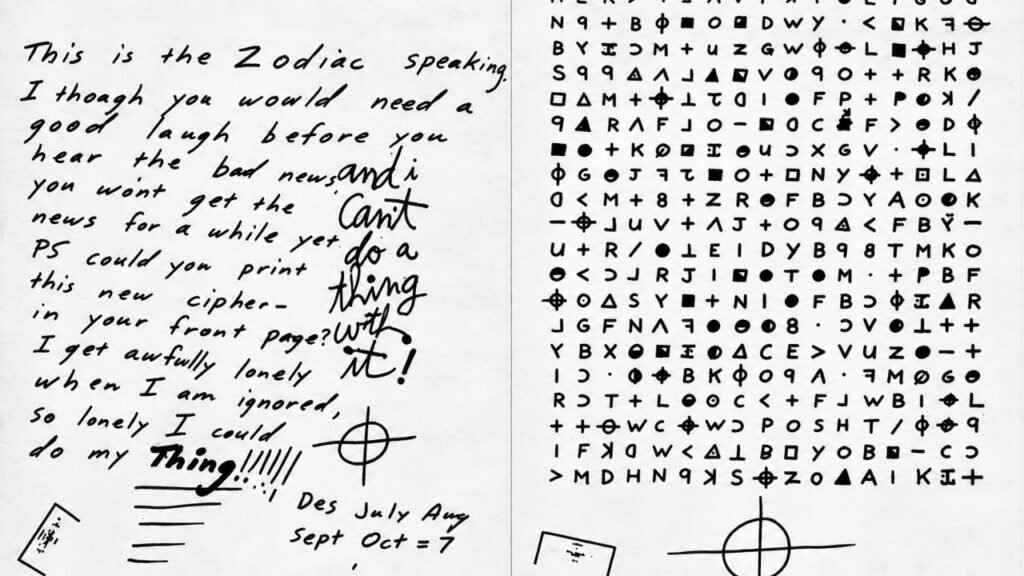
He never used a real name – “Zodiac” was something he came up with himself, not a label reporters slapped on later. Between December 1968 and October 1969, he tore through the Bay Area, and he made absolutely sure everyone knew who was behind it by writing directly to the newspapers, especially the San Francisco Chronicle. His signature was hard to miss too: a circle with a cross through it, built to look like a gun’s crosshair, sitting right below the word “Zodiac” every single time.
Here’s what defines the case, in short:
- Officially linked to 7 attacks – 5 fatal, across 4 different Northern California locations.
- Claimed body count: up to 37, a number no investigator has ever been able to back up with evidence.
- No arrest, ever – nobody has been arrested or charged in over fifty years.
- Multiple agencies involved – San Francisco PD, Vallejo PD, Napa County Sheriff’s Office, Solano County Sheriff’s Office, and the FBI have all worked pieces of the case.
- Case status: open – it has never been formally closed.
Quick Facts
| Detail | Information |
| Active period | December 1968 – October 1969 (confirmed attacks); letters continued to 1974 |
| Location | Northern California Bay Area (Benicia, Vallejo, Napa County, San Francisco) |
| Confirmed murders | 5 |
| Confirmed survivors | 2 |
| Claimed victims (unverified) | Up to 37 |
| Ciphers sent | 4 (2 solved, 2 unsolved) |
| Suspects named by police | 1 (Arthur Leigh Allen) |
| Status | Case remains open; killer never identified or charged |
Who Was the Zodiac Killer? A Timeline of the Confirmed Attacks
You can’t really understand this case without walking through it chronologically – one attack after another, exactly how it unfolded on the ground. Seven people, four separate incidents, all officially confirmed. This is the timeline as it’s been pieced together from court records and reporting at the time.
| Date | Location | Victims | Outcome |
| Dec 20, 1968 | Lake Herman Road, Benicia | David Faraday, 17; Betty Lou Jensen, 16 | Both killed |
| Jul 4–5, 1969 | Blue Rock Springs Park, Vallejo | Darlene Ferrin, 22; Michael Mageau, 19 | Ferrin killed; Mageau survived |
| Sep 27, 1969 | Lake Berryessa, Napa County | Cecelia Shepard, 22; Bryan Hartnell, 20 | Shepard died 2 days later; Hartnell survived |
| Oct 11, 1969 | Presidio Heights, San Francisco | Paul Stine, 29 | Killed (last confirmed victim) |
December 20, 1968 – Lake Herman Road, Benicia
It started on a stretch of road locals used to call a lovers’ lane – quiet, isolated, exactly the kind of spot teenagers went to be alone. David Faraday, 17, and Betty Lou Jensen, 16, were there on their first date together when someone ambushed them and opened fire. Neither one made it. And here’s the strange part: at the time, police had no reason to think this was anything but an isolated tragedy. The dots wouldn’t connect for another seven months, not until the killer himself stepped forward to claim it.
July 4–5, 1969 – Blue Rock Springs Park, Vallejo
Independence Day, roughly four miles from where the first attack happened, and he was back. This time it was Blue Rock Springs Park – a parking lot, late at night. Darlene Ferrin, 22, was killed. Her companion, 19-year-old Michael Mageau, took multiple bullets and somehow lived. What happened next is what actually gave the case its name: a call came into the Vallejo Police Department shortly afterward, someone claiming credit for both this shooting and the one back in December. It was the first time anyone heard from him directly.
September 27, 1969 – Lake Berryessa, Napa County
This attack still makes people uneasy, decades later, because of how different it was. He didn’t shoot from a distance this time – he walked straight up to his victims, hood over his face, a symbol clipped to his chest that mimicked his crosshair logo, carrying a gun in one hand and a knife in the other.
What happened at the lake, briefly:
- Bryan Hartnell, 20, and Cecelia Shepard, 22, were having a picnic near the water when the masked man approached.
- He claimed to be an escaped convict who needed money and a car.
- He tied both victims up before stabbing them repeatedly.
- Hartnell survived despite being stabbed multiple times in the back; Shepard died from her wounds two days later.
- Before leaving, he scrawled a message on the door of Hartnell’s car, listing the dates of his earlier attacks next to his crosshair symbol.
October 11, 1969 – Presidio Heights, San Francisco
For the first and only time, he struck within city limits. Paul Stine, 29, was driving a cab that night when a passenger asked to be taken to Presidio Heights. At Washington and Cherry Streets, the fare pulled out a gun, shot Stine in the head, then tore off a piece of his bloodstained shirt before walking off into the dark. That fabric fragment later turned up in the mail at the Chronicle, sent as proof of authenticity. Stine’s murder marks the last confirmed Zodiac killing – even though the letters themselves didn’t stop for years.
After 1969: Letters Without Bodies
The killings, as far as anyone can confirm, ended there. The letters didn’t. Postcards and letters kept showing up in mailboxes and newsrooms all through the early-to-mid seventies, with the last one investigators broadly accept as genuine arriving in 1974. A few of them hinted at victims nobody had ever officially connected to him – Kathleen Johns, who claims she narrowly got away from an attack after taking a ride from a stranger in March 1970, and Donna Lass, a woman who disappeared near Lake Tahoe that same year and later turned up by name in one of the killer’s postcards. Neither case has ever crossed the line into an officially confirmed Zodiac crime.
Over the years, plenty of amateur researchers – and a few actual detectives, too – have wondered whether his spree started before 1968 or ran well past 1969. None of it has ever been backed by solid evidence, so treat the following as theories, not facts:
- Cheri Jo Bates (1966) – an unsolved stabbing death of a college student in Riverside, California, sometimes linked because of taunting letters sent to police afterward.
- Robert Domingos and Linda Edwards (1963) – a Santa Barbara County double murder of teenagers, occasionally floated as a possible early Zodiac crime.
- Kathleen Johns (1970) – a survivor’s account referenced in a later Zodiac letter (more on this below).
- Donna Lass (1970) – a missing-persons case name-dropped in a Zodiac postcard, never confirmed.
How Many People Did the Zodiac Killer Kill?
Probably no question about this case gets asked more, and the real answer means untangling what he bragged about from what anyone could actually prove in court.
- Confirmed murders: five. David Faraday, Betty Lou Jensen, Darlene Ferrin, Cecelia Shepard, and Paul Stine.
- Confirmed survivors: two. Michael Mageau and Bryan Hartnell.
- Claimed victims: as many as 37, according to his own letters – a figure no investigator has ever verified. Criminologists tend to view inflated body-count claims like this with a healthy dose of skepticism; boasting for shock value is a pretty well-documented habit among serial offenders.
You’ll come across plenty of headlines throwing out numbers like 20, or 28, or the full 37 he claimed. None of that holds up against actual physical evidence. What law enforcement has formally confirmed is five deaths and two survivors, spread across four attacks – nothing more.
Why the Case Crossed So Many Jurisdictions
There’s a fairly unglamorous reason this case dragged on unsolved for so long, and it has nothing to do with the killer’s cleverness – it’s bureaucratic. Lake Herman Road fell under Solano County and Benicia Police. Blue Rock Springs went to Vallejo PD. Lake Berryessa belonged to Napa County. Presidio Heights was San Francisco’s problem. Four agencies, four separate case files, and back then, nothing tying them together digitally in real time. Effectively, four different departments spent years chasing fragments of a single killer’s spree without ever fully pooling what they knew. It’s one of the reasons this case later got cited in arguments for centralized violent-crime databases – a gap the FBI’s Violent Criminal Apprehension Program (ViCAP) was eventually built to close.
The Letters and the Ciphers
If there’s one thing that separates the Zodiac from other unsolved killers of that era, it’s how badly he wanted an audience. Starting in the summer of 1969, he flooded Bay Area newsrooms with letters, several of them wrapped around encrypted messages he insisted held real clues to his identity.
Four ciphers are generally attributed to him:
| Cipher | Sent | Length | Status |
| Z408 | July 1969 | 408 characters | Solved within a week (1969) by a schoolteacher and his wife |
| Z340 | November 1969 | 340 characters | Solved December 5, 2020, after 51 years |
| 13-character cipher | 1970 | 13 characters | Unsolved |
| 32-character cipher | 1970 | 32 characters | Unsolved |
The Z340 Breakthrough of 2020
Z340 was the one nobody could crack – a genuine holy grail for cryptographers, amateur and professional alike, for over half a century. That finally changed on December 5, 2020. Three people, working from three different countries – David Oranchak in the U.S., Sam Blake in Australia, Jarl Van Eycke in Belgium – finally solved it. The trick, it turned out, was realizing the cipher wasn’t just letter substitution. It also involved a diagonal transposition, meaning you had to trace it almost like a word-search grid instead of reading straight across. Once they had a solution, they sent it to the FBI’s Cryptanalysis and Racketeering Records Unit, and it checked out.
After fifty-one years of buildup, the actual payoff was underwhelming, honestly. The decoded text was mostly taunts directed at police, a mention of “the gas chamber,” and a denial that he was the same caller who’d phoned into a local TV show that same month. No name. No confession. Nothing that cracked the case wide open.
The remaining two – the 13-character and 32-character ciphers – are still sitting there unsolved. No verified decryption of either has ever produced a name.
Zodiac Killer Identity: The Leading Suspects
Even with decades of investigation, tens of thousands of tips, and multiple task forces behind it, nobody has ever actually been charged. A handful of names keep resurfacing whenever the Zodiac killer identity comes up – none of them proven beyond reasonable doubt.
Arthur Leigh Allen
If you’ve heard one name connected to this case, it’s this one. Arthur Leigh Allen is the only person the official investigation ever publicly named, and by far the most talked-about suspect the case has ever produced. He was born in Honolulu in 1933, grew up in Vallejo – the same city that saw two of the attacks – served in the Navy, taught elementary school for a while, and was later convicted of molesting a child.
Here’s how the case against him unfolded – and why it fell apart:
- 1971: An acquaintance told police Allen had talked about wanting to kill people and had used the word “Zodiac” before it was public knowledge.
- Search of his property: Investigators searched his home and trailer and seized weapons, but nothing tied him directly to the murders.
- Handwriting analysis: Experts compared his writing to the Zodiac letters and found no match.
- 2002 DNA test: San Francisco police announced a partial DNA profile pulled from saliva on a Zodiac letter’s stamp didn’t match Allen.
- Palm print: Didn’t line up with one lifted from a later Zodiac letter either.
- 1992: Allen died of a heart attack at his home in Vallejo, without ever being charged, and denied any involvement to the end.
Most of why his name still comes up today traces back to Robert Graysmith’s bestselling books and the film they inspired, rather than anything conclusive. Researchers who’ve gone back through the case since then have picked apart a good chunk of the circumstantial evidence against him – a lot of it, they argue, simply doesn’t hold together.
Gary Francis Poste
A newer theory came from a group calling itself “The Case Breakers” – retired law enforcement and forensic professionals who publicly named a deceased man, Gary Francis Poste, as their pick. Their case rests mostly on circumstantial details, like a photo they say resembles a police sketch. Neither the FBI nor SFPD has backed this claim, and longtime Zodiac researchers have pushed back hard, arguing the evidence falls well short of anything usable.
Other Named Suspects
Beyond those two, dozens of other names have surfaced over the decades – Richard Gaikowski and Lawrence Kane among the more frequently mentioned – floated by true-crime writers, amateur sleuths, and occasionally family members. None of it has ever produced physical evidence or led to a single charge.
Suspects at a Glance
| Suspect | Named by | Key evidence against | Why the case fell apart |
| Arthur Leigh Allen | San Francisco Police Department (official suspect) | Acquaintance tip, proximity to crimes, search of his property | DNA and palm print excluded him (2002); handwriting didn’t match |
| Gary Francis Poste | “The Case Breakers” (private group) | Photo/sketch resemblance, circumstantial claims | Not endorsed by FBI or SFPD; evidence disputed by researchers |
| Richard Gaikowski | Independent researchers | Alleged voice/handwriting similarities | Never substantiated with physical evidence |
| Lawrence Kane | Independent researchers | Circumstantial biographical overlap | Never substantiated with physical evidence |
Was the Zodiac Killer Ever Caught?
Short answer: no. And it’s worth pausing on just how much effort went into trying, before accepting that. This ranks among the largest serial killer manhunts in American history, and it still ended with nobody arrested, nobody charged, nobody named with certainty. The file’s still open.
A few things have kept it that way for over fifty years:
- No confirmed biological evidence – no blood or semen recovered from any crime scene.
- The weapons vanished – the gun used in three attacks and the knife from Lake Berryessa were never found.
- Only a partial DNA profile exists, pulled from saliva under a postage stamp on one letter – enough to rule people out, not enough to positively identify anyone.
- Four different police agencies were chasing separate pieces of the same case in an era before shared digital records.
- No verified confession – for all the letters he sent, he never handed over anything that actually proved his identity.
That partial DNA profile is really the only physical thread anyone has connecting a specific person to the crimes – developed in the early 2000s, and strong enough to rule out Arthur Leigh Allen when it was tested in 2002. But since it’s incomplete, it can only eliminate people, not confirm them. And it hasn’t matched anyone through modern genetic genealogy databases yet, at least not publicly.
Is the Zodiac Killer Still Alive?
Run the numbers and the odds keep shrinking. If he was in his twenties or thirties back in 1968 and 1969 – which lines up with most witness accounts – he’d be pushing 90 by now, maybe well past it. So technically, sure, it’s not impossible he’s still out there. But every year that passes makes it less likely. And every major suspect anyone’s ever publicly named, Arthur Leigh Allen included, has already died without facing charges, which makes any future prosecution that much harder even if new evidence eventually surfaces. Genetic genealogy could theoretically still put a name to this case after the fact. A courtroom conviction, though, only happens if the person’s still alive to stand in one.
Did They Ever Find the Zodiac Killer? The Case Today
Based on the FBI’s most recent public statements, this case is still open, and no announcement has ever pointed to a confirmed identity. Word is investigators are still exploring whether forensic genetic genealogy – the method that finally cracked the Golden State Killer case in 2018 – could be applied to that partial DNA profile lifted from the letters.
The public hasn’t lost interest either. Between new documentaries, a steady stream of true-crime podcasts, and the 2020 cracking of Z340, there’s been a real wave of hope that the remaining ciphers might eventually give something up. Cryptographers tend to be a little more cautious about that, though – ciphers as short as 13 or 32 characters are notoriously hard to solve with any real confidence, simply because there’s not enough text to rule out other equally plausible “solutions.”
Until DNA, a confession, or some other piece of undeniable evidence ties a specific name to these crimes, the Zodiac Killer is going to stay exactly what he’s been for more than fifty years now: one of the biggest open questions in American criminal history.
The Detective Who Chased the Zodiac for Nearly a Decade
Ask anyone who’s studied this case and one name comes up before all the others: San Francisco Police Inspector Dave Toschi. He landed on the case in October 1969, right after Paul Stine was killed, and spent close to a decade on it alongside his partner, Inspector Bill Armstrong.
A quick look at Toschi’s role in the case:
- Interviewed roughly 5,000 people over the course of the investigation, by his own count.
- Believed Arthur Leigh Allen was the killer – a conviction he held for the rest of his life, even without enough evidence to charge him.
- Inspired two famous fictional cops – Steve McQueen’s character in Bullitt and Clint Eastwood’s Harry Callahan in Dirty Harry, largely thanks to his bow ties, shoulder holster, and habit of chewing cherry-flavored cigarillos.
- Played by Mark Ruffalo in David Fincher’s 2007 film Zodiac.
- Removed from the case in 1978 after admitting he wrote anonymous fan letters to a Chronicle columnist praising his own detective work – an admission that also raised (never-proven) suspicion he might have written a hoax Zodiac letter.
- Retired from the SFPD in 1985, still visibly haunted by the case; friends say he returned to the Presidio Heights crime scene every year on the anniversary of Stine’s murder.
- Died in January 2018, at age 86, in San Francisco.
Composite Sketches and the Killer’s Physical Description
A few witnesses at Lake Berryessa and Presidio Heights actually laid eyes on the man responsible, which is how police ended up with composite sketches to work from. The one that circulated most widely – a heavyset white man, short curly or crew-cut hair, glasses – came largely from people who saw him near the Stine murder scene. The problem is the descriptions never fully lined up. Height, build, age – witnesses across the different attacks disagreed on the details, and that inconsistency has made it genuinely hard to pin the sketches on any one suspect. Arthur Leigh Allen included: his build, by several accounts, wasn’t quite a match either.
Kathleen Johns and Other Disputed Cases
Kathleen Johns’ story is one of the more argued-over pieces of this case. Here’s what she reported:
- March 1970: A man driving behind her on a Northern California highway flagged her down, warning that her tire looked loose.
- He offered to fix it – but, she said, deliberately loosened it further.
- He then talked her into a ride and drove erratically for miles, making comments she took as threats.
- She escaped by jumping from the moving car with her infant daughter.
- A letter that later reached the Chronicle, supposedly from the Zodiac, referenced details of the incident that hadn’t been made public – lending it credibility with investigators, even though it’s never been formally confirmed as a Zodiac crime the way the five core murders have been.
Then there’s Donna Lass, a nurse who went missing near Lake Tahoe in 1970 and was never found. Almost two years after she vanished, a postcard mailed to a Bay Area paper name-checked her directly, which is basically the only reason anyone connects her disappearance to this case at all. It’s still an open file. There’s never been a body.
Zodiac Killer Pop Culture Legacy
Few unsolved crimes have dug this deep into American pop culture:
- Robert Graysmith’s books – Zodiac (1986) and Zodiac Unmasked (2002), which shaped how most people understood the killer for decades, though some researchers say the books blend verified fact with speculation more than readers realize, particularly around Arthur Leigh Allen.
- David Fincher’s Zodiac (2007) – starring Jake Gyllenhaal, Robert Downey Jr., and Mark Ruffalo; widely regarded as one of the more carefully researched dramatizations of the case.
- Netflix’s This Is the Zodiac Speaking – a recent docuseries that leaned heavily into the Allen theory, drawing pushback from online communities and longtime researchers who felt it overstated how strong that evidence actually was.
- True-crime podcasts, books, and video games – the case continues to generate new content decades later.
- Documented copycat crimes – the Zodiac’s letters and symbol have inspired multiple real-world imitators over the years.
Read More Stories: mackenzie shirilla | Kouri Richins | Sarah Khalifa Case
Frequently Asked Questions
The Zodiac Killer is the unidentified serial murderer responsible for at least five confirmed killings in Northern California between 1968 and 1969. His identity has never been officially confirmed.
No. The Zodiac Killer was never arrested or charged, and the case remains officially open and unsolved to this day.
Investigators have confirmed five murders and two surviving victims across four attacks, though the killer himself claimed to have killed as many as 37 people – a claim that has never been verified.
It’s possible but increasingly unlikely, since anyone involved in the 1968–1969 attacks would now be in their late 80s or older. Every major named suspect has already died without being charged.
No. Despite one of the largest manhunts in California history, his identity was never conclusively established, and the case remains unsolved.
No. He was never arrested, and no one has ever been convicted in connection with the murders.
It’s never been proven. Allen was the only publicly named police suspect, but a 2002 DNA test excluded him, and his palm print and handwriting didn’t match the Zodiac’s letters either.
Source: WikiPedia