Not many unsolved crimes hold onto the strange mix of tabloid hysteria, forensic dead ends, and pop-culture obsession the way Jack the Ripper does. Over roughly ten weeks in the autumn of 1888, someone killed and mutilated at least five women in London’s Whitechapel neighborhood. That person walked away clean. No arrest ever followed. Charges never came. No name attached with any certainty. More than a century and a third later, people still type “who was Jack the Ripper” into search bars more than almost any other true-crime question in English. An entire cottage industry of writers, historians, and hobbyist investigators keeps arguing about the answer.
This case never reached a courtroom. No trial ever happened, so there’s no verdict and no sentence to point to. Investigators simply ran out of leads. The killer vanished. Newspapers dreamed up a nickname that has long outlasted every man once floated as a suspect. Over the decades the story has swallowed up dozens of possible culprits, a stack of taunting letters nobody can fully authenticate, and – more recently – a DNA claim that has split opinion right down the middle. Some call it the final word. Others wave it off as shaky science.
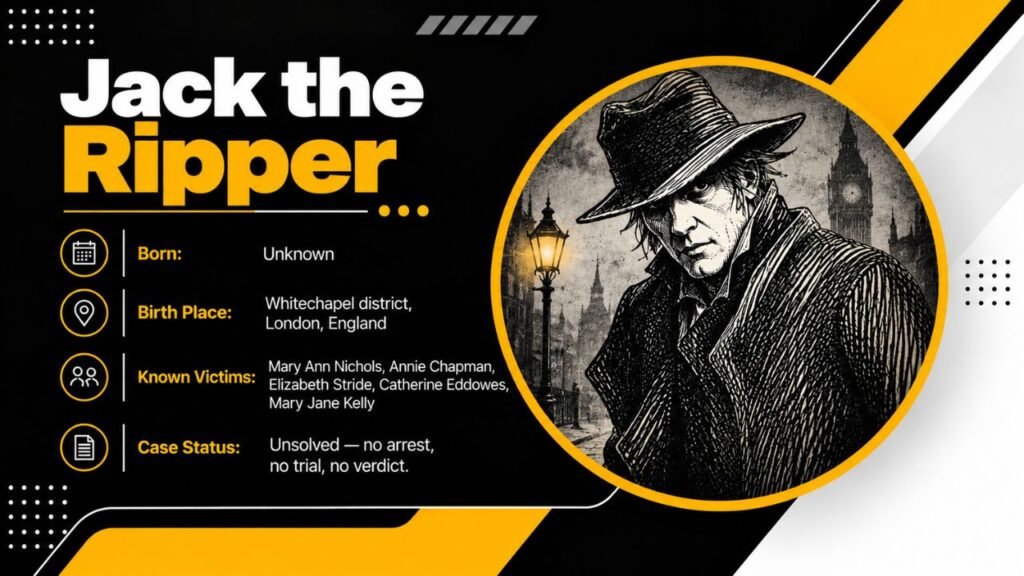
Case Snapshot
| Detail | Information |
| Common name | Jack the Ripper |
| Real identity | Never officially confirmed |
| Charge | None – police never formally charged a suspect |
| Verdict | Case remains legally unsolved |
| Victims (Canonical Five) | Mary Ann Nichols, Annie Chapman, Elizabeth Stride, Catherine Eddowes, Mary Jane Kelly |
| Killing spree | August 31 – November 9, 1888 |
| Location | Whitechapel district, East End of London |
| Lead investigators | Metropolitan Police Detective Inspector Frederick Abberline, City of London Police |
| Leading suspects | Aaron Kosminski, Montague John Druitt, George Chapman, Francis Tumblety, and others |
| Most-cited modern theory | Aaron Kosminski, based on 2014–2019 shawl DNA analysis |
| Case status | Officially unsolved; case files closed to public review after 100 years |
Who Was Jack the Ripper?
Here’s a detail people often miss: “Jack the Ripper” was never anyone’s real name. It was a signature on a letter someone mailed to the Central News Agency in London near the end of September 1888, right in the thick of the killings. Whoever wrote it seemed to be goading the police and threatening more bloodshed. Historians still argue over the letter’s origin. Nobody can say for sure whether the real killer penned it or whether a reporter invented it to sell papers. Either way, the name caught on almost overnight and has stuck to the case ever since.
What’s Actually Known
Strip away the pop-culture noise and a smaller, harder set of facts remains. The victims were women who lived and worked around Whitechapel. Several turned to street-level sex work just to get by in a neighborhood crushed by poverty. Every killing involved brutal violence: throats slashed, and in most cases, the abdomen cut open in a way investigators at the time read as showing some anatomical knowledge. Historians have since picked that assumption apart.
Nobody witnessed a killing as it happened. No eyewitness account ever held up well enough for police to trust it fully. No confession from that era has survived serious scrutiny. That mix – savagge violence, a press campaign built on taunts, and an investigation that never closed – sets the Ripper case apart from other Victorian-era crimes. It’s exactly why “jack the ripper identity” remains a live search topic well into this century.
When Was Jack the Ripper Active?
The murders most historians confidently attribute to the Ripper happened within a tight, roughly ten-week stretch in the fall of 1888. Even the precise start and end points still spark debate among researchers.
Quick timeline of the killing spree:
- August 31, 1888 – Mary Ann Nichols turns up dead in Buck’s Row, typically counted as the first of the Canonical Five
- September 8, 1888 – Someone kills Annie Chapman in the back yard of a lodging house on Hanbury Street
- September 27, 1888 – The Central News Agency receives the “Dear Boss” letter, the earliest known use of the “Jack the Ripper” name
- September 30, 1888 – The so-called “double event”: someone murders Elizabeth Stride and Catherine Eddowes roughly an hour apart, in two separate spots
- November 9, 1888 – Someone kills Mary Jane Kelly, usually treated as the last of the Canonical Five, indoors at Miller’s Court – by far the most severely mutilated of the five
A Case That Stopped as Suddenly as It Started
Some historians push the “active” window further, tying other unresolved Whitechapel-area killings from 1888 through 1891 to the same offender. No real agreement exists on which, if any, actually belong to him. The five core murders cluster tightly together. Then the killing simply stops after Kelly’s death. That sudden halt remains one of the case’s more baffling threads, and nobody has ever pinned down a convincing explanation for it.
Jack the Ripper Victims: The Canonical Five
Researchers who study this case seriously – a group people often call Ripperologists – largely agree on five murders as its true core, known as the Canonical Five. Researchers sometimes tie other killings from the same period and the same part of London to the same offender, but that connection is far less settled.
| Victim | Age | Date Killed | Location |
| Mary Ann Nichols | 43 | August 31, 1888 | Buck’s Row |
| Annie Chapman | 47 | September 8, 1888 | Hanbury Street |
| Elizabeth Stride | 44 | September 30, 1888 | Dutfield’s Yard, Berner Street |
| Catherine Eddowes | 46 | September 30, 1888 | Mitre Square |
| Mary Jane Kelly | approx. 25 | November 9, 1888 | Miller’s Court, Dorset Street |
The Poverty Behind the Headlines
Every one of these women scraped by on the financial fringes of Victorian London. Several had been moving in and out of the East End’s cheap common lodging houses in the days before their deaths.
That backdrop of hardship now sits at the center of how historians discuss the case. It’s less a tale about one monstrous individual and more a story about a district poverty had battered badly enough to make a predator’s job easier. Meanwhile, the era’s newspapers mostly treated the victims as an afterthought next to the killer’s growing legend.
How Many People Did Jack the Ripper Kill?
This might be the most genuinely open question people search about this case. The honest truth: nobody actually knows. Serious historians have floated numbers ranging anywhere from four up to eleven.
The five deaths above make up the Canonical Five. That tally has held up best over time, ever since researchers coined the term decades after the fact while digging back through the original police files.
The Eleven-File Question
Scotland Yard compiled its own Whitechapel murders file at the time; it spans eleven separate killings between 1888 and 1891. Even the police officials working the case back then couldn’t agree among themselves on how many of those eleven shared the same killer.
Two extra cases regularly come up alongside the Canonical Five:
- Martha Tabram, killed in early August 1888, just ahead of Nichols – some researchers treat her as victim number one, though her wounds don’t quite match the later pattern
- Mary Ann “Emma” Smith, attacked in April 1888 and later dying from her injuries – most researchers leave her out of the Ripper’s count today, since her assault doesn’t fit the later pattern either
Why a Final Number Doesn’t Exist
DNA testing didn’t exist back then. Nothing resembling modern forensic pathology existed either. Record-keeping stayed inconsistent across two overlapping police forces – the Metropolitan Police and the City of London Police, both of whom held jurisdiction in parts of the area. Put all that together, and nobody ever nailed down a firm body count in 1888. Nobody can reconstruct it with any real confidence now. Most popular retellings land on five as the “official” number, while conceding the true total could well be higher.
Was Jack the Ripper Ever Caught?
No. Hundreds of officers worked the case. Investigators conducted thousands of interviews. It turned into one of the largest manhunts the Victorian era ever saw. Yet police never arrested or charged Jack the Ripper, and he never stood trial. That single, stubborn fact is basically the reason this case still makes headlines nearly 150 years on.
An Investigation Without Modern Forensics
Detective Inspector Frederick Abberline of the Metropolitan Police led much of the investigation. He worked with tools that would look almost unrecognizable to a modern homicide detective. England hadn’t yet adopted fingerprinting for routine use. Blood-typing didn’t exist as an investigative tool. No forensic pathology existed that could pull reliable evidence out of a crime scene the way it happens today.
Police had to lean hard on witness statements. Most of those statements were partial, contradictory, or came from people who’d only caught a glimpse in poor lighting late at night – hardly a foundation for a confident identification.
Suspects Who Were Never Charged
Officers compiled a fairly substantial list of possible suspects. Internal memos from senior officials named a handful of men they took seriously. Police never formally charged any of them with the murders.
Police investigated and cleared some outright. They watched others but never arrested them for lack of evidence. A few only became well-known suspects decades later, once officials eventually opened up private files to historians and researchers.
The Hoax-Letter Problem
On top of all that, police and newspapers received a flood of letters during the panic – hundreds claiming to be from the killer himself. Historians now assume nearly all of them were hoaxes that reporters angling for a story wrote, or that members of the public caught up in the hysteria sent in.
That flood of noise made it that much harder for investigators to pick out a real lead from public theater. It’s a big part of why the answer to “was Jack the Ripper ever caught” is still a flat no more than 130 years later.
Jack the Ripper Identity: The Top Suspects
Over the years, researchers have put forward dozens of candidates for who the Ripper really was – everything from plausible working-class Londoners to far-fetched theories tying the murders to the royal family. A short list of names, though, dominates any serious conversation about “jack the ripper real name” today.
| Suspect | Background | Why He’s Suspected |
| Aaron Kosminski | Polish-Jewish immigrant, barber, lived in Whitechapel | Named in period police memos as a top suspect; subject of the 2014–2019 shawl DNA claim |
| Montague John Druitt | English barrister and teacher | Died by suicide shortly after the final canonical murder; named privately by a senior police official years later |
| George Chapman (born Seweryn Kłosowski) | Polish immigrant, later convicted poisoner | Later executed for murdering three wives with poison, showing capacity for premeditated killing, though his method differed sharply from the Ripper’s |
| Francis Tumblety | American-based “quack doctor” | Reportedly collected anatomical specimens; fled England for the U.S. shortly after the murders under suspicion |
| Walter Sickert | Prominent English painter | Popularized as a suspect largely through later true-crime writing rather than contemporary police suspicion |
Which Suspects Historians Take Seriously
Kosminski, Druitt, and Chapman are the three names that keep coming up in serious historical work. That’s mainly because surviving police paperwork from 1888 through 1894 actually names them, rather than someone inventing the theory decades or a century afterward. Sickert’s story runs differently. He only became a household suspect thanks to popular true-crime writing in the late 20th century, and most historians today treat that particular theory with a healthy dose of skepticism.
Was Jack the Ripper Identified? Is the Case Solved?
This is where things get genuinely messy. Anyone searching “jack the ripper solved” ends up wading through competing claims instead of finding one tidy answer.
The 2014 Shawl Claim
Back in 2014, British author and businessman Russell Edwards published a book arguing he’d finally cracked the case. He based the claim on DNA pulled from a bloodstained shawl he’d bought at auction back in 2007 – a shawl reportedly tied to victim Catherine Eddowes. Working with biochemist Jari Louhelainen, Edwards said the genetic material recovered from the shawl matched a living descendant of Aaron Kosminski. It also separately matched a descendant of Eddowes.
Edwards has repeated in interview after interview since then that he sees the match as conclusive.
The 2019 Peer-Reviewed Follow-Up
That same claim resurfaced in a more rigorous form in 2019. Louhelainen teamed up with University of Leeds researcher David Miller to publish a peer-reviewed paper in the Journal of Forensic Sciences, laying out the mitochondrial DNA work in far more technical depth than Edwards’s original book had.
The 2019 paper pointed to Kosminski again. It also reported that the recovered genetic profile matched brown hair and brown eyes – details some researchers flagged as lining up with a contemporary witness’s description of a man seen near one of the crime scenes.
Why Experts Remain Skeptical
This claim has never come close to earning real scientific or historical consensus. Critics have raised the same handful of objections consistently since 2014:
- Chain of custody – No verified, unbroken record confirms the shawl actually came from the Eddowes crime scene in 1888, rather than getting acquired, or contaminated, at some point much later
- Contamination risk – The shawl reportedly changed hands among private collectors for well over a century before any scientific testing took place, leaving open the possibility that the DNA found on it dates from long after 1888
- Limits of mitochondrial DNA – This type of DNA passes down strictly through the maternal line. That means it can rule someone out with confidence, but it can’t uniquely pin down one specific person, since an entire maternal bloodline shares it
- No independent replication – Both the 2014 and 2019 results trace back to the same shawl and largely the same small research team, rather than getting confirmed independently by a separate group working from separate evidence
Where the Case Actually Stands
Given all of that, most professional historians describe Kosminski as a solid, well-supported theory rather than a confirmed identification. Edwards himself keeps pushing for a formal inquest. He has publicly renewed his call for an official reexamination in recent years, and at least one victim’s family has separately asked police to formally look into the DNA claims.
Right now, no British court and no police authority has issued any official finding naming Kosminski – or anyone else – as Jack the Ripper. So “was Jack the Ripper identified” does have a genuinely interesting answer: yes, a widely publicized DNA claim exists, and yes, it points to a specific, historically documented suspect. But the honest, current answer to “is the Jack the Ripper case solved” is still no, at least not in any sense that would hold up legally or scientifically.
Stalking Jack the Ripper and Other Pop-Culture Touchpoints
The case’s unsolved status is a big reason it has spawned so much fiction over the years.
The Novel
People searching “stalking jack the ripper” usually want one of the more popular recent entries in that tradition. Stalking Jack the Ripper is a young-adult novel by author Kerri Maniscalco, first published in 2016. It centers on a fictional teenage forensic investigator named Audrey Rose Wadsworth as she tries to track down the killer’s identity in Victorian London.
The book became a bestseller and spawned a multi-book series. Nobody has turned it into a film or TV show yet, despite plenty of fan interest and the occasional rumor.
On Screen
The “jack the ripper movie” question has a much longer answer. The case has inspired dozens of film and TV adaptations across more than a hundred years, with wildly varying levels of historical accuracy. Notable examples include From Hell (2001), a graphic-novel adaptation starring Johnny Depp that leans into a fictionalized royal-conspiracy version of the killer’s identity. There’s also the more recent docuseries Jack the Ripper: Written in Blood, which spends less time naming the killer and more time examining how period newspapers helped build the Ripper legend in the first place.
Reports also point to a big-budget dramatized feature starring Benedict Cumberbatch, reportedly with David Fincher directing. Early reporting suggests it focuses less on solving the mystery and more on the social conditions of Victorian London that let the killer operate. Whether or when it will actually come out remains unconfirmed.
Why the Case Still Matters
Beyond the raw facts of who killed whom that autumn in 1888, the Jack the Ripper case became one of the founding blueprints for modern true crime. Think of the unsolved serial killer, the taunting letters, the media frenzy, and the whole cottage industry of amateur investigators that grew up around it.
The case also helped shape early conversations about policing, forensic science, and how society treated women living in poverty. Period newspapers frequently reduced the five Canonical victims to little more than a footnote beside the killer’s growing mythology.
A Shift Toward the Victims
That imbalance is part of why more recent scholarship on the case has deliberately turned the focus away from “who was Jack the Ripper” and toward the actual lives these five women led before they died. A widely cited 2019 book focused specifically on the victims themselves reflects that shift.
Even so, the identity question hasn’t disappeared, and it probably never will, given how much of the case remains genuinely unresolved. Short of a documented, verified breakthrough that can survive the scrutiny modern forensic science demands, Jack the Ripper looks set to remain exactly what he’s been for well over a century: officially unidentified, endlessly theorized about, and one of the most famous unsolved murder cases in history.
Read Also: Sarah Khalifa Case | Kouri Richins | Kewon White
Frequently Asked Questions
An unidentified killer responsible for at least five, and possibly more, murders of women in London’s Whitechapel district in 1888. The name itself comes from a letter sent to a news agency during the murders, not from any confirmed real name.
Most historians agree on five confirmed victims, known as the Canonical Five. The original police files covered eleven Whitechapel-area murders between 1888 and 1891, though experts disagree on how many of those belong to the same killer.
The core killing spree ran from August 31 to November 9, 1888, a period of roughly ten weeks.
No. Despite a major police investigation, nobody was ever arrested or charged, and the case remains officially unsolved.
A 2014 and 2019 DNA analysis of a shawl reportedly linked to victim Catherine Eddowes pointed to suspect Aaron Kosminski. The findings carry significant scientific and evidentiary limitations, though, and police and the wider historical community have not treated them as conclusive.
Not officially. Kosminski remains the leading modern theory, but no court, police force, or scientific body has issued a formal, accepted identification.
Unknown. “Jack the Ripper” was a pen name used in a letter during the murders. The leading suspect in modern DNA-based theories is Aaron Kosminski, but that identification remains disputed rather than confirmed.
The Canonical Five are Mary Ann Nichols, Annie Chapman, Elizabeth Stride, Catherine Eddowes, and Mary Jane Kelly, all killed in or near Whitechapel in 1888.