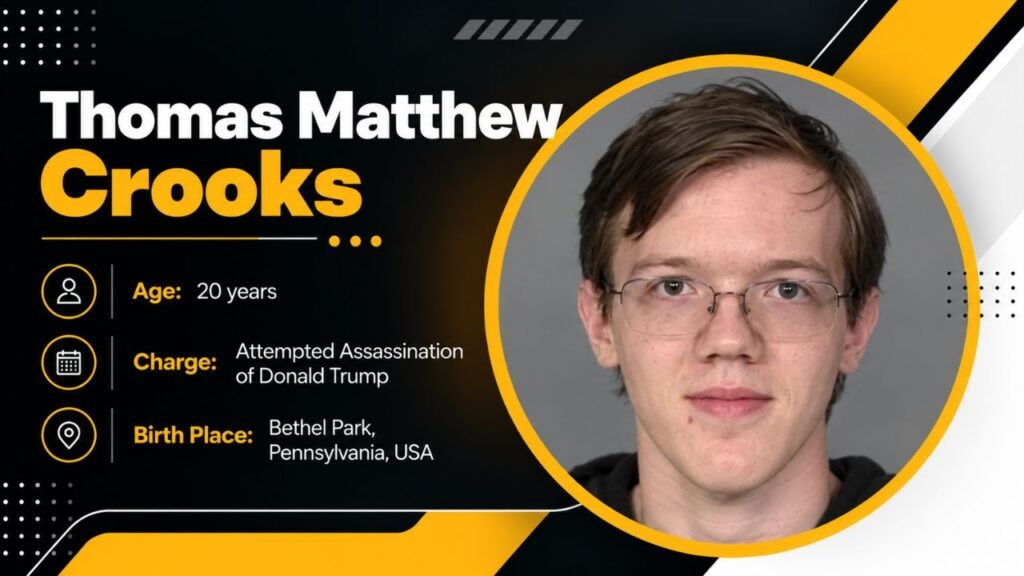
On July 13, 2024, 20-year-old Thomas Matthew Crooks climbed onto a rooftop near a Trump campaign rally in Butler, Pennsylvania, and opened fire. A Secret Service counter-sniper shot and killed him roughly 26 seconds later. More than two years on, the FBI’s investigation has closed, congressional committees are still releasing new documents. The central question – why he did it – remains officially unanswered.
Case Snapshot
| Detail | Information |
| Full name | Thomas Matthew Crooks |
| Age | 20 at time of death |
| Born | September 20, 2003 |
| Died | July 13, 2024, Butler, Pennsylvania |
| Hometown | Bethel Park, Pennsylvania |
| Education | Bethel Park High School (2022); associate’s degree, Community College of Allegheny County |
| Act | Attempted assassination of Donald Trump at a campaign rally |
| Weapon | AR-15-style rifle (DPMS Panther Arms DR-15), purchased by his father |
| Killed by | Secret Service Counter Sniper Team |
| Cause of death | Gunshot wound to the head |
| Manner of death | Homicide |
| Motive | Never officially determined |
| Victim of attack | Corey Comperatore, 50, killed; two others critically injured; Trump grazed on ear |
| Investigating agency | FBI; investigation closed November 2025; new documents released September 2026 |
Who Was Thomas Matthew Crooks?
Before the shooting, Crooks was, by every available account, an unremarkable young man. He grew up in Bethel Park, a quiet Pittsburgh suburb roughly an hour’s drive from where he would eventually die, and attended Abraham Lincoln Elementary School as a child before graduating from Bethel Park High School in 2022. Former classmates who later spoke to reporters described him as slim, bespectacled, and someone who mostly kept to himself, more of a quiet loner than an obvious outsider. A video of his own graduation ceremony reportedly showed only scattered applause when he walked across the stage to collect his diploma.
After high school, he earned an associate’s degree from the Community College of Allegheny County. He was apparently still living at home with his parents at the time. Nothing in his academic or disciplinary record has suggested he was on anyone’s radar. This holds true for the period before the day of the shooting. Unlike many attackers in comparable cases, he left behind no manifesto. There was no diary entry, no social media farewell post, no note of any kind. This absence of explanation is part of why the case has remained so hard to close.
Family and Background
His voter registration listed him as a Republican, but campaign-finance records also show a small $15 donation to a progressive political action committee on the day President Biden was inaugurated in January 2021. That inconsistency has never been resolved and is often cited as evidence that Crooks did not fit neatly into any obvious ideological box.
His parents, Matthew and Mary Crooks, are both licensed professional counselors in Pennsylvania. They have been credentialed since 2002. Their licenses were still active at the time of the shooting. Neither has given an extensive public interview about their son. Both largely avoided media contact right after the shooting. This held true in the years since as well. FBI interview summaries with the family were later shared with congressional investigators. These have gradually made their way into public reporting. They now form much of what is publicly known about the household Crooks grew up in.
What Happened on July 13, 2024
The attack took place at a Trump campaign rally at the Butler Farm Show grounds, north of Pittsburgh. Local law enforcement first flagged Crooks as suspicious more than an hour before the shooting, later spotting him using a rangefinder and browsing news sites on his phone, and then carrying a backpack near the perimeter of the event.
Crooks climbed HVAC piping on the outside of a nearby warehouse. The building was owned by AGR International. He traversed across multiple rooftops from there. This got him to a position with a clear line of sight to the stage. That’s where Trump was set to speak. A local officer was boosted up onto the roof to check on the activity. He spotted Crooks at 6:11 p.m. The officer immediately dropped back down rather than engaging. Roughly 25 to 30 seconds later, Crooks opened fire with his rifle. This is according to the FBI’s own reconstructed timeline.
Minute-by-Minute Timeline
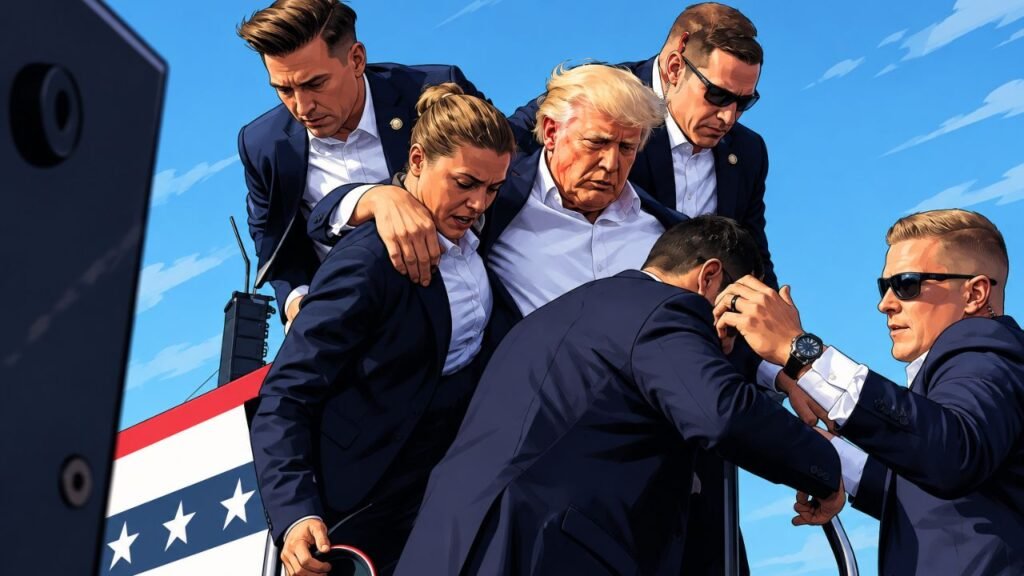
Crooks fired eight rounds toward the stage. One round killed Corey Comperatore, a 50-year-old former volunteer fire chief from Buffalo Township who had come to the rally with his family, while two other attendees, David Dutch and James Copenhaver, were critically injured. Trump himself was grazed on the upper right ear by a bullet.
A Secret Service counter-sniper returned fire and killed Crooks almost immediately, ending the attack within seconds of it beginning. Representative Clay Higgins has separately claimed a local tactical officer on the ground also fired a round just before that, possibly damaging the buffer tube on Crooks’s rifle and preventing it from firing again after his eighth shot, though the FBI says it found no forensic evidence confirming that shot struck either Crooks or his weapon, leaving that particular detail unresolved.
The Autopsy: What It Actually Found
Crooks’s body was transferred to the Allegheny County Medical Examiner’s Office. This happened the day after the shooting. He lived in Allegheny County, though he died in neighboring Butler County. The autopsy was performed on July 14, 2024. It began at 9:15 a.m. An FBI Major Incidents Program Manager was present as an official witness. Several Pennsylvania State Police troopers were also present. The autopsy found he died from a high-velocity gunshot wound to the head. The entrance wound was at his left upper lip.
The report describes the bullet’s path as traveling downward, backward, and to the right, exiting through the right side of his neck before re-entering and exiting again near his right upper back. Butler County Coroner William Young formally classified the death a homicide and recorded the time of death as 6:25 p.m. on July 13, 2024.
Cause and Manner of Death: The Finer Details
Beyond the fatal head wound, the report notes only minor additional findings: small facial abrasions, and bruising and scraping on both elbows and knees, most likely from his fall or from being moved after he was shot. It also documents zip-tie marks on his forearms, wrists, and hands, left by law enforcement securing his body at the scene.
Toxicology testing came back negative for alcohol and drugs of abuse. The report did note a mildly elevated blood lead level. Medical experts say this finding is not unusual. It has several innocuous explanations. Butler County initially declined to release the full report. It remained unclear for some time whether Crooks had been tested for prescription medications specifically. This gap fed speculation about a possible undisclosed cause. That speculation has never been officially confirmed.
The Cremation Controversy
One of the stranger threads in the case involves what happened to Crooks’s body after the autopsy. Representative Clay Higgins revealed in 2024 that the FBI released Crooks’s remains to his family for cremation just 10 days after the shooting, a timeline he called troublingly fast given the scope of the ongoing investigation.
A more specific detail surfaced in September 2026, when documents turned over to Senate Judiciary Chairman Chuck Grassley showed that an anonymous donor paid for that cremation. The same records indicated Crooks’s father was unemployed and later “retired,” and that his mother had gone on leave from work, suggesting the family may not have had the means to cover funeral costs on its own, though the donor’s identity has never been disclosed.
Bomb-Making Materials and the Attack’s Planning
Investigators have said Crooks put substantial effort into planning the attack well before July 13. According to the FBI, he registered for the Butler rally on July 6 and, that same day, searched online for how far Lee Harvey Oswald had been positioned from President John F. Kennedy during his 1963 assassination, a search FBI Director Christopher Wray later cited as an early window into Crooks’s mindset, telling lawmakers that his subsequent online searches began to shift more specifically toward Trump and the logistics of the Butler event itself.
On the day of the rally, he purchased a box of 50 rounds of ammunition. He also flew a drone roughly 200 yards from the stage. This happened more than two hours before Trump began speaking. He was apparently scouting the site in advance. This helped him plan his eventual shooting position. Investigators also recovered bomb-making materials from his car. Similar materials were found at his family’s home. A suspected remote detonator was also found on his body. Officials described this as showing a level of premeditation. It went well beyond simply bringing a rifle to a public event. No working explosive was ever detonated, though. No one else was reported injured by that material.
The Weapon: Where the Rifle Came From
The rifle used in the attack, a DPMS Panther Arms DR-15, is a variant of the AR-15 platform and had been purchased by Crooks’s father about six months before the shooting. Investigators have said they were still working, even in the investigation’s later stages, to determine exactly how Crooks gained access to a firearm that, on paper, belonged to his father.
Recently released documents also reportedly show Crooks used the alias “Bob Dole” to order suspicious packages of gun parts in the months before the attack, a detail that has added another layer to the picture of how deliberately he assembled his plan. No evidence has surfaced tying anyone else to sourcing or assembling that equipment.
Security Failures and the Congressional Task Force
In the days after the shooting, it became clear that Crooks had been spotted by multiple people, including local police, well before he ever fired a shot, raising immediate questions about how he was still able to reach a rooftop with a direct line of sight to the stage. A bipartisan congressional task force was formed specifically to examine those security failures, separate from the FBI’s criminal investigation into Crooks himself, and it has continued gathering testimony and documents well into 2026.
That task force’s work is the main reason new details have kept surfacing. Senator Chuck Grassley’s parallel Judiciary Committee inquiry played a role too. This happened years after the shooting rather than the story fading away. Then-Attorney General Merrick Garland called it “extremely alarming.” He was referring to how close a shooter got to a former president. The fallout from those security lapses extended well beyond Crooks’s own case file.
Did the FBI Find a Motive?
This is the question that has defined the entire case. More than two years later, the answer is still no. The FBI reviewed dozens of electronic accounts and devices. It manually went through hundreds of thousands of files. Investigators processed hundreds of interviews and thousands of public tips. Officials called this one of the bureau’s most exhaustive digital forensics operations. It was conducted for a single-subject case. The effort concluded Crooks acted alone. There was no evidence tying him to co-conspirators or foreign actors. It never identified why he did it.
Kevin Rojek is the special agent in charge of the FBI’s Pittsburgh Field Office. He said in August 2024 that Crooks had engaged in sustained, detailed planning. Crooks had researched a number of possible events or targets. He then became what Rojek called “hyper-focused” on the Butler rally. This happened once the rally was publicly announced in early July. Rojek added that investigators found no clear political ideology behind his actions. This conclusion has held steady through every subsequent update on the case.
The Social Media Account
Later in the investigation, the FBI surfaced a social media account believed to belong to Crooks, containing roughly 700 comments posted between 2019 and 2020, a period stretching from when he was around 15 to 17 years old. FBI Deputy Director Paul Abbate described some of that material as appearing to reflect antisemitic and anti-immigration themes and as seeming to endorse political violence, though he cautioned the findings were preliminary, that authentication of the account’s ownership was still ongoing, and that comments from a teenager years earlier did not by themselves establish a motive for an act committed as an adult.
The FBI formally closed its investigation in November 2025. Deputy Director Dan Bongino told reporters there had been no cover-up and no identifiable reason behind the attack, while Trump himself has previously called Crooks “just a nutjob looking to do this.”
Mental Health Questions
Alongside the motive question, a parallel debate has played out over whether Crooks was dealing with untreated mental health issues. The FBI’s early public statements said investigators had found no indication of mental health problems, but other reporting and observations from people who knew him suggested at least some signs of decline in the period before the attack.
At least one former Secret Service agent has since suggested publicly that a depressive or other psychological disorder may have played a role, though this remains an outside theory rather than an official finding. No official report has ever attributed the attack to a diagnosed or documented condition.
Recent News: FBI Releases New Documents, Trump Calls It a “Democrat Plot”
On September 15, 2026, the FBI publicly released hundreds of newly unclassified documents about the Butler shooting, giving what reporters described as the clearest picture yet of Crooks’s background and the months leading up to the attack. The release prompted an immediate political firestorm: Trump posted on social media that the assassination attempt was “all a Democrat Plot” orchestrated to remove him from the 2024 election, blaming the Biden-era FBI for information he said was “missing, altered, corrupted, or gone” by the time he returned to office, and singling out former FBI Director Christopher Wray by name as someone who should “pay a price” for how the investigation was handled.
Attorney General Todd Blanche told reporters “new information” had emerged from the documents but declined to detail it during a White House press briefing, saying only that it had been produced in response to Senator Grassley’s Senate inquiry. FBI Director Kash Patel, testifying before the Senate the same day, reiterated there remains no evidence Crooks worked with anyone else, directly contradicting the implication behind Trump’s “Democrat plot” framing. Neither Trump nor any administration official has offered public evidence supporting that claim, and the newly released material – including the “Bob Dole” alias detail and the anonymous cremation donor – has not been reported by any outlet to contain proof of a broader conspiracy.
Public Reaction and Conspiracy Theories
The combination of a young, socially invisible shooter, an official “no motive found” conclusion, and a rapid, anonymously funded cremation has left plenty of room for public skepticism. Polling conducted about a month after the shooting found that more than half of Americans surveyed did not believe Crooks acted alone, despite the FBI’s repeated public statements to the contrary, and that skepticism has only grown as new, sometimes unexplained details like the “Bob Dole” alias and the anonymous cremation donor have continued to surface years later.
Those security failures were real enough to have consequences independent of any conspiracy theory: Secret Service Director Kimberly Cheatle resigned days after the shooting amid bipartisan criticism over how a gunman was able to get onto a rooftop with a clear line of sight to a former president, and multiple other agency officials faced internal reviews and reassignments as a direct result of what went wrong at Butler that afternoon.
How This Case Fits Among Attempts on Trump’s Life
The Butler shooting was widely described at the time as the closest any attacker had come to killing a sitting or former U.S. president since the 1981 attempt on Ronald Reagan, and it remains, more than two years on, the most serious of several security incidents involving Trump. A second, unrelated incident later in 2024 at a Trump golf course in Florida added to public anxiety around his safety during that campaign season, even though it involved a different suspect entirely and no connection to Crooks.
Analysts and former Secret Service officials have pointed to the Butler case repeatedly in discussions of rally security since, treating it as the clearest real-world example of how a determined, methodical individual with no criminal record and no obvious warning signs can still slip past standard event security. That has made the case a reference point well beyond its own facts, cited in congressional hearings and security reviews for events entirely unrelated to Trump, and it has directly shaped how outdoor rallies and campaign events for candidates of both parties have been secured since 2024, with wider security perimeters and stricter rooftop and building-access protocols now standard at many large outdoor political events.
Why the Case Still Matters
Thomas Matthew Crooks left behind almost no public trace before July 13, 2024 – no manifesto, no well-documented ideology, no social circle willing or able to explain what happened. What he left instead is a case study in the limits of even a massive federal investigation: thousands of interviews, hundreds of thousands of reviewed files, and still, formally, no motive.
That unresolved quality is exactly why the story hasn’t gone away, with congressional committees continuing to request and release new documents years after the fact. Barring some unexpected disclosure, the most likely outcome is that Crooks’s motive stays exactly where the FBI left it: unknown, and probably unknowable.
Read Other Criminal Stories: John Wayne Gacy | Richard Ramirez |
Frequently Asked Questions
20-year-old who attempted to assassinate Donald Trump at a Butler, Pennsylvania rally on July 13, 2024, before being shot dead by the Secret Service.
He fired eight rounds at the rally stage, killing one attendee and injuring two others, before a Secret Service counter-sniper killed him seconds later.
Yes. He died at the scene on July 13, 2024, from a single gunshot wound to the head.
He died from a high-velocity gunshot wound to the head; toxicology was negative for alcohol and drugs, with a mildly elevated blood lead level noted.
He was shot and killed by a Secret Service counter-sniper immediately after opening fire on the rally crowd.
It was autopsied, released to his family about 10 days later, and cremated, reportedly paid for by an anonymous donor per 2026 documents.
An AR-15-style rifle, a DPMS Panther Arms DR-15, purchased by his father roughly six months before the shooting.
An unnamed “anonymous donor,” according to documents released to Congress in September 2026; no identity has been disclosed.
Hundreds of newly unclassified files released September 15, 2026, detailing Crooks’s background and planning, including an alias used to order gun parts.
Yes. He claimed on social media it was a “Democrat Plot,” though officials, including the FBI director, say there’s no evidence of one.
Source: WikiPedia