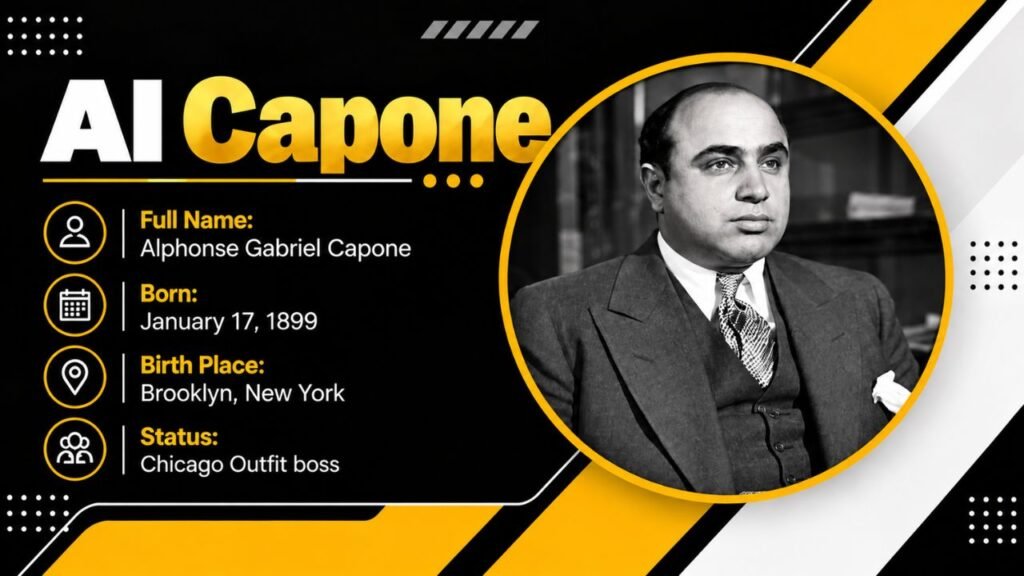
Some names from America’s criminal past just don’t fade – Al Capone’s sits at the top of that short list. Nearly eighty years after his death, Al Capone remains a popular figure in searches about 1920s Chicago. People still want to know how he died, how much he was worth, who he was, and why “Al Capone Does My Shirts” appears in search results. This guide covers his early life, rise to power, illness, death, burial, family, fortune, cigars, and lasting presence in movies and popular culture.
Al Capone Snapshot
| Detail | Information |
| Full name | Alphonse Gabriel Capone |
| Nickname | “Scarface” |
| Born | January 17, 1899, Brooklyn, New York |
| Died | January 25, 1947 (age 48), Palm Island, Miami Beach, Florida |
| Cause of death | Cardiac arrest following a stroke, complicated by neurosyphilis and pneumonia |
| Burial site | Mount Carmel Cemetery, Hillside, Illinois (originally Mount Olivet Cemetery, Chicago) |
| Criminal role | Head of the Chicago Outfit during Prohibition |
| Convicted of | Federal income tax evasion, 1931 |
| Sentence | 11 years; served at Atlanta USP and Alcatraz |
| Wife | Mae Josephine Coughlin (married 1918–1947) |
| Son | Albert Francis “Sonny” Capone |
| Estimated net worth (peak, 1920s) | Roughly $100 million, well over $1 billion in today’s money |
Who Was Al Capone?
Ask someone to picture a classic mob boss, and there’s a decent chance they’re unknowingly picturing Al Capone. During the 1920s, Al Capone led the Chicago Outfit and expanded its bootlegging operations after Prohibition began. His organization also became involved in gambling, prostitution, and extortion. Capone eventually became the focus of a major federal tax-evasion case.
His story also became a lasting part of American popular culture. Movies, television shows, and true-crime programs have repeatedly portrayed his rise and fall. But behind the famous image was a Brooklyn-born son of Italian immigrants who became one of the most notorious criminals of his era. He died at the age of 48 after years of declining health.
His story starts on January 17, 1899, in Brooklyn. He grew up as one of nine children born to Gabriele and Teresa Capone, both Naples-born immigrants, with his father earning a living as a barber. School ended for Al after sixth grade, cut short by a clash with a teacher, and not long after that he’d already fallen into Brooklyn’s street gang culture – years before he even reached his teens. Whatever direction his life eventually took traces back to that early start.
Building an Empire: Career and Rise to Power
Al Capone’s criminal career began to take shape in New York’s Five Points Gang. During this period, Johnny Torrio noticed him and became an important influence on his early criminal career. While working at a Brooklyn nightclub, Capone got into a fight after making a remark to a woman. He was slashed across the face during the incident, leaving the scars that later led to his famous nickname, “Scarface.”
Torrio moved to Chicago in 1919 to work with his uncle, gang boss “Big Jim” Colosimo. He later brought Capone to Chicago and helped him become part of the organization. After Colosimo was murdered in 1920, Torrio took control of the operation, with Capone serving as his second-in-command. Prohibition began nationwide that same year. The ban on alcohol created a huge opportunity for illegal liquor sales. Torrio’s organization expanded its bootlegging business and generated significant profits. In 1925, Torrio stepped down after surviving an assassination attempt. This allowed Capone to take full control of the organization, which became known as the Chicago Outfit.
Investigators spent years chasing murder and racketeering charges that never stuck. Federal tax investigators ultimately brought Capone down, rather than a homicide case. They focused on his failure to file federal income tax returns while he maintained a lavish lifestyle. A jury convicted him of tax evasion in 1931, and he received an 11-year federal prison sentence along with heavy financial penalties.
Capone initially served his sentence at the U.S. Penitentiary in Atlanta. In 1934, officials transferred him to Alcatraz, where tighter security limited his ability to communicate with the outside world and maintain influence over his organization.
How Did Al Capone Actually Die?
Most people expect a dramatic answer to “how did Al Capone die,” but his death was far removed from the violence associated with his criminal reputation. He was not killed in a shootout or by a rival gang. Instead, his health gradually deteriorated after years of untreated illness.
After leaving Alcatraz in 1939, following roughly seven and a half years in prison, Capone’s health had already declined significantly. He had likely contracted syphilis in his early twenties. The untreated infection later progressed to neurosyphilis, which can affect the brain and nervous system. Doctors monitored his declining health during his time in prison and after his release. By 1946, a Baltimore psychiatrist working with Capone’s personal physician reportedly assessed his cognitive abilities. The assessment suggested that his mental capacity had declined to roughly that of a twelve-year-old.
Then came January 21, 1947, and a stroke. He briefly stabilized and regained consciousness, but three days later, on January 24, pneumonia set in, and on January 25 – the following day – cardiac arrest ended his life at the Palm Island home, with relatives around him. He was 48 years old. Officials attribute his death to cardiac arrest triggered by a stroke, with pneumonia and the lasting damage from syphilis marked down as significant contributing causes.
How Did He Contract Syphilis in the First Place?
Historians cannot identify exactly when Al Capone contracted syphilis. Most accounts place the infection in his late teens or early twenties. During this period, Capone was involved in New York’s gang scene. He also spent time around brothels and nightclubs in Brooklyn and later Chicago. Historians generally connect the infection to this environment. Gambling, speakeasies, and prostitution were common parts of the underworld in which Capone operated.
At the time, effective treatment for syphilis was limited, and penicillin did not become widely available until the 1940s. By then, Capone’s infection had likely remained untreated for years. Historical accounts indicate that the disease progressed to its later stages, eventually affecting his nervous system and overall health.
There is no confirmed record of exactly when he contracted syphilis or why he did not receive treatment earlier. What is known is that the infection had progressed significantly by the time he was diagnosed with neurosyphilis, contributing to the severe decline in his health during his final years.
Where Is Al Capone Buried?
Following his death, Capone was initially buried at Mount Olivet Cemetery in Chicago. He was placed in a family plot beside his father, Gabriele, and his brother, Frank. In March 1950, the family moved all three graves to Mount Carmel Cemetery in Hillside, Illinois. The family reportedly wanted a quieter location away from the attention surrounding the original burial site. Capone remains buried at Mount Carmel Cemetery today.
Al Capone Net Worth
No verified figure for his wealth actually exists – what’s out there are estimates built from Prohibition-era press coverage, later tax records, and inflation calculations, and depending on the source, those numbers swing fairly widely. The number that gets repeated most often lands around $100 million at the peak of his power in the late 1920s. Run through inflation, that typically translates into a range of $1 billion to $1.5 billion in today’s dollars – a figure that shows up constantly in coverage of his legacy across finance and entertainment media alike.
The truly unusual part of his financial story isn’t how much he made – it’s how completely it disappeared. By his death in 1947, most historical accounts agree the fortune was effectively gone. Legal costs from the tax case, outstanding federal tax debt, years lost to imprisonment, and a criminal organization that had fallen apart without him at the helm together left him with almost nothing in liquid assets. Papers from January 1947 carried headlines reporting, on his own lawyer’s word, that he’d died broke. Rumors of hidden money and secret vaults have persisted for decades since, famously stoked by a 1986 live TV special that opened a sealed vault tied to Capone on camera – and revealed essentially nothing inside. That contrast, between the reported $100-million peak and the broke reality at the end, really sums up the entire story: a fortune built fast and lost almost entirely.
Al Capone Son: Sonny Capone
Type “Al Capone son” into a search bar and you always get the same answer: Albert Francis Capone, whom family called “Sonny” and reporters later did too. Born in 1918, he was Capone’s only child, arriving not long after Al married Mae Josephine Coughlin. Where his father built an empire on crime, Sonny took a very different path – he kept his distance from organized crime and mostly stayed out of the public criminal spotlight, though a minor shoplifting charge in his younger years did draw some press attention, purely because of the last name attached to it.
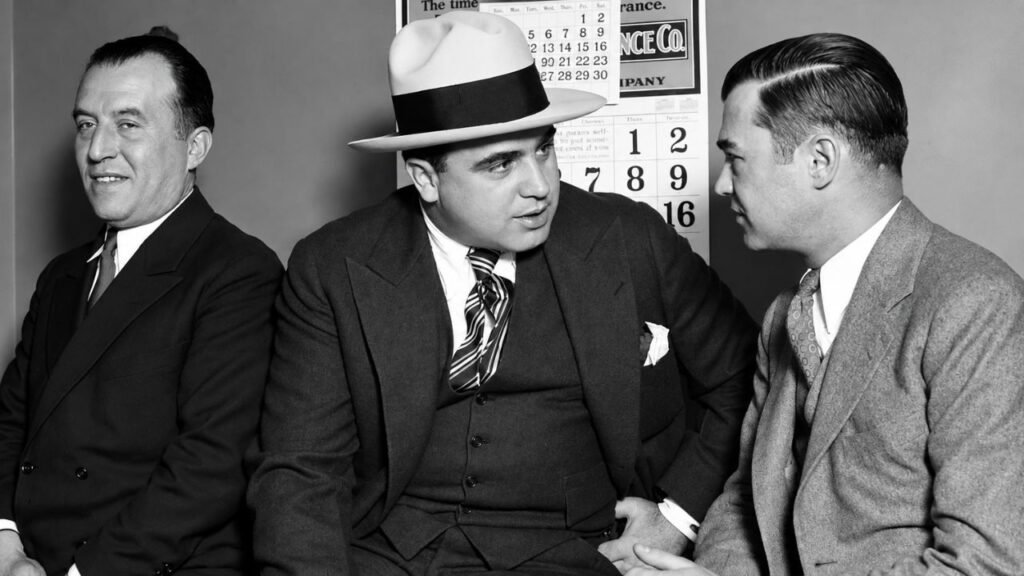
By most accounts, Sonny carried a heavy weight throughout much of his life just from being his father’s son, and at one point he even changed his surname legally, hoping to separate himself from that legacy. He spent his working years in fairly conventional jobs and businesses, living a much quieter existence than his father ever did. He passed away in 2004. Since then, his children and grandchildren – some of whom have appeared publicly in interviews and documentaries – have remained the closest surviving link to the family’s history, occasionally surfacing in reality TV or historical programming centered on the Capone name.
Al Capone Cigars
Two different storylines come up when people search “Al Capone cigars.” Capone smoked cigars heavily throughout his adult life. He often appeared in photographs with a cigar, making it an important part of his visual image alongside his fedora and overcoat. Films and television later reinforced this association, turning the cigar into one of the defining elements of the classic “Capone look.”
The second storyline is purely commercial. Since his death, various cigar companies have put out products branded with the “Al Capone” name, leaning into the recognition his story still commands decades later. None of these connect to the actual historical Capone family – licensed manufacturers make them and sell them widely through cigar retailers, generally marketed around a vague Prohibition-gangster theme rather than any real claim tied to something Capone actually smoked.
Al Capone Movies and Pop Culture
Not many real-life American criminals have inspired as many films, references, and loose fictional retellings as Al Capone has, which explains why “Al Capone movie” remains such a consistently searched phrase. A few of the most notable examples:
- Scarface (1932) – Technically not a biopic, but widely understood as a thinly disguised retelling of Capone’s rise, released while he was still alive and still very much a household name.
- Al Capone (1959) – A more conventional biographical crime film, with Rod Steiger playing Capone and charting his ascent through Chicago’s underworld.
- The Untouchables (1987) – Probably the single most influential Capone film culturally, casting Robert De Niro as Capone opposite Kevin Costner’s Eliot Ness, dramatizing the tax case that eventually finished him off.
- Capone (2020) – A more recent portrayal, with Tom Hardy focused specifically on Capone’s final, physically and mentally broken years at Palm Island – the same decline covered earlier in this piece.
Outside of feature films, Capone’s name and image keep resurfacing across documentaries, TV dramas, video games, and museum exhibits tied to Prohibition-era Chicago and American organized crime history at large.
A Quick Note on “Al Capone Does My Shirts”
People who search “Al Capone Does My Shirts” are usually looking for the novel, not a fact about Capone. Gennifer Choldenko wrote the young-adult novel, which was first published in 2004. The story follows a boy whose family moves to Alcatraz Island in the 1930s. His father takes a job at the prison, where Capone was also held. The novel uses Capone’s presence on Alcatraz as part of its historical setting. It focuses on the boy’s family and his sister, who has autism. The book has also introduced many younger readers to Capone’s name.
Why Al Capone Story Still Gets Searched
A lot of what keeps Al Capone relevant in true-crime and history searches, year after year, comes down to the contradictions baked into nearly every part of his life story. A violent crime boss, ultimately taken down not by a murder charge but by an accountant’s paperwork. A fortune worth close to a billion dollars in modern terms, and yet he died with virtually nothing left of it. One of the most publicly visible, most photographed men in the country during his prime, who then spent his final stretch so cognitively diminished that doctors compared his mind to that of a twelve-year-old. Even the manner of his death – a slow, largely preventable illness rather than a violent end – runs completely against the Hollywood image his own myth helped create.
Read More Crime Stories: John Wayne Gacy | Thomas Matthew Crooks | Richard Ramirez
Frequently Asked Questions
Head of the Chicago Outfit during Prohibition, who built a fortune from bootlegging and organized crime before being jailed for tax evasion in 1931.
A Brooklyn-born son of Italian immigrants who dropped out after sixth grade and fell into street gangs, later rising through Chicago’s underworld under mentor Johnny Torrio.
A Brooklyn-born son of Italian immigrants who dropped out after sixth grade and fell into street gangs, later rising through Chicago’s underworld under mentor Johnny Torrio.
Cardiac arrest following a stroke, on January 25, 1947, with pneumonia and untreated syphilis as major contributing factors.
January 25, 1947, at his Palm Island home in Miami Beach – eight days after turning 48.
Likely contracted in his late teens or twenties through Brooklyn and Chicago’s nightlife scene, then left untreated for roughly two decades.
Mount Carmel Cemetery, Hillside, Illinois – moved there from Mount Olivet Cemetery, Chicago, in 1950.
Roughly $100 million at his 1920s peak (over $1 billion today), though he reportedly died broke.
Albert “Sonny” Capone, born 1918, his only child – stayed out of crime and the spotlight, died in 2004.
A 2004 YA novel by Gennifer Choldenko set on Alcatraz during Capone’s real imprisonment there – fiction, not biography.
Capone was a lifelong cigar smoker, and licensed brands sell cigars under his name today, but they have no real tie to him.
Scarface (1932), Al Capone (1959), The Untouchables (1987) with De Niro, and Capone (2020) with Tom Hardy.
Source: WikiPedia