Few American criminal cases have gripped the public as long as the hunt for the Golden State Killer. For more than four decades, one offender terrorized California under several different names. First, he burgled homes in the Central Valley. Then he raped victims across Sacramento and the Bay Area. Finally, he murdered couples along the southern coast.
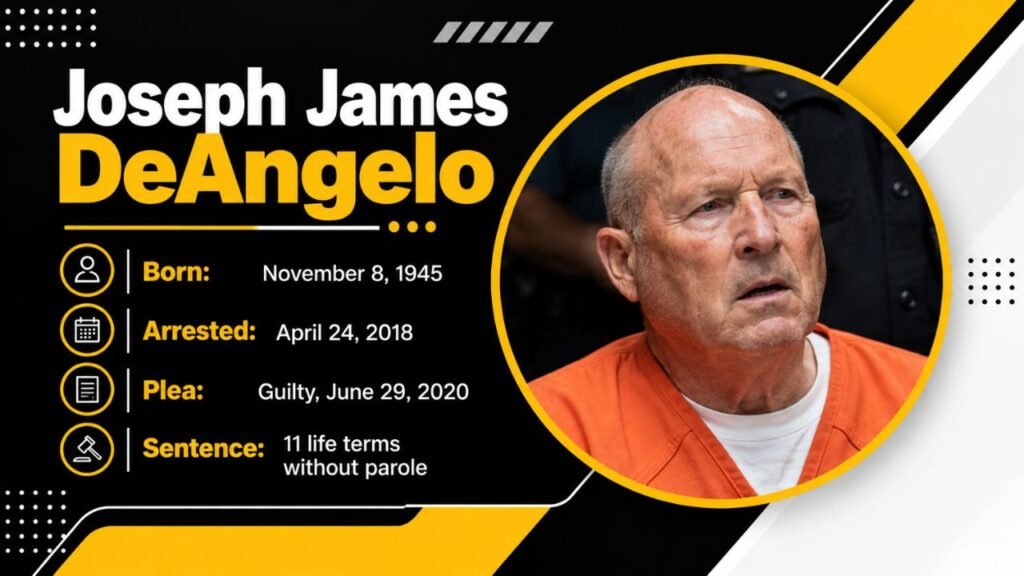
On April 24, 2018, investigators arrested 72-year-old Joseph James DeAngelo. He was a retired truck mechanic and former police officer who lived in a suburban Sacramento home. On August 21, 2020, Judge Michael Bowman sentenced him to 11 consecutive terms of life in prison without the possibility of parole.
The case took roughly 42 years to solve. Detectives followed cold trails and rival theories for decades. Then genetic genealogy changed everything, because investigators identified a suspect through his relatives’ DNA. As a result, the case reshaped criminal investigation across the country.
The case also produced one of the most emotional sentencing hearings in California history. Dozens of survivors and family members spoke directly to the man who upended their lives.
Case Snapshot
| Detail | Information |
|---|---|
| Full name | Joseph James DeAngelo Jr. |
| Age | 72 at his April 2018 arrest; 74 at sentencing |
| Also known as | Golden State Killer, East Area Rapist, Original Night Stalker, Visalia Ransacker |
| Charges | 13 counts of first-degree murder, 13 kidnapping-related counts, plus enhancements |
| Plea | Guilty, June 29, 2020 (plea deal; death penalty off the table) |
| Sentence | 11 consecutive life terms without parole, plus additional life terms and 8 years |
| Judge | Michael Bowman, Sacramento County Superior Court |
| Arrest | April 24, 2018, Citrus Heights, California |
| Crime period | 1974–1986 |
| Prosecutors’ count | 87 victims at 53 crime scenes across 11 California counties |
| Key investigative method | Investigative genetic genealogy |
| Sentencing venue | Sacramento State University ballroom |
Who Is Joseph James DeAngelo?
Early Life and Education
Joseph James DeAngelo Jr. entered the world on November 8, 1945, in Bath, New York. His family later moved to the Sacramento area of California, where his father served with the U.S. Air Force. Nothing about his early life marked him as a suspect.
Neighbors and coworkers described an ordinary man. He raised children, owned a home, and kept his yard tidy. However, some neighbors also recalled occasional angry outbursts over local disputes.
He served in the U.S. Navy during the Vietnam War era. Afterward, he attended community college and then Sacramento State University. There he earned a bachelor’s degree in criminal justice in 1971.
From Police Officer to Mechanic
That detail became one of the most unsettling facts in the case. The future Golden State Killer had studied law enforcement. Then he joined the profession himself. He served on the police force in Exeter, California, in the early 1970s. Later, he joined the Auburn Police Department. His career ended in 1979 after an arrest for shoplifting, and the department fired him.
After that, he worked for decades as a mechanic at a grocery distribution center. Eventually, he retired. He married and had children. From the outside, his life looked entirely unremarkable. That contrast between ordinary neighbor and prolific predator appears in nearly every account of the case.
A Quick Note on Names
Court records call him Joseph James DeAngelo Jr. News coverage usually shortens this to Joseph DeAngelo or simply “DeAngelo.” He did not choose the nickname “Golden State Killer.” Instead, writers coined it years after his crimes stopped. They wanted to unify offenses that authorities long believed came from different people.
One Man, Four Names: The Golden State Killer’s Identities
For decades, investigators in different parts of California believed they chased separate offenders. To understand why, look at the four names attached to Joseph DeAngelo’s crimes.
The Visalia Ransacker (1974–1975)
In Tulare County, a prowler committed well over a hundred burglaries in and around Visalia. He often rummaged through homes and stole small personal objects. Sometimes he rearranged the residents’ belongings. The pattern involved intrusion as much as theft.
The Visalia case turned deadly in September 1975. Claude Snelling, a college professor, tried to protect his daughter from an intruder who attempted to abduct her. The intruder shot and killed him.
The East Area Rapist (1976–1978)
In the summer of 1976, a series of nighttime home invasions rocked the eastern suburbs of Sacramento County. The attacker wore a mask and carried a flashlight. He often targeted couples or women home alone. Bound them and terrorized them for hours.
He also made threatening phone calls to victims. According to reports, he sometimes called police as well. Gradually, the attacks spread to other parts of Northern California, including the Bay Area.
The Original Night Stalker (1979–1986)
After the Northern California attacks tapered off, a similar pattern of home invasions appeared in Southern California. This time, the crimes repeatedly turned to murder. Investigators dubbed the offender the Original Night Stalker. The label distinguished him from Richard Ramirez, who terrorized Los Angeles in the 1980s.
The Golden State Killer
In the 2010s, crime writer Michelle McNamara used the name “Golden State Killer” for the unified offender. She hoped to draw attention to a case she believed the public had forgotten. The name stuck, and today it is the most widely used label.
DNA testing in the early 2000s finally connected the four identities. That link tied together crime scenes that investigators had treated as unrelated. It was the first major breakthrough. The second, naming the man behind the DNA, took another 15 years.
The Crimes: A Timeline of the Golden State Killer’s Spree
Prosecutors built their case against Joseph DeAngelo around murder and kidnapping charges. However, they said his offenses involved dozens of additional victims. The clearest way to grasp the scope is by phase and geography.
Quick timeline of the crime spree:
- 1974–1975: Visalia burglaries begin; Claude Snelling dies in September 1975.
- June 1976: The East Area Rapist strikes first in Rancho Cordova, in Sacramento County.
- February 1978: Brian and Katie Maggiore die in Rancho Cordova.
- Late 1978: Attacks in Northern California slow, then appear to stop.
- December 1979: Debra Manning and Robert Offerman die in Goleta, in Santa Barbara County.
- March 1980: Charlene and Lyman Smith die in Ventura County.
- August 1980: Patrice and Keith Harrington die in Dana Point, in Orange County.
- February 1981: Manuela Witthuhn dies in Irvine.
- July 1981: Cheri Domingo and Gregory Sanchez die in Goleta.
- May 1986: Janelle Cruz dies in Irvine, the last murder linked to the offender.
Those crimes account for the 13 murders to which Joseph DeAngelo ultimately pleaded guilty.
Sacramento and the Bay Area
The East Area Rapist attacks in Sacramento County set the template for what followed. Attacks usually happened at night in single-story suburban homes. They often involved careful planning. Survivors and investigators described an offender who knew his targets’ routines. Sometimes he entered homes while the occupants were away, and he unlocked doors or moved objects in advance.
The attacks caused lasting fear across the region. Residents bought guns, installed locks and floodlights, and slept in shifts. Meanwhile, the media covered the case relentlessly. The offender fled on foot or bicycle and vanished into the neighborhood. As a result, police always seemed a step behind.
Southern California Murders
After the Northern California attacks subsided, the murders began in the south. Most involved couples or people in their own homes. Prosecutors said the offenses included both sexual assault and killings. Through DNA, investigators tied several southern cases to one another. Then they tied those cases to the earlier Northern California crimes. That is how the offender came to look like a single, mobile individual.
A Note on the Numbers
Different sources cite different figures because each one measures something different. DeAngelo pleaded guilty to 13 murders and 13 kidnapping-related counts. Prosecutors said the overall case involved 87 victims and 53 crime scenes across 11 counties. Charges covered offenses against 26 victims. DeAngelo also admitted crimes against 61 additional victims. However, prosecutors could not charge those crimes, largely because of statute-of-limitations rules. Other tallies online, such as burglary totals, are estimates and vary by source.
Why the Golden State Killer Evaded Capture for Decades
Several factors combined to keep the Golden State Killer free for more than forty years.
Jurisdictional Fragmentation
The offenses spanned many counties. Each county had its own police department, case files, and detectives. Before modern databases, information moved slowly. For example, investigators in one county often had no idea that an almost identical crime had happened hundreds of miles away.
No DNA Evidence at the Time
DNA evidence did not exist as a tool when the offenses occurred. Later, it took years for law enforcement to build the databases needed to use it. Even after labs tested the biological evidence, the offender’s profile matched no one in the criminal databases.
Possible Inside Knowledge of Police Work
Investigators and writers have long noted the offender’s careful habits. He wore gloves and masks, and he chose his approach and escape routes with care. Because Joseph DeAngelo had served as a police officer, many observers concluded that his training helped him anticipate police tactics. That remains an inference, not a legal finding. Still, it recurs in coverage of the case.
Misleading Assumptions
Early profiles of the offender proved wrong in several respects. Consequently, they sent investigators down unproductive paths for years. In addition, the crimes stopped abruptly in 1986. Many people assumed the offender had died, gone to jail for something else, or moved away.
Michelle McNamara and the Public Push
It is impossible to tell the story of the Golden State Killer without Michelle McNamara. She was a true-crime writer and the founder of the site TrueCrimeDiary. She became fixated on the case and wrote about it for Los Angeles magazine in 2013. That article introduced the “Golden State Killer” name to a national audience. Over the years, she combed through police reports, interviewed detectives and survivors, and built timelines.
McNamara died in April 2016, before she could finish her book. Her collaborators completed her research, and the book appeared in 2018 as I’ll Be Gone in the Dark. It became a bestseller, and HBO later adapted it into a documentary series. Her husband, the comedian Patton Oswalt, became a public advocate for the case.
Many people credit her work with renewing public attention at a crucial moment. However, she did not live to see the arrest. In 2016, the FBI and local agencies also held a news conference. They announced a renewed nationwide push to identify the offender, and they offered a reward. That attention brought resources and fresh eyes to the case.
Joseph DeAngelo Arrested: The 2018 Breakthrough
Police arrested Joseph James DeAngelo on April 24, 2018, in Citrus Heights, in the Sacramento area. That location sits a short distance from where the East Area Rapist first struck in the 1970s. Deputies took him into custody without a fight. By then, they had gathered the evidence needed to confirm his identity.
The story of how investigators found him is now a case study in modern forensic work. It unfolded in five steps.
How Investigators Found Him
Step 1: The crime scene DNA. Investigators had a genetic profile of the offender from evidence saved at earlier crime scenes. For years, it matched no one in the criminal databases.
Step 2: Genetic genealogy. Instead of searching a criminal database, investigators uploaded the profile to GEDmatch. This open-source genealogy website lets hobbyists share DNA data to find relatives. The upload turned up distant family matches, third or fourth cousins. Those matches pointed to a family tree that branched across several generations.
Step 3: Building family trees. Genealogists, including consultant Barbara Rae-Venter, built out those trees. Gradually, they narrowed the pool of suspects by age, sex, and location. They also eliminated candidates by comparing their lives against the crime timeline.
Step 4: Surveillance and confirmation. Once Joseph DeAngelo emerged as a candidate, investigators watched him. They collected discarded DNA, including material from an item he threw away and another sample from a car door handle. Tests matched both samples to the crime scene profile.
Step 5: Arrest. With the DNA match in hand, deputies arrested DeAngelo at his home. Early reports noted the anticlimax. A frail-looking older man stood in a driveway, far from the terrifying figure survivors described.
The Legal Debate Over Genetic Privacy
The arrest sparked intense discussion about privacy and genetic data. Critics asked whether people who upload their DNA to a consumer genealogy site should expect police to trace their relatives. Supporters countered that the method is an invaluable tool for solving violent crimes.
GEDmatch and other services later revised their policies. In addition, several jurisdictions have considered laws that regulate how investigators may use consumer DNA databases. Many people regard the Golden State Killer case as the first high-profile use of investigative genetic genealogy on a decades-old violent crime. Since then, investigators have used the technique in many other cases.
The Legal Process: From Charges to Guilty Plea
After the arrest, prosecutors first charged Joseph DeAngelo with a number of murders. Later, they expanded the case to cover additional killings in other counties. Because the crimes spanned so many jurisdictions, county prosecutors coordinated their work. The Sacramento County District Attorney’s Office took the lead.
What Shaped the Pretrial Stage
Several features shaped the pretrial stage:
- The death penalty question. Prosecutors initially considered seeking death. However, California has had a moratorium on executions since 2019. The advanced ages of the defendant, the survivors, and the witnesses also weighed on the decision to settle.
- Preliminary proceedings. In hearings, prosecutors presented evidence linking DeAngelo to the crimes. A judge then decided there was enough to proceed.
- Delays. The COVID-19 pandemic complicated any plan for a long, multi-county trial with many elderlyy witnesses.
The June 2020 Plea Hearing
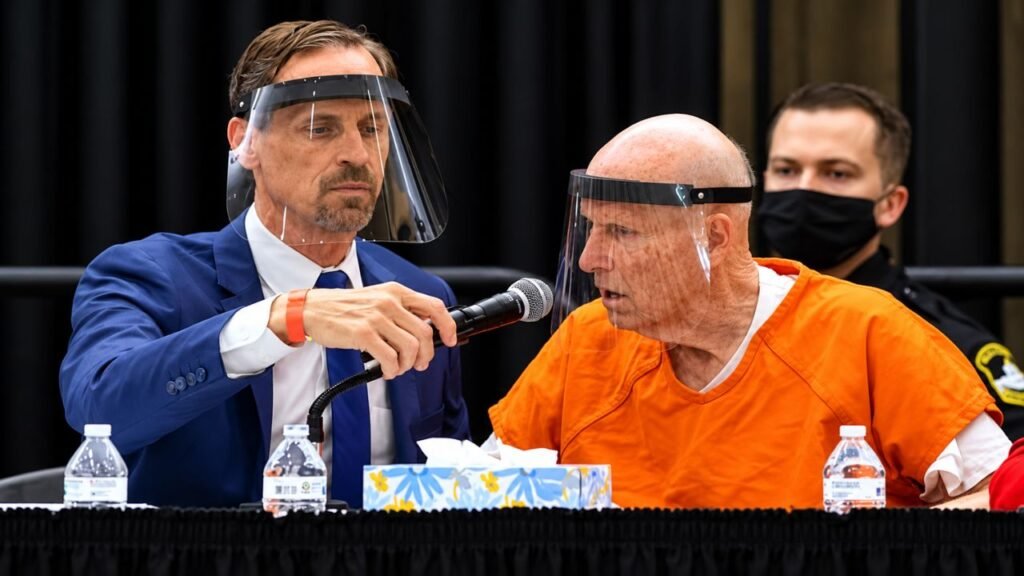
On June 29, 2020, Joseph DeAngelo appeared at a hearing in a large ballroom at Sacramento State University. Officials chose the venue for social distancing and for the many victims and family members who wanted to attend. There he pleaded guilty to 13 counts of first-degree murder and 13 counts of kidnapping-related offenses. He also admitted to a broader set of crimes that prosecutors could not charge separately. According to reports, he responded to the charges by repeatedly saying he admitted them.
The plea deal guaranteed a life outcome without the delays and uncertainty of a trial. It also gave survivors and families a form of closure. A long trial and the risk of appeals might have denied them that.
Joseph DeAngelo Sentenced: Life Without Parole
The sentencing hearing began in August 2020 and lasted several days. Its centerpiece was three days of victim impact statements. Some survivors had waited more than forty years to speak. They described the physical and psychological harm they had suffered and the fear that lasted for decades. They also described relationships and lives that changed forever. Relatives of murder victims spoke about the people they had lost. Many addressed DeAngelo directly.
The Sentence Itself
On August 21, 2020, Judge Michael Bowman imposed the sentence. According to the Contra Costa County District Attorney’s office, DeAngelo received 11 consecutive life sentences without parole for the 13 murder counts. That term runs consecutively to a life term for kidnapping to commit robbery and to eight years for weapon enhancements. The plea agreement also included 15 life terms with the possibility of parole for other counts.
Press reports say the judge explained that a life sentence made sense given the ages of the defendant and the victims. He stressed that the sentence did not mean DeAngelo deserved less than death.
DeAngelo’s Statement in Court
Before sentencing, DeAngelo spoke briefly. Reports say he stood from his wheelchair and removed his face mask. He told the courtroom that he had listened to the victims and was sorry for the harm he caused. Some survivors and observers found the statement inadequate. Others noted that it was the first time he publicly acknowledged their suffering.
What the Sentence Means in Practice
Because the terms are life without parole and run consecutively, DeAngelo will spend the rest of his life in state prison. Reports place him in the California state prison system. He was 74 at sentencing, and he is now 80. Realistically, he will never leave prison alive.
| Element | Detail |
|---|---|
| Murder counts | 13 counts of first-degree murder |
| Primary sentence | 11 consecutive life terms without parole |
| Additional terms | Life term for kidnapping to commit robbery; 15 life terms with parole eligibility; 8 years for weapon enhancements |
| Death penalty | Avoided through plea deal |
| Appeals | Limited, given the plea agreement |
The Victims: Remembering the People at the Center of the Case
In a case with a notorious offender, it is easy to let the perpetrator dominate the story. However, the people he harmed deserve equal attention.
Prosecutors said the offenses left 87 victims. They include people attacked in their homes, the couples and individuals he murdered, and the families left behind. Many survivors were teenagers or young adults at the time. Some have lived with the effects for their entire adult lives.
The sentencing hearing let survivors reclaim a measure of power. Several chose to face their attacker in court after years of silence. Others spoke of the strength they found in one another. Fear and the lack of a suspect had isolated them for decades, but together they formed a community. Family members of the murdered spoke of birthdays, careers, and futures cut short.
The murder victims in the case include Claude Snelling, Brian and Katie Maggiore, Debra Manning and Robert Offerman, and Charlene and Lyman Smith. They also include Patrice and Keith Harrington, Manuela Witthuhn, Cheri Domingo and Gregory Sanchez, and Janelle Cruz. Their names, far more than the nicknames of their killer, form the enduring record of the case.
The Evidence and Methods That Solved the Case
Investigators relied on the following evidence and techniques to identify and charge Joseph DeAngelo:
- DNA from decades-old crime scenes, saved and later tested
- Genetic genealogy built from consumer DNA databases
- Traditional genealogy research, including family trees and public records
- Surveillance of DeAngelo before the arrest
- Discarded-DNA collection to confirm the match
- Cross-county case linking through modern forensic databases
- Survivor and witness accounts gathered over decades
- Victim and family cooperation during the plea and sentencing
Because DeAngelo pleaded guilty, a jury never tested most of this evidence. Prosecutors and law enforcement discussed the DNA match and the investigative process publicly in hearings. Still, the plea removed the need for a full trial presentation.
Why the Golden State Killer Case Matters Beyond California
The case of Joseph DeAngelo matters for reasons that reach far beyond who committed which crime.
It Changed Forensic Investigation
Genetic genealogy opened a new era of cold-case investigation. Since 2018, investigators across the United States have used similar techniques to identify suspects. In some cases, they have even named previously unidentified victims. The approach has also raised lasting questions about privacy, consent, and the regulation of genetic data.
It Demonstrated the Value of Persistence
Detectives, analysts, survivors, and writers kept the case alive for decades. McNamara’s work in particular showed how public attention can support law enforcement. Nevertheless, attention alone cannot replace the scientific and legal work that ultimately solves cases.
It Shaped How Courts Treat Survivors
The multi-day victim impact hearing became a model for giving survivors a voice in high-profile cases. Many observers saw it as proof that the justice system can make space for people it once overlooked.
It Highlighted the Limits of the System
Statutes of limitations kept prosecutors from charging DeAngelo for many of his crimes, especially the earlier rapes and burglaries. That limit frustrated survivors. It also prompted debate about whether time limits should apply to serious sexual offenses. Since then, many states have revisited their laws.
It Reshaped Public Understanding of Offenders
Many people pictured the Golden State Killer as an elusive, sophisticated criminal. Instead, they saw an aging man in a wheelchair. Some commentators found the contrast anticlimactic. Survivors, however, pointed out that it did not lessen the harm he caused.
Lessons From the Golden State Killer Investigation
Investigators and legal experts still study this case. First, it shows how much cold cases depend on preserved evidence. Because detectives saved DNA for decades, they could test it once the technology improved. Without that foresight, Joseph DeAngelo might never have faced justice.
Second, the case shows the power of cooperation. When agencies shared files across county lines, the pieces finally fit together. Meanwhile, survivors and family members refused to let the case fade. Their persistence kept pressure on authorities, and it kept the story in the public eye.
Third, the case reminds us that offenders often hide in plain sight. Neighbors saw an ordinary retiree. However, investigators eventually proved that he had led a terrifying double life. Therefore, many departments now review old files with fresh eyes. In addition, they train detectives to link crimes across jurisdictions early.
Finally, the case proves that time does not erase accountability. Although 42 years passed, the legal system still delivered a verdict of sorts. For survivors, that outcome mattered deeply. Still, no sentence can undo the harm. As a result, many of them now focus on healing and on helping others.
Read Also: Top 10 Most Famous Serial Killers – Notorious Cases in History 2026
Frequently Asked Questions
He is the former police officer and retired mechanic whom investigators identified in 2018 as the Golden State Killer. In 2020, he pleaded guilty to 13 murders and 13 kidnapping-related charges.
Yes. “Golden State Killer” is the collective nickname for the offender behind the crimes of the Visalia Ransacker, the East Area Rapist, and the Original Night Stalker. Investigators linked all of them to Joseph James DeAngelo.
Crime writer Michelle McNamara used the name in her writing. It then became the most common label for him.
Police arrested him on April 24, 2018, in Citrus Heights, California.
They used genetic genealogy. First, they uploaded crime scene DNA to a public genealogy database. Next, they built family trees from distant relatives’ matches. Finally, they confirmed the suspect through discarded DNA.
No. He pleaded guilty in June 2020 under a plea deal that avoided the death penalty.
He received 11 consecutive life sentences without the possibility of parole, plus additional terms. Judge Bowman imposed them on August 21, 2020.
Reports cite California’s execution moratorium, the pandemic, and the advanced ages of the defendant, survivors, and witnesses. Together, these factors led to a plea deal that took death off the table.
He is serving his sentence in the California state prison system. Officials do not expect him ever to go free.
For DeAngelo, yes, because he has a conviction and a sentence. However, the wider story continues. Survivors still work toward recovery, the debate over genetic privacy goes on, and investigators keep using the techniques this case made famous.
Source: WikiPedia