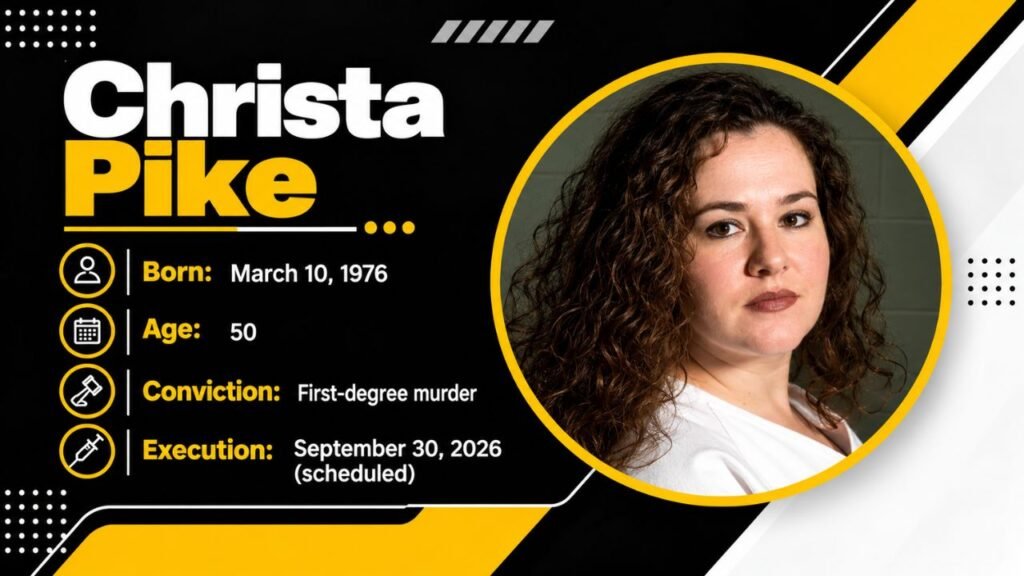
There’s a particular kind of silence that settles over a country when a story everyone thought they understood suddenly stops following the script, and that’s exactly what happened in Nashville on the night of September 30, 2026. For three decades, Christa Pike was a name that lived mostly in Tennessee court filings and true-crime podcasts: the only woman on the state’s death row, sentenced at 20 for a killing committed at 18. Her execution was supposed to be a historic but orderly event, the first time Tennessee put a woman to death in roughly 200 years. Instead, by every credible account, the state gave her two doses of lethal drugs and she was still alive afterward.
It’s the kind of case that would have drawn headlines on its own. Add a governor’s last-minute clemency denial, three federal courts moving in a single day, and a brand-new documentary released days earlier, and you end up with the kind of story cable news assigns a full-time producer to.
That’s why so many people are typing the same questions into search engines right now: what was the christa pike execution date, what actually went wrong, is christa pike still alive, and what does christa pike now look like in practical terms. What follows is everything that’s publicly known so far: who Christa Pike is, what happened to Colleen Slemmer in 1995, how the case crawled through three decades of appeals, what unfolded on execution day, and what’s likely to happen now that a governor has ordered a review and halted the rest of the year’s executions.
Case Snapshot
| Detail | Information |
| Full name | Christa Gail Pike |
| Born | March 10, 1976, Beckley, West Virginia |
| Age | 50 now; 18 at the time of the killing; 20 when sentenced |
| Convictions | First-degree murder and conspiracy to commit first-degree murder (1996) |
| Sentence | Death, imposed in 1996 |
| Victim | Colleen Slemmer, 19 |
| Location of the killing | University of Tennessee agricultural campus, Knoxville |
| Date of the killing | January 1995 |
| Scheduled execution | Wednesday, September 30, 2026, by lethal injection |
| Execution site | Riverbend Maximum Security Institution, Nashville |
| Drug | Pentobarbital, two doses administered |
| Outcome | Survived; taken to a hospital |
| Governor | Bill Lee, who denied clemency September 28, then ordered a third-party review |
| Current status | Alive per latest reporting; sentence not vacated |
Who Is Christa Pike?
Long before any of this, Christa Gail Pike was a girl from Beckley, West Virginia, born in March 1976, whose childhood didn’t offer much stability. Court records and news coverage describe frequent moves, constant school changes, and a household where the adults around her failed to keep her safe. Her mother testified in earlier proceedings that Pike attempted an overdose as a young child, after which she received psychiatric treatment and therapy at different points.
Her attorneys have argued for years that she endured sexual and physical abuse and neglect starting at a very early age, and that the state’s child-protection system knew about her circumstances without stepping in. Those claims, along with later diagnoses of bipolar disorder and post-traumatic stress disorder, sit at the center of nearly every clemency request and appeal filed for her. Prosecutors and the victim’s family have never accepted that this history excuses what happened, and courts have consistently declined to overturn her sentence on that basis.
As a teenager, she joined the Job Corps, a federal vocational program for young people, hoping to become a nurse. Reporting on the case says the Knoxville environment turned out to be nothing like the safe start she had imagined. That program is where the story that would define her life took place.
What makes Christa Pike unusual in the history of American capital punishment is the combination of facts. She was one of the youngest women ever sent to death row. She spent three decades there. And she became the last person in Tennessee sentenced to death for a crime committed at 18, the youngest age at which a person can legally face execution in the United States.
The Night Colleen Slemmer Died
The basic facts of January 1995 are not seriously disputed in court records. Colleen Slemmer, 19, a fellow Job Corps student, was killed in Knoxville. Prosecutors argued that Pike believed Slemmer was interested in her boyfriend, Tadaryl Shipp, and that jealousy drove what followed. Pike, Shipp, and a third young man, Shawn Peterson, led Slemmer to a wooded area on the University of Tennessee’s agricultural campus, where she was beaten and stabbed to death.
Some of the details that made the case infamous in the 1990s were deeply disturbing. Reports say a symbol was carved into the victim’s body, and that Pike kept a fragment of her skull and showed it to classmates afterward. Those facts shaped how the crime was presented to jurors and the public, and they remain the reason the case is still described as one of the most brutal in Tennessee history.
Peterson cooperated, testified against Pike at trial, and received probation. Shipp was prosecuted separately. That structure, an 18-year-old woman presented as the driving force behind a killing carried out with two others, shaped how the state argued for the death penalty and how the jury saw her.
How the Case Unfolded: A Timeline
It’s worth laying out the sequence of events in order, because the sheer number of legal steps, trial, appeals, lawsuits, a pause on executions, and finally a date, is itself part of the story.
January 1995 – Colleen Slemmer is killed in Knoxville; Pike is 18
1996 – Pike is convicted of first-degree murder and conspiracy and sentenced to death
2004 – Pike is convicted of attempting to strangle another inmate; 25 years are added to her sentence
2022 – Tennessee pauses executions after lethal injection drug testing failures
September 2024 – A settlement in her confinement lawsuit allows more social interaction
May 2025 – Tennessee resumes executions under a new single-drug protocol
October 2025 – The state Supreme Court sets September 30, 2026 for Pike
January 2026 – Pike’s attorneys sue over the lethal injection protocol
September 28, 2026 – Governor Bill Lee denies clemency
September 30, 2026 – Two doses of pentobarbital are given; Pike survives
October 1, 2026 – Lee orders a third-party review and halts the remaining 2026 execution
Trial, Conviction, and Three Decades on Death Row
A jury convicted Pike in 1996, and the same year she was sentenced to death. At 20, she was reportedly the youngest person on Tennessee’s death row. Her defense later argued that her court-appointed trial lawyers presented very little of the evidence about her abuse and mental health history, the kind of evidence that might have persuaded jurors toward a life sentence. That claim has been a recurring theme in the decades of appeals since, and it’s one of the main points highlighted by human-rights groups that took up her case in 2026.
Her time in custody complicated the picture. In 2004, she was convicted of trying to strangle another. Inmate during a fight, which added 25 years to her sentence. Supporters say she has changed since. Her attorneys describe a remorseful woman who understands her actions, receives treatment for her mental illness, and guides other incarcerated women.
For most of the period between 1996 and 2025, Christa Pike was a background figure in Tennessee’s capital system. Her case moved through state post-conviction review and federal habeas proceedings without producing a date. The state’s attention was elsewhere for a while, because Tennessee paused all executions in 2022. After it emerged that lethal injection drugs hadn’t been properly tested. An independent review found that none of the drugs. Prepared for the seven men executed since 2018 had been fully tested, and the Attorney General’s office. Conceded that two officials overseeing the drugs had testified incorrectly under oath. Executions resumed in 2025 under a new protocol using a single drug, pentobarbital.
Christa Pike Execution Date: How September 30 Was Set
The christa pike execution date was set when the Tennessee Supreme Court issued a schedule of 2026 dates in early October 2025, covering Pike and three male inmates. Hers landed on Wednesday, September 30, 2026, when she was 49. Had it gone forward, she would have been the first woman executed in Tennessee since 1820. The 19th woman executed in the modern era of American capital punishment, which began in 1976. The most recent woman executed in the country before this case was Amber McLaughlin in Missouri in January 2023.

Pike’s federal defenders, Luke Ihnen and Stephen Ferrell of Federal Defender Services of East Tennessee, filed a lawsuit in January 2026 challenging the state’s lethal injection process. They argued that her medical conditions, including a blood disorder. Described by an anesthesiologist who reviewed her case, would make the drug cause severe suffering. They also argued it was unfair that the state had agreed to spare two other prisoners while their lawsuits continued. The state defended pentobarbital, pointing to a long history of its use, and said Pike had offered speculation rather than proof of a unique risk.
As the date approached, public pressure grew. Advocacy groups circulated petitions, churches planned to toll bells on the morning of the execution, and a “March 4 Mercy” rally took place at the state Capitol in Nashville on Sunday, September 27. On Monday, September 28, Governor Lee announced that he would not grant clemency, saying in a short statement that he had reviewed her request and would uphold the sentence. In a letter written that same week, Pike said she was mostly nervous about the process. On paper, the christa pike execution date looked settled. It wasn’t.
Christa Pike Execution Day: A Day-by-Day Breakdown
The sequence of events that Wednesday involved several courts and moved fast, which is part of why the timeline confused so many readers. A federal appeals court issued a temporary stay roughly an hour before the 10 a.m. execution time, and for a few hours it looked as though the date would simply pass. By midday, the U.S. Supreme Court had lifted that stay, clearing the legal barrier after already rejecting a separate request that challenged the lethal injection protocol. Around 8 p.m., correctional staff gave Pike two doses of pentobarbital at Riverbend, according to her attorneys’ court filings.
Then came the detail that turned a regional story into a national one. At 8:53 p.m., media witnesses were asked to leave the viewing area, and reporters said Pike could still be heard snoring loudly behind the closed curtain, clearly alive. Emergency vehicles later arrived at the prison, and she was taken to a nearby hospital. The head of the Death Penalty Information Center called the outcome singular and unparalleled, noting that seven other people have survived medical problems tied to a failure to find a vein, but that no one had previously stayed alive after receiving the actual execution drugs.
| Phase | Status |
| Appeals court stay (morning) | Granted about an hour before the scheduled time |
| U.S. Supreme Court (midday) | Lifted the stay; earlier protocol challenge already denied |
| Lethal injection (about 8 p.m.) | Two doses of pentobarbital administered |
| Media removed (8:53 p.m.) | Pike reported still alive and snoring |
| Aftermath | Hospitalized; condition unclear |
Is Christa Pike Still Alive?
The obvious question, is christa pike still alive, became the story overnight, and the answer, based on the most recent reporting, is yes. Witnesses said she was alive after the second dose, and she was taken to a hospital. On Thursday, October 1, Governor Lee told reporters that her health status was unknown to him and that it was very early in understanding what had occurred. Her legal team said the state had once again failed to carry out a lawful execution.
A note on “is christa pike still alive” searches: this is one of the most common questions tied to the case, and the careful answer has two parts. First, nothing in credible reporting says she died on September 30 or afterward, and multiple outlets documented that she survived the attempt. Second, her medical status hasn’t been publicly detailed and could change, so anyone reading this days or weeks after publication should check a current news source. Why the procedure failed hasn’t been explained either. Possible causes, from drug quality to intravenous access to her particular medical conditions, remain speculation until the governor’s review reports back.
Governor Lee’s Review and the Halt on Executions
On Thursday, October 1, Governor Lee said he had ordered a comprehensive, third-party review to determine exactly what occurred. He also paused the only other execution left on the state’s 2026 calendar, scheduled for December, saying it would not go forward this year. That decision puts Tennessee’s resumed execution program, which restarted in 2025 after a three-year pause, back on hold, and it puts the state’s lethal injection protocol under outside scrutiny for the second time in four years. In 2022, the pause followed testing failures. In 2026, it follows a lethal injection that left the condemned person breathing after two doses.
For Pike’s lawyers, the review opens a new line of argument. The Constitution bars cruel and unusual punishment, and whether a state may try again after a failed attempt is a hard legal question courts have touched on only rarely. A case where a full dose was delivered and failed has no clean precedent, so expect it to be tested directly.
Christa Pike Now: What Happens Next
When people search for christa pike now, they are usually asking three practical questions. Where is she? What is her legal status? And will the state try again?
Where she is: Pike was taken to a hospital after the failed procedure. Whether she has returned to prison or remains in medical care isn’t confirmed in the reporting available as of this writing. Her legal status: her death sentence has not been formally vacated. Governor Lee denied clemency and halted the remaining 2026 execution, but his announcements concerned the schedule and the review, not a commutation. Whether the state will try again: there is no date, and the review has no announced deadline. Past American cases involving botched executions have produced long legal fights over whether a second try is permissible, and Pike’s case is unusual because the drug was fully delivered rather than blocked by a failure to find a vein.
A note on “christa pike now” searches: much of the honest answer is still unknown. What will shape christa pike now over the coming months is the findings of the independent review, new filings from her attorneys, any change to Tennessee’s protocol or drug supply, the political reaction, and her health, which will decide whether any further procedure is even medically possible.
The Christa Pike Documentary
Interest in the case was already high before September 30, partly because of a new christa pike documentary released shortly before the scheduled execution. “Dead Woman Walking: Pike v. Tennessee” was announced by Sinclair’s Criminally Obsessed in partnership with The CW Chattanooga. The film examines the 1995 killing, the conviction, and more than three decades of legal proceedings, drawing on original reporting, archival material, interviews with Pike conducted from prison, conversations with Slemmer’s mother, and members of Pike’s legal team.
An earlier christa pike documentary appearance came in May 2024, when the case was covered in an episode of the series She-Devil titled “Mean Girl Murders.” That hour leaned on the Satanism angle that dominated 1990s coverage, with archive footage of Pike and interviews with a journalist, an investigator, an author, a teacher, and the victim’s mother.
One caution for viewers: a lot of true-crime videos and articles with headlines like “shocking secrets” are low-quality summaries that repeat rumor and were written before September 30. Court records, established news outlets, and documentaries with named producers are safer ground, and the christa pike documentary from Sinclair and CW Chattanooga stands out because it includes the victim’s family alongside the defense.
Since the failed execution, interest in any christa pike documentary has only grown, because viewers who watched before September 30 are now seeing a film whose final chapter has been rewritten by events. The story it tells is no longer about an execution that was about to happen, but about one that did not work, and that gap between the film and the news is part of what keeps the case in the headlines.
The Other People in the Case
| Name | Role | Status |
| Christa Pike | Convicted of the 1995 murder | Alive per latest reports; sentence not vacated |
| Colleen Slemmer | Victim, age 19 | Killed in January 1995 |
| Tadaryl Shipp | Pike’s boyfriend, involved in the killing | Prosecuted separately |
| Shawn Peterson | Involved; testified against Pike | Received probation |
| Bill Lee | Tennessee governor | Denied clemency; ordered review |
| Luke Ihnen and Stephen Ferrell | Pike’s federal defenders | Challenging the lethal injection protocol |
Who Was Colleen Slemmer? A Brief Look at the Victim
It’s easy for a case like this to become entirely about the condemned, the unprecedented procedure, and the legal fights. But at the center of all of it is a 19-year-old who was enrolled in a job-training program in Knoxville, hoping, like her classmates, to build a future. Her mother has kept her memory in public view for thirty-one years and appears in the new documentary. Whatever happens next in the courts, Slemmer’s death is the fixed point the entire case revolves around.
Why the Case Matters Beyond Tennessee
Part of why this case has traveled so far beyond Nashville is that it sits at the intersection of several national debates. On age and culpability, the Supreme Court has barred execution for crimes committed under 18 but left the line there. Pike’s supporters argue that brain-development science shows no real difference between a 17-year-old and an 18-year-old, especially one with severe childhood trauma, while opponents respond that a bright legal line is necessary and that the crime was planned and deliberate. On abuse and mitigation, her lawyers say jurors never heard the full story of her childhood, and the state and the victim’s family answer that many people endure hardship without committing murder.
Gender is part of it too. Women are executed far less often than men, and since 1976 the United States has executed 18 women. Some see that rarity as a reason for extra caution, while others argue equal justice means equal application of the law. But the biggest spotlight now falls on method and competence. Tennessee’s earlier testing failures, its move to a single-drug protocol, and now a survived procedure raise the question of whether the state can administer the sentence reliably at all. And for Colleen Slemmer’s family, every delay reopens a wound from 1995.
Where people land on these questions depends on deeply held values, and reasonable people disagree. What the events of September 30 establish is that a state tried to carry out a lawful sentence and failed, which is a separate issue from whether the sentence itself is just.
Check Other Crime Stories: joseph deangelo | Frank Lucas | John Dillinger Death
Frequently Asked Questions
Tennessee’s only woman on death row, convicted of the 1995 murder of Colleen Slemmer when she was 18.
September 30, 2026, scheduled by lethal injection at Riverbend Maximum Security Institution in Nashville.
Yes, per reporting. She survived two doses of pentobarbital and was taken to a hospital.
She was hospitalized after the failed procedure. Her current condition and location haven’t been fully confirmed publicly.
The cause is unknown. Governor Lee ordered an independent third-party review to determine exactly what occurred.
No. He denied it September 28, then ordered a review and paused the remaining 2026 execution.
No. Her sentence stands for now, the review is pending, and more court fights are expected.
Colleen Slemmer, 19, a fellow Job Corps student in Knoxville, Tennessee.
Pentobarbital, under a single-drug protocol Tennessee adopted in 2025 after pausing executions in 2022.
Source: WikiPedia