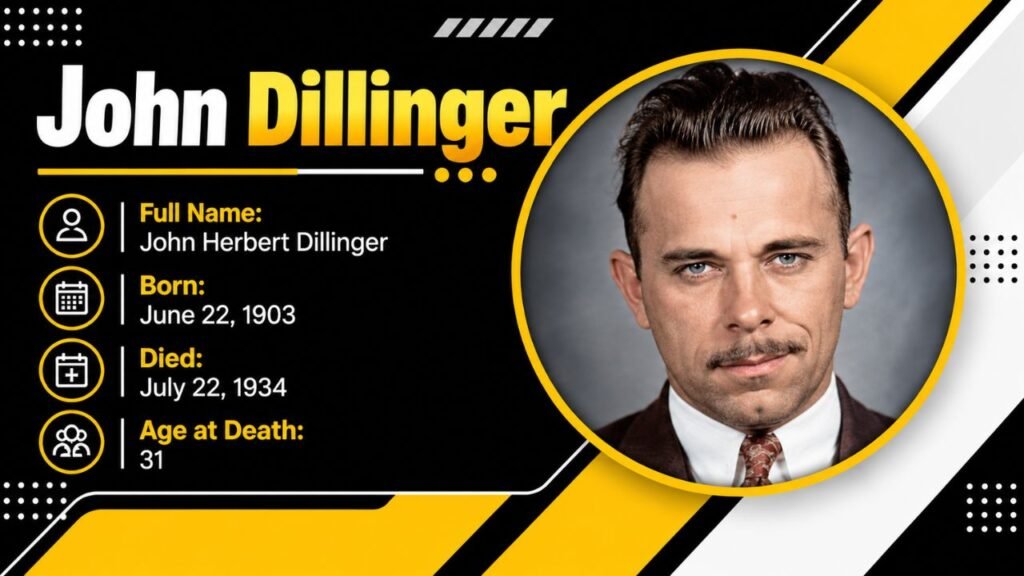
There’s a particular kind of whiplash that comes with watching a Depression-era parolee turn into the FBI’s top target almost overnight, and that’s exactly what happened across the Midwest in 1933 and 1934. On July 22, 1934, federal agents closed in outside Chicago’s Biograph Theater in the final act of a manhunt for John Dillinger – a former grocery-store robber turned bank-robbing folk antihero accused of holding up roughly two dozen banks and staging two of the boldest jailbreaks in American history. It’s the kind of case that would have drawn regional headlines on its own. Add a reality-defying escape with a fake wooden gun, two women caught up in his final hours. A betrayal by an informant remembered as the “Woman in Red,”. You end up with a story newsreels and newspapers couldn’t get enough of.
What follows is everything that’s known about Dillinger’s life and death. Who he was, what happened the night he was killed, how the manhunt crawled from parole to ambush. And what became of the people, places, and relics connected to his final days.
Case Snapshot
| Detail | Information |
| Full name | John Herbert Dillinger |
| Born | June 22, 1903, Indianapolis, Indiana |
| Died | July 22, 1934, age 31 |
| Cause of death | Multiple gunshot wounds inflicted by FBI agents |
| Alleged crimes | Roughly 24 bank robberies, four police-station raids |
| Companion at death | Polly Hamilton, girlfriend |
| Informant | Anna Sage, later known as the “Woman in Red” |
| Location of death | Outside the Biograph Theater, Lincoln Avenue, Chicago |
| Common-law partner | Evelyn “Billie” Frechette |
| Burial site | Crown Hill Cemetery, Indianapolis, Indiana |
| Lead agents | Melvin Purvis and Samuel P. Cowley |
| Weapon carried that night | Colt Model 1908 Vest Pocket pistol |
John Dillinger
Long before any of this, John Dillinger was just a restless young man from Indianapolis with a good arm. A sharp temper, and a family farm in Mooresville, Indiana, that never quite held his attention. He was known around town as athletic. Charismatic but impatient with structure, whether it came from school, church, or eventually the law. At 21, he robbed a grocery store owner alongside an older accomplice – his first major crime. His well-meaning father encouraged him to plead guilty, believing a young first offender would be treated leniently. Instead, the judge handed down the maximum sentence, a decision many historians point to as the moment that hardened Dillinger for good.
Nearly a decade split between the Indiana Reformatory and the Indiana State Prison did exactly that. Rather than reforming him, prison connected him with experienced bank robbers. Who mentored him in the trade he’d soon make infamous. When he was finally paroled in May 1933, Dillinger didn’t waste time. He robbed banks within weeks of his release and, in an act of loyalty that defined his early gang. Smuggled guns into Indiana State Prison to help several old associates break out. Men who would later return the favor when Dillinger himself needed rescuing.
John Dillinger Death
Dillinger’s criminal career came to an abrupt, violent end after just fourteen months on the run. Despite multiple arrests, two headline-grabbing jailbreaks, and a botched FBI raid. That let him slip away once already, he was ultimately tracked down through the betrayal of an informant working directly with federal agents. His death closed out one of the most intense manhunts in American law-enforcement history and effectively ended. The “public enemy” era of Depression-time outlaws that also included Bonnie and Clyde, Pretty Boy Floyd, and Baby Face Nelson.
The event dominated front pages nationwide within hours. For a bureau still proving its own relevance under J. Edgar Hoover, Dillinger’s death became a career-defining moment for agents Melvin Purvis and Samuel Cowley, and a permanent fixture in American crime lore – one still referenced in books, documentaries, and films nearly a century later.
How Did John Dillinger Die
Dillinger was shot and killed by federal agents as he tried to flee after being ambushed outside a movie theater. He had spent the evening of July 22, 1934, watching Manhattan Melodrama at Chicago’s Biograph Theater alongside his girlfriend, Polly Hamilton, and an acquaintance named Anna Sage – who had quietly tipped off the FBI earlier that day in exchange for help avoiding deportation. Agents led by Purvis and Cowley surrounded the building and waited for the group to exit rather than risk a shootout inside a packed house.
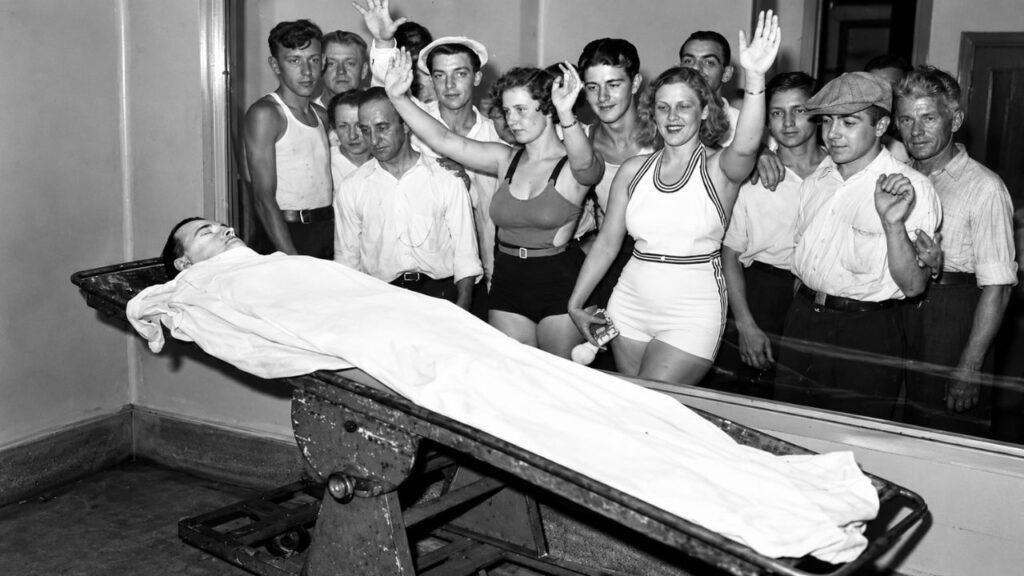
As Dillinger stepped out into the warm night, he appears to have sensed something was wrong almost immediately. According to accounts from agents on the scene, he drew his pistol and broke into a run toward a nearby alley. He was struck several times before he could get clear, bringing fourteen months of robberies, shootouts, and narrow escapes to an end in a matter of seconds.
John Dillinger Last Words
Unlike a lot of outlaws memorialized on film, Dillinger left behind no verified deathbed statement. Dillinger died almost instantly after agents shot him while he tried to flee, leaving no real opportunity for him to speak his final words. No agent or witness at the scene ever provided a credible account of him speaking afterward. Movies have sometimes invented a final line for dramatic effect, but historians consistently note that no authentic record exists of anything Dillinger said after he was shot. That silence has, if anything, only deepened the mystique around how quickly and quietly it all ended.
John Dillinger Cause of Death
The official cause of death was multiple gunshot wounds, including a fatal shot to the head, inflicted by FBI agents during the ambush outside the theater. Agents had surrounded the building for hours after receiving a tip that Dillinger would be there that night. When Dillinger reached for his weapon and tried to break away from the group, several agents opened fire at close range. They struck him at least three times, and he died at the scene before medical personnel could transport him.
The shooting drew scrutiny in the years that followed. Some witnesses and later researchers disputed minor details, including the number of shots fired, whether the gunfire struck any bystanders, and whether the agents gave Dillinger any warning before shooting. None of that dispute has seriously challenged the basic cause of death, which has stood unchanged in the historical record for nine decades.
Where Did John Dillinger Die
Dillinger died on a Chicago street, just outside the movie theater he’d been watching a film in that evening. The location placed him in a busy stretch of Chicago’s Lincoln Park neighborhood on a warm July night, so numerous bystanders who had just left the theater witnessed the shooting. In the chaotic minutes afterward, several onlookers reportedly dipped handkerchiefs in his blood and kept them as souvenirs, a detail that later accounts of the case repeatedly mentioned.
The alley beside the old theater remains a well-known stop for true-crime visitors to Chicago today.
Where Was John Dillinger Killed
John Dillinger was killed by federal agents outside the Biograph Theater on North Lincoln Avenue in Chicago, on July 22, 1934, after being lured there by informant Anna Sage’s tip earlier that day. The theater had been showing a gangster film that night, an irony not lost on later retellings of the story. Agents quietly ringed the building rather than moving in during the film, waiting instead for Dillinger to step into the open where a confrontation would put fewer bystanders at risk. That choice of a crowded, public theater as the final setting is part of why the case has stayed so vivid in American memory – it turned an ordinary night at the movies into one of the most famous law-enforcement ambushes on record.
John Dillinger Death Mask
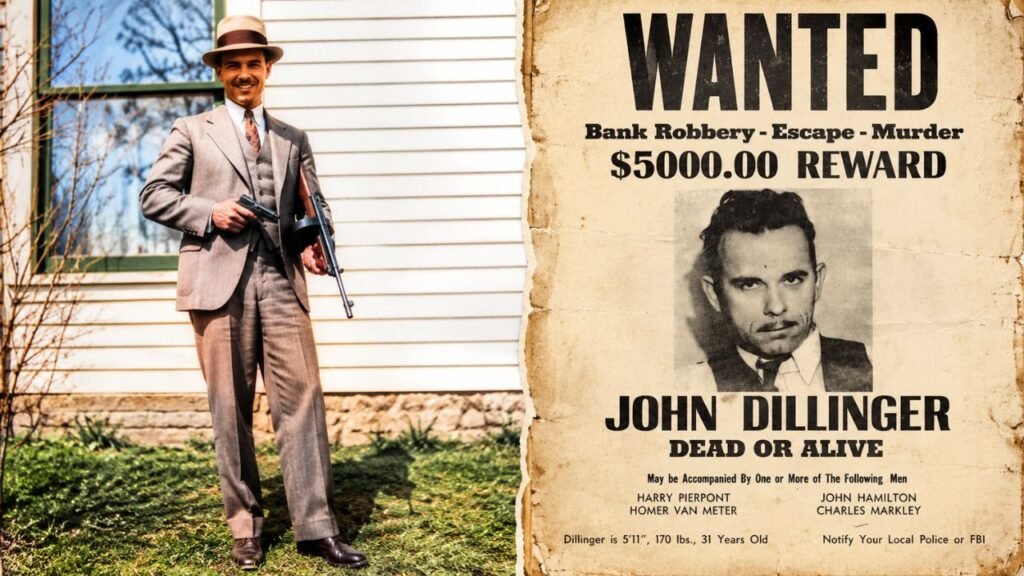
After FBI agents gunned down the bank robber outside Chicago’s Biograph Theater, several plastic death masks were made of his face – so many, in fact, that Dillinger’s dead face and hair were damaged in the process. FBI Director J. Edgar Hoover reportedly kept one of the masks on display just outside his office, treating it almost as a trophy of the bureau’s biggest early victory. Surviving masks now sit in collections at institutions such as the Indiana State Police Museum. The museum displays John Dillinger’s death mask alongside the wicker corpse basket that carried his body from the Cook County Morgue and his blood-stained “death pants,” which have faded with age but remain among the museum’s most requested exhibits.
John Dillinger Wife
Dillinger was never legally married. He did, however, have a common-law relationship with Evelyn “Billie” Frechette, a woman of French-Canadian and Menominee heritage he met in Chicago in 1933. Frechette became one of the most publicly recognized companions associated with Dillinger’s outlaw life. Authorities later arrested and imprisoned her for harboring him during his crime spree, and the legal ordeal made her a notable figure in the broader story of the gang’s downfall. Film adaptations of Dillinger’s life have also prominently portrayed their relationship, often presenting her as his primary romantic partner.
John Dillinger Girlfriend
At the time of his death, Dillinger’s companion was Polly Hamilton, a Chicago waitress he had been seeing. She was at his side on the night he was killed, along with Anna Sage – the acquaintance whose tip to federal agents, made in exchange for help with her own deportation case, ultimately sealed his fate. Sage became infamously known afterward as the “Woman in Red,” though she’d actually worn an orange skirt that simply read as red under the theater’s marquee lights. Both women were present outside the Biograph Theater during the ambush, making that final evening one of the more dramatic personal betrayals in American crime history.
John Dillinger Grave
Dillinger’s final resting place is Crown Hill Cemetery in Indianapolis, not far from where he grew up. Souvenir hunters chipped away at Dillinger’s original tombstone for decades until little of the inscription remained, forcing officials to replace it in 1958. Workers later removed the damaged stone from the grave and placed it in a museum alongside other artifacts from his life and death. His grave remains a popular, if unofficial, pilgrimage site for true-crime visitors even now, and cemetery officials have reportedly poured reinforced concrete around newer markers to head off further vandalism.
John Dillinger Movie
Dillinger’s dramatic life and death have inspired numerous films over the decades, turning a real manhunt into one of the most enduring true-crime narratives in American cinema. The most prominent recent adaptation is Public Enemies (2009), directed by Michael Mann and starring Johnny Depp as Dillinger, which dramatized his crime spree, his relationship with Billie Frechette, and the fatal betrayal outside the Biograph Theater in vivid period detail. Earlier versions include Dillinger (1945), one of the first major screen treatments of his life, and a 1973 remake starring Warren Oates in the title role. Most adaptations lean heavily on the romantic mythology surrounding his relationships and the tense manhunt led by Melvin Purvis, almost always building toward that now-iconic final scene outside a darkened theater.
How the Case Unfolded: A Timeline
It’s worth laying out the sequence of events in order, because the sheer number of arrests, escapes, and near-misses is itself part of the legend.
- June 1903 – John Herbert Dillinger is born in Indianapolis, Indiana
- 1924 – Dillinger is arrested for his first major crime and receives the maximum sentence
- May 1933 – Dillinger is paroled and begins robbing banks almost immediately
- October 1933 – Associates break Dillinger out of jail in Lima, Ohio, killing Sheriff Jess Sarber in the process
- March 3, 1934 – Dillinger escapes the “escape-proof” Crown Point, Indiana jail using a fake wooden gun
- April 1934 – A botched FBI raid at Little Bohemia Lodge in Wisconsin allows Dillinger to escape again
- Spring–Summer 1934 – The Dillinger Gang carries out further robberies and shootouts across the Midwest
- July 22, 1934 – Informant Anna Sage tips off federal agents; Dillinger is ambushed and killed outside the Biograph Theater in Chicago
The Manhunt That Followed Him
By the spring of 1934, Dillinger had become the FBI’s top priority, and Hoover assigned agent Melvin Purvis to lead the Chicago field office’s pursuit. The bureau repeatedly suffered setbacks, including the April raid on Wisconsin’s Little Bohemia Lodge. During the raid, agents mistakenly opened fire on civilians and allowed Dillinger and several associates to escape into the woods.. The failure was a public-relations disaster for the young FBI and only deepened the sense, in the press and among the public, that Dillinger was untouchable. The FBI brought Agent Samuel Cowley in to lead a tighter, more disciplined investigation. The investigation ultimately succeeded not through force, but through the inside information Anna Sage provided that July.
The People Around the Case
| Name | Role | Status |
| John Dillinger | Subject, outlaw | Killed July 22, 1934 |
| Evelyn “Billie” Frechette | Common-law partner | Previously imprisoned for harboring Dillinger |
| Polly Hamilton | Girlfriend | Present the night he was killed |
| Anna Sage | Informant, acquaintance | Tipped off the FBI; became known as the “Woman in Red” |
| Melvin Purvis | Lead FBI agent | Headed the Chicago field office’s pursuit |
| Samuel P. Cowley | FBI agent | Coordinated the final ambush |
| J. Edgar Hoover | FBI Director | Publicized the case as a bureau milestone |
Read More Crime Stories: Thayne Ormsby | Harvey Weinstein | Aileen Wuornos
Frequently Asked Questions
July 22, 1934, outside Chicago’s Biograph Theater.
FBI agents led by Melvin Purvis and Samuel Cowley.
Crown Hill Cemetery in Indianapolis, Indiana.
Anna Sage, the informant who tipped off federal agents.
No legal wife; Billie Frechette was his common-law companion.
Girlfriend Polly Hamilton and informant Anna Sage.
Public Enemies (2009), starring Johnny Depp.
Institutions like the Indiana State Police Museum hold one.
He bluffed guards with a fake wooden gun.
A botched FBI raid let Dillinger escape again in 1934.
Source: WikiPedia