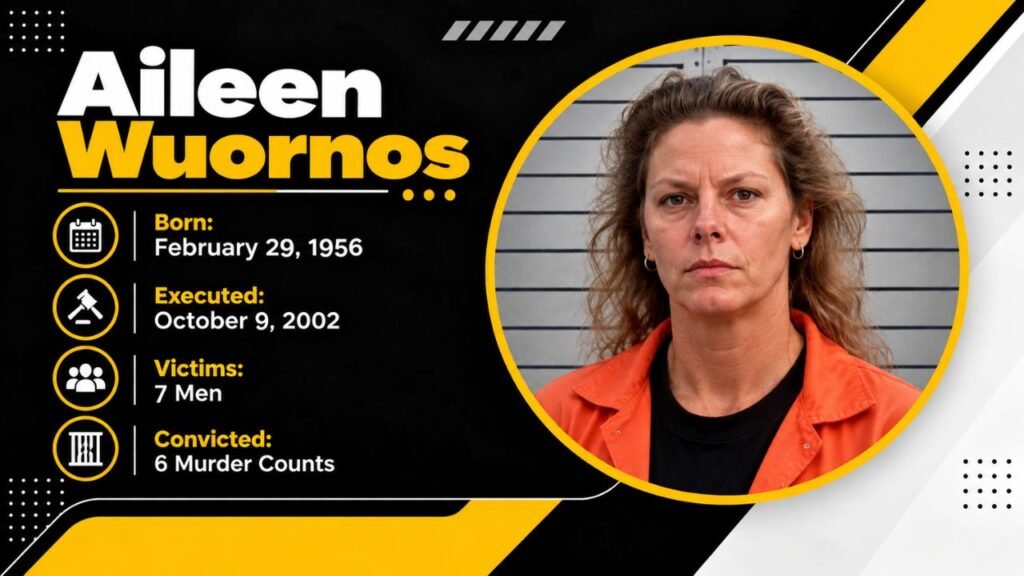
For a brief period in the early 1990s, Aileen Wuornos became one of the most talked-about criminals in America. She was a sex worker in Florida who was convicted of killing men who had picked her up along the state’s highways. She claimed she had acted in self-defense. Prosecutors said the killings were robberies. The debate over which account was true, and what her life said about women, violence and the justice system, has never fully ended.
Wuornos was executed by lethal injection on October 9, 2002, at age 46. Her life became the basis for the Academy Award-winning film Monster (2003), starring Charlize Theron, and it has been the subject of documentaries, television episodes, music and new productions as recently as 2026. This article covers her childhood, the killings, the arrest and trial, her years on death row, the execution and the legacy that followed.
Case Snapshot
| Detail | Information |
| Full name | Aileen Carol Wuornos, born Aileen Carol Pittman |
| Born | February 29, 1956, Rochester, Michigan |
| Died | October 9, 2002, Florida State Prison, Starke, Florida, aged 46 |
| Nickname | “The Damsel of Death” |
| Victims | Seven men, killed between November 1989 and November 1990 |
| Location of crimes | Highways across central Florida and southern Georgia |
| Weapon | High Standard .22 revolver |
| Arrest | January 9, 1991, at a biker bar in Volusia County, Florida |
| Convictions | Murder of Richard Mallory, January 1992; pleas in five other cases |
| Sentence | Six death sentences |
| Execution | Lethal injection, October 9, 2002 |
| Partner | Tyria Moore, girlfriend from 1986 to 1991, who helped secure the confession |
| Film | Monster (2003), starring Charlize Theron, who won the Academy Award for Best Actress |
Latest Updates
Interest in Wuornos has continued into late 2026. Britannica updated its profile of her in October 2026, the 24th anniversary of her execution. Its entry notes a dramatized series called Unmasking a Monster: Aileen Wuornos, which uses AI to recreate her crimes and alter the face of the actress playing her. The production drew attention for its use of technology in a true-crime setting.
Sarah Paulson has also been reported to play Wuornos in an upcoming season of Netflix’s Monster anthology. Netflix released Aileen: Queen of the Serial Killers, a documentary directed by Emily Turner, in 2025. Wikipedia’s page on Wuornos was last edited on November 20, 2026.
Who Was Aileen Wuornos?
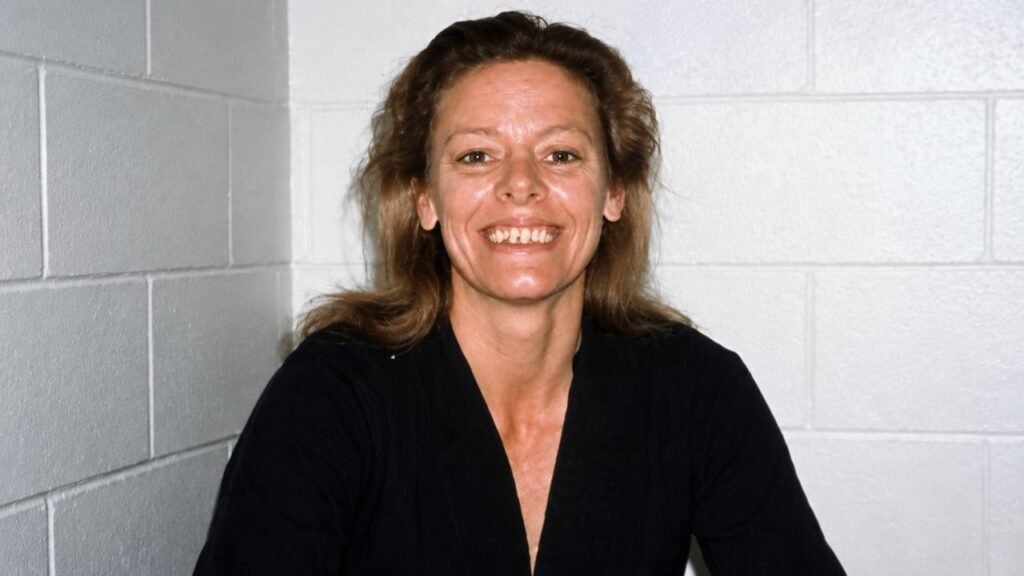
Aileen Carol Pittman was born on February 29, 1956, in Rochester, Michigan. Her teenage parents, Diane Wuornos and Leo Pittman, had married and separated before she was born. Her father was sentenced to life in prison in 1967 for kidnapping and raping a seven-year-old girl. He died by suicide in prison in 1969. Aileen never met him.
When Aileen was about four, her mother left her and her older brother, Keith, in the care of their maternal grandparents, Lauri and Britta Wuornos. The grandparents adopted both children in 1960. Both grandparents had problems with alcohol. Aileen later said her grandfather physically and sexually abused her. She also said she had a sexual relationship with her brother.
Wuornos began trading sex for money, food, cigarettes and drugs while still a child. At about 14, she became pregnant after a rape by a friend of her grandfather. She gave birth in 1971, and the child was given up for adoption. She left home soon after and lived outdoors for much of her youth, turning to prostitution to survive.
Early Criminal Record
Wuornos was arrested in Colorado in 1974 for drunk driving, disorderly conduct and firing a gun from a moving vehicle. Over the following years she was arrested in several states on charges including assault, armed robbery, check forgery and auto theft.
In 1976, she hitchhiked to Florida and married Lewis Gratz Fell, a 69-year-old yacht club president. The marriage ended after about nine weeks. Fell later obtained a restraining order, saying Wuornos had hit him with his own cane. In 1978, at age 22, she tried to kill herself by shooting herself in the stomach. Wikipedia reports that she attempted suicide six times between ages 14 and 22.
Her brother Keith died of esophageal cancer in 1976. Wuornos received $10,000 from his life insurance, and she spent most of it within months.
Tyria Moore and the Move to Florida
In 1986, Wuornos met Tyria Moore, a 24-year-old motel maid, at a gay bar in Daytona Beach. Wuornos was about 30. The two women moved in together, and Wuornos supported them with her earnings from prostitution. Moore later became central to the case when she agreed to help police.
Wuornos’s record in the years that followed included arrests for car theft, resisting arrest, assault and armed robbery. Her associates and law enforcement often described her as erratic and easily angered.
The Seven Killings, 1989 to 1990
Between November 1989 and November 1990, seven middle-aged men were killed along Florida’s highways and in neighboring areas. All were motorists between the ages of about 40 and 65. Their cars were taken, and many of their belongings were later sold at pawnshops.
Richard Charles Mallory, 51, was an electronics store owner from Clearwater. He was the first victim, killed on November 30, 1989. Wuornos said Mallory had raped her, and later claimed she shot him in self-defense. It later emerged that Mallory had been convicted of attempted rape in Maryland. Wuornos did not mention that conviction until her trial, and Moore said she had never heard it from her.
David Andrew Spears, a construction worker from Winter Garden, was reported missing in May 1990. His body was found in Citrus County. Charles Edmund Carskaddon, 40, a part-time rodeo worker, was killed in May 1990 and found in Pasco County. Troy Eugene Burress, 50, a sausage salesman from Ocala, was found in Marion County in August 1990.
Charles Richard “Dick” Humphreys, 56, was a retired Air Force major, former state child abuse investigator and former police chief. His body was found in Marion County in September 1990. Peter Abraham Siems, 65, a retired merchant seaman, left Florida for Arkansas in June 1990. His car was found in July, and his body was never recovered. Walter Gino Antonio, 61, a trucker and reserve police officer, was found in Dixie County in November 1990.
Some sources list slightly different ages for some of the men. Accounts also differ on whether an eighth victim may have been killed in the same period.
Arrest and Confession
In July 1990, Wuornos and Moore abandoned Siems’s car after a crash. A witness described the two women, and police began searching for them. Investigators found items belonging to Mallory at a pawnshop, along with a receipt bearing Wuornos’s thumbprint. More stolen items were traced to her, and her fingerprints matched a print left in Siems’s car.
On January 9, 1991, Wuornos was arrested at a biker bar in Volusia County, Florida, on an outstanding warrant for carrying a concealed weapon. The warrant was issued under the name Lori Grody. Police had already come to regard her as a suspect. They found Moore in Pennsylvania the next day. Moore agreed to help investigators obtain a confession in exchange for immunity from prosecution. She returned to Florida and made calls to Wuornos, pleading for help in clearing her name.
On January 16, 1991, Wuornos confessed. She said the men had tried to rape her and that she had killed them in self-defense.
Trial and Sentence, 1992
Wuornos went on trial for Mallory’s murder in January 1992. Under Florida’s Williams Rule, prosecutors were allowed to introduce evidence of her other crimes to show a pattern. On January 27, 1992, the jury convicted her of Mallory’s murder, with Moore’s testimony playing a key role.
At sentencing, defense psychiatrists testified that Wuornos was mentally unstable and diagnosed her with borderline personality disorder and antisocial personality disorder. Four days later she was sentenced to death.
The defense tried to introduce records showing Mallory’s history of sexual offenses and treatment. The judge refused to admit them, and he denied her request for a retrial.
In March 1992, Wuornos pleaded no contest to the murders of Humphreys, Burress and Spears. She told the court she wanted to “get right with God.” She also said Mallory had raped her, but that the other men had not. Over the next year, she pleaded to Carskaddon’s murder and to Antonio’s murder. In total, she received six death sentences.
Siems’s body was never found, so she was not tried for his death.
Shifting Accounts
Wuornos gave several versions of what happened. At first she said all seven men had raped or attempted to rape her. Later she dropped the self-defense claim and said she had killed for robbery and to leave no witnesses. In a 2001 court petition, she wrote that the motive was robbery in all seven deaths.
In an interview with documentary filmmaker Nick Broomfield, which she believed was not being recorded, she said she had killed Mallory and “some others” in self-defense. She said she had lied to hasten her execution because she could no longer bear life on death row.
Death Row and Execution
Wuornos spent more than a decade on death row, first at the Broward Correctional Institution and later at the Florida State Prison. Her appeal to the U.S. Supreme Court was denied in 1996.
In 2001, Wuornos filed a petition in which she said she wanted to fire her lawyers and end her appeals. She wrote that she had killed the men and would do it again. Her lawyers argued that she was not competent to make that decision. A court-appointed panel of psychiatrists concluded that she was competent.
In 2002, Wuornos complained that prison staff were tampering with her food and mistreating her. Her attorney said she wanted humane treatment until her execution.
Before her execution, she gave interviews to Broomfield. In her final interview, she repeated complaints about her treatment in prison and turned on the filmmaker, saying the system and the media had exploited her story. Her final words on the day of her execution were that she was “sailing with the rock” and would be back.
Wuornos was executed by lethal injection on October 9, 2002. She declined a special last meal and asked only for a cup of coffee. She died at 9:47 a.m. She was the second woman executed in Florida and the tenth in the United States since the Supreme Court restored capital punishment in 1976.
After her death, her body was cremated and her ashes were scattered in Michigan by her childhood friend, Dawn Botkins. At her request, Natalie Merchant’s song “Carnival” from the album Tigerlily was played at her funeral. Wuornos had listened to the album often on death row.
Psychological Assessments
Some specialists have linked Wuornos’s crimes to her personality and her traumatic childhood. Using the Psychopathy Checklist, she scored 32 out of 40. The cutoff for psychopathy is 30. Researchers have also pointed to her childhood sexual abuse, her forced entry into prostitution and her early loss of her mother as factors in her psychological state. Her borderline personality disorder has been linked to her early trauma.
FBI profiler Robert Ressler wrote about Wuornos in his memoir. He noted that female serial killers often kill in sprees rather than sequentially, and he described her as an exception.
Legacy and Public Debate
Wuornos’s case is seen in some feminist circles as an example of a woman who was pushed to violence by abuse and the dangers of street prostitution. Critics of that view argue that the evidence showed robbery and that the men she killed were not attackers. The debate has continued for decades.
Her case has also raised questions about how mental illness is treated in capital cases. Her execution went ahead after psychiatrists found her competent, despite objections from her supporters.
The case’s influence extends to pop culture. Monster (2003) starred Charlize Theron as Wuornos and Christina Ricci as Tyria Moore, and Theron won the Academy Award for Best Actress for the role. Aileen Wuornos: American Boogeywoman (2021), starring Peyton List, depicted a fictional version of her marriage to Lewis Fell. Documentaries by Nick Broomfield, Aileen: The Selling of a Serial Killer (1992) and Aileen: Life and Death of a Serial Killer (2003), remain among the most cited. An opera, Wuornos, premiered in San Francisco in 2001. Musicians including Jewel, It Dies Today and Lingua Ignota have written about her, and Cardi B recreated her mugshot in her 2019 single “Press.”
Timeline
| Date | Event |
| February 29, 1956 | Aileen Carol Pittman born in Rochester, Michigan |
| 1960 | Mother leaves; Aileen and brother Keith adopted by maternal grandparents |
| 1967 | Father sentenced to life in prison for rape of a seven-year-old |
| 1970 | Becomes pregnant at about 14 after a rape |
| 1971 | Gives birth; child placed for adoption |
| 1974 | Arrested in Colorado on driving and weapons charges |
| 1976 | Marries Lewis Gratz Fell in Florida; marriage ends after nine weeks |
| 1978 | Attempts suicide by shooting herself |
| 1986 | Meets Tyria Moore in Daytona Beach |
| November 30, 1989 | Richard Mallory killed |
| 1989 to 1990 | Six more men killed along Florida highways |
| July 1990 | Car abandoned after crash; police begin tracing items |
| January 9, 1991 | Arrested at a biker bar in Volusia County |
| January 16, 1991 | Confesses, claiming self-defense |
| January 27, 1992 | Convicted of Mallory’s murder |
| March 1992 | Pleads no contest to three murders |
| 1992 to 1993 | Pleads to further murders; receives six death sentences |
| 1996 | U.S. Supreme Court denies her appeal |
| 2001 | Files petition dropping appeals |
| October 9, 2002 | Executed by lethal injection in Florida |
| 2003 | Monster released; Broomfield’s second documentary released |
| 2025 | Netflix documentary Aileen: Queen of the Serial Killers released |
| 2026 | Unmasking a Monster: Aileen Wuornos dramatization released |
Check Also: Frank Lucas | Nancy Guthrie | Jeffrey Dahmer | Lindsay Clancy | Matthew Farwell | Scott Colom | Dana White
Frequently Asked Questions
She was an American serial killer who murdered seven men along Florida highways between 1989 and 1990, while working as a sex worker.
She was convicted of six murders and pleaded no contest to some others. Prosecutors say she killed seven men in total, though one body was never found.
On October 9, 2002, by lethal injection.
She claimed she killed the men in self-defense after they assaulted her. She later said the killings were for robbery.
Wuornos’s girlfriend from 1986 to 1991. Moore agreed to help police get a confession in exchange for immunity.
Yes. She had a son in 1971 at about age 14 and gave him up for adoption.
Her body was cremated, and her ashes were scattered in Michigan by her childhood friend, Dawn Botkins.