Few criminal cases have shaped American horror as deeply as the case of Ed Gein. The quiet farmhouse handyman from Plainfield, Wisconsin, was arrested in November 1957 after the disappearance of a hardware store owner. What investigators found on his property shocked the country, and the case has since inspired films such as Psycho, The Texas Chain Saw Massacre and The Silence of the Lambs.
Gein was never convicted of the murders he was suspected of committing in the 1940s and 1950s. He was found guilty of one murder in 1968 but was declared not guilty by reason of insanity. He spent the rest of his life in psychiatric hospitals and died on July 26, 1984. This article covers his early life, the grave robberies, the two murders he confessed to, the arrest, the trial, the disappearances he was linked to, his death and his lasting place in popular culture.
Case Snapshot
| Detail | Information |
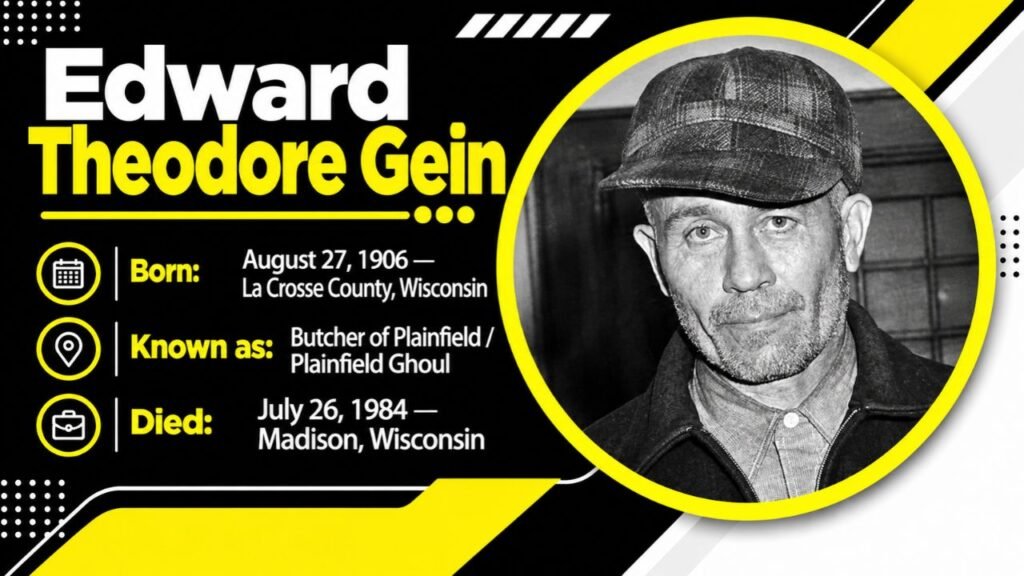
| Full name | Edward Theodore Gein |
| Born | August 27, 1906, La Crosse County, Wisconsin |
| Died | July 26, 1984, aged 77, Mendota Mental Health Institute, Madison, Wisconsin |
| Cause of death | Respiratory failure caused by lung cancer |
| Home | Isolated farm in Plainfield, Wisconsin |
| Confessed murders | Mary Hogan (December 1954) and Bernice Worden (November 1957) |
| Grave robberies | At least nine graves, between 1947 and 1955 |
| Arrest | November 1957, Plainfield |
| Trial | November 1968; guilty of first-degree murder, then found not guilty by reason of insanity |
| Diagnosis | Chronic schizophrenia; psychiatrists also described necrophilic fetishism and psychopathy |
| Nicknames | “Butcher of Plainfield,” “Plainfield Ghoul” |
| Burial | Plainfield Cemetery, next to his mother |
| Film inspirations | Psycho (1960), The Texas Chain Saw Massacre (1974), The Silence of the Lambs (1991) |
Latest Updates
Interest in Gein has returned in recent years. Ryan Murphy’s Netflix series Monster: The Ed Gein Story (2025) brought his story to a new audience, and it continues to be one of the most-watched true-crime productions about him. Gein’s grave in Plainfield remains unmarked after his original headstone was repeatedly damaged and stolen by souvenir hunters. Local officials have discouraged visitors from treating the site as a tourist attraction.
Who Was Ed Gein?
Edward Theodore Gein was born on August 27, 1906, in La Crosse County, Wisconsin. He grew up in a household that his later psychiatrists described as deeply dysfunctional. His father, George Gein, was an alcoholic who struggled to hold a steady job. His mother, Augusta Gein, was a domineering and fiercely religious woman who believed the world was evil and that women, apart from herself, were sinners.
To protect Ed and his older brother, Henry, from outside influence, Augusta moved the family to an isolated farm in Plainfield. Ed was allowed to leave the property only to attend school, and he was discouraged from making friends.
Family Deaths and Breakdown
The family’s isolation deepened through a series of deaths. George Gein died of heart failure in 1940, leaving Augusta in full control of the household. In 1944, Henry died in a brush fire near the farm. He had bruises on his head, and Ed led police to the body. Authorities ruled the death an accidental asphyxiation.
Augusta suffered a series of strokes and died in December 1945. Ed was left alone in the farmhouse. He closed off the upstairs bedrooms and the parlor his mother had used, keeping them as a shrine. He lived in squalor in a small room next to the kitchen.
Grave Robberies, 1947 to 1955
Alone and isolated, Gein began reading true-crime magazines, adventure stories and books on anatomy. Between 1947 and 1955, investigators say he made roughly 40 nighttime visits to local cemeteries.
He read local obituaries to find recently buried middle-aged women who resembled his mother. He dug up at least nine graves and took whole bodies or parts of them back to his farm. Investigators later found objects and clothing made from human remains inside the house. Gein’s psychiatrists said he wanted to become a woman, and to bring his mother back to life by wearing parts of other women.
The Murders
Gein confessed to killing two women. Mary Hogan, a 51-year-old tavern owner from nearby Pine Grove, disappeared from her bar on December 8, 1954. Police found blood and a spent shell casing at the scene but no body. Gein later admitted he had shot her and dragged her body back to the farm on a sled.
On November 16, 1957, Bernice Worden, 58, disappeared from her hardware store in Plainfield. Her son, Deputy Sheriff Frank Worden, went to the shop and found the cash register missing and blood on the floor.
The Arrest, November 1957
A sales receipt from the hardware store showed that the last customer had bought antifreeze. Witnesses also recalled seeing Gein near the store the night before. Police arrested him that evening and searched his property.
In a shed on the farm, officers found Bernice Worden’s body. Inside the farmhouse, which had no electricity, investigators searched by flashlight and found the remains of other people, along with garbage piled high and objects made from human bodies. Mary Hogan’s remains were also found.
After first staying silent, Gein confessed to killing Worden and Hogan, and to digging up bodies from local cemeteries. He was also investigated for seven other disappearances in the region, though no physical evidence ever tied him to them.
The Disappearances Linked to Gein
Investigators examined several other disappearances between 1947 and 1957, which some accounts link to Gein. None of these cases led to charges.
| Name | Date missing | Location | Why he was suspected |
| Georgia Weckler, 8 | May 1, 1947 | Fort Atkinson, Wisconsin | Vanished after being dropped off near her home; a dark sedan similar to Gein’s was reported nearby |
| Victor Travis and Raymond Burgess | November 1952 | Plainfield area | Two hunters who visited a tavern near Gein’s farm vanished; neither they nor their car were found |
| Evelyn Hartley, 15 | October 1953 | La Crosse, Wisconsin | Vanished while babysitting; bloodied items were found, and Gein was in La Crosse that week |
Other cases in the region have been attributed to Gein in some accounts, but the records are incomplete. Gein is reported to have denied involvement in them.
The Trial and Institutionalization
In 1958, psychiatrists diagnosed Gein with chronic schizophrenia and found him unfit to stand trial. He was committed to the Central State Hospital for the Criminally Insane in Waupun, Wisconsin.
In March 1958, shortly before the farm was scheduled to be auctioned, the farmhouse was destroyed by a fire. Local residents suspected a neighbor, who may have wanted to prevent the site from attracting morbid visitors.
Ten years after his arrest, doctors found Gein mentally fit for trial. To save state money, prosecutors tried him only for Bernice Worden’s murder. In November 1968, Judge Robert H. Gollmar found him guilty of first-degree murder. In a second phase, the court ruled him not guilty by reason of insanity and returned him to psychiatric confinement.
Psychological Profile
Psychiatrists who examined Gein over nearly three decades described a man shaped by his mother’s teachings. Augusta forced him to read the Bible daily, focusing on verses about sin and death, and told him that women were instruments of the devil. Psychiatrists said this created a split in which he both worshipped and feared women.
Gein denied having sex with the bodies he took, describing them as too foul-smelling. Psychiatrists said his main motive was a desire to take on a woman’s identity. They diagnosed chronic undifferentiated schizophrenia, along with necrophilic fetishism, which is an attraction to corpses without sexual acts, and psychopathy. Once he was separated from his mother’s shrine and given antipsychotic medication, his violent urges were reported to have diminished.
A Quiet Life in the Town
Before his arrest, Gein was known to his neighbors as a shy and soft-spoken man. Parents hired him to babysit their children, and some children later recalled strange stories he told them about shrunken heads he said were sent to him from the South Seas. Those heads were, in fact, human faces taken from graves.
Gein had no steady job after his mother’s death. He lived on federal farm subsidies and did handyman work, carpentry and field labor for neighbors. Shortly before his arrest, when residents talked about the missing tavern owner, Mary Hogan, he is reported to have joked that she was “up at the house right now.” People laughed at the remark, assuming it was awkward small-town humor.
The Possessions and the Car
After the arrest, the human remains and the items made from them were seized by the state. After the 1968 trial, they were destroyed or buried in undisclosed locations.
In March 1958, authorities auctioned off some of Gein’s personal property. His 1949 Ford sedan, which he had used to transport bodies, was bought for $760 by a carnival showman named Bunny Gibbons. Gibbons charged visitors to see the car, known as the “Ed Gein Ghoul Car,” until public outrage led authorities to close the exhibit.
After the farmhouse burned, the land was sold. Today the site is private timberland with no trace of the original buildings.
Gein’s Death
Gein was a quiet and compliant patient for the rest of his life. He was moved to the Mendota Mental Health Institute in Madison, Wisconsin. On July 26, 1984, at age 77, he died of respiratory failure caused by lung cancer.
He was buried next to his mother in Plainfield Cemetery. His headstone was repeatedly chipped away and eventually stolen by souvenir hunters, and the grave today is unmarked.
Cultural Legacy
Gein’s crimes helped move American horror away from supernatural monsters and toward real-world psychological terror. Several well-known fictional characters have been linked to him:
- Norman Bates, in Psycho (1960), was inspired by Gein’s devotion to his dead mother and his preservation of her rooms.
- Leatherface, in The Texas Chain Saw Massacre (1974), was inspired by Gein’s habit of wearing masks made from human skin.
- Buffalo Bill, in The Silence of the Lambs (1991), was modeled partly on Gein’s effort to make a suit from skin.
Gein’s life remains a major subject of true-crime programming, including Ryan Murphy’s 2025 Netflix series Monster: The Ed Gein Story.
Timeline
| Date | Event |
| August 27, 1906 | Edward Theodore Gein born in La Crosse County, Wisconsin |
| 1940 | Father George Gein dies |
| 1944 | Brother Henry dies in a brush fire; death ruled accidental |
| December 1945 | Mother Augusta dies; Gein closes off her rooms |
| 1947 to 1955 | Roughly 40 nighttime visits to cemeteries; at least nine graves disturbed |
| December 8, 1954 | Mary Hogan disappears from her tavern |
| November 16, 1957 | Bernice Worden disappears from her hardware store |
| November 1957 | Gein arrested after receipt and witness leads |
| 1958 | Declared unfit for trial; committed to Waupun; farmhouse burns in March |
| November 1968 | Found guilty of Worden’s murder; then found not guilty by reason of insanity |
| July 26, 1984 | Dies at Mendota Mental Health Institute, aged 77 |
| 2025 | Netflix series Monster: The Ed Gein Story released |
Why the Case Still Resonates
● The contrast with his image. Neighbors saw a harmless handyman who babysat their children. The reality was far darker.
● The line between fact and fiction. His crimes inspired some of the most famous villains in film, which keeps his name in popular culture.
● The unanswered questions. Gein was linked to several disappearances, but no further charges were ever brought.
● The psychology. His case is still cited in discussions of how isolation and religious extremism can shape a damaged mind.
Check Also: Frank Lucas | Nancy Guthrie | Jeffrey Dahmer | Lindsay Clancy | Matthew Farwell | Scott Colom | Dana White
Frequently Asked Questions
He was a Wisconsin farmhand and handyman who committed grave robberies and two murders in the 1950s, and who inspired several famous horror films.
He confessed to two murders, Mary Hogan and Bernice Worden. He was suspected in several other disappearances, but no further charges were filed.
He was found guilty of Bernice Worden’s murder in 1968. He was then declared not guilty by reason of insanity.
At the Mendota Mental Health Institute in Madison, Wisconsin, on July 26, 1984.
In Plainfield Cemetery, next to his mother. His headstone was stolen, and the grave is unmarked.
The name comes from his grave robberies and the objects found at his farm.
Psycho (Norman Bates), The Texas Chain Saw Massacre (Leatherface) and The Silence of the Lambs (Buffalo Bill).
Yes. Monster: The Ed Gein Story was released in 2025 as part of Ryan Murphy’s Monster anthology.
No. The remains and objects made from them were destroyed or buried after the trial.