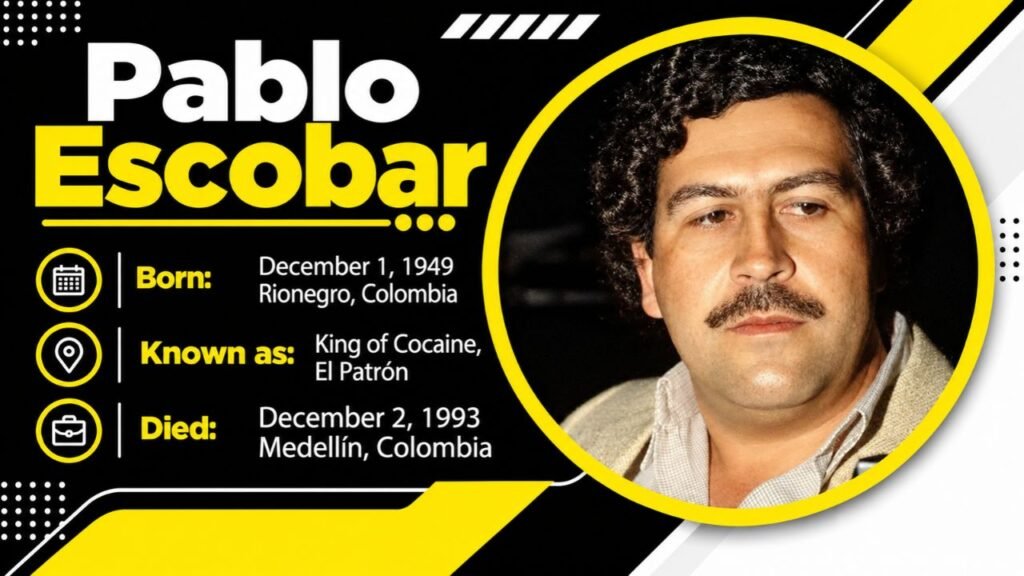
Few criminals in modern history have become as famous as Pablo Escobar. Born in Rionegro, Colombia, on December 1, 1949, he rose from a poor family in Medellín to lead the Medellín Cartel, the criminal organization that dominated the cocaine trade into the United States in the 1980s and early 1990s. He was known as the “King of Cocaine,” and at his peak he was estimated to be one of the wealthiest criminals in the world. He was also responsible for a long campaign of bombings, assassinations and attacks on the state.
Escobar was killed on December 2, 1993, a day after his 44th birthday, when Colombian forces tracked him to a house in Medellín. More than three decades later, his name still draws books, films, television series and music. This article covers his early life, the rise of the cartel, his wealth and politics, his war with the Colombian state, his prison and escape, his death and the family he left behind.
Case Snapshot
| Detail | Information |
| Full name | Pablo Emilio Escobar Gaviria |
| Born | December 1, 1949, Rionegro, Antioquia, Colombia |
| Died | December 2, 1993, Medellín, Colombia, aged 44 |
| Cause of death | Gunshot wound during a police raid; some speculated he took his own life |
| Known as | King of Cocaine, El Patrón, Paisa Robin Hood |
| Organization | Medellín Cartel, which he helped found in the mid-1970s |
| Political role | Alternate member of the Colombian Chamber of Representatives, 1982 to 1983 |
| Estimated wealth | Between $25 billion and $30 billion at his peak, according to varying estimates |
| Estate | Hacienda Nápoles, a large ranch in Antioquia that became a theme park |
| Prison | La Catedral, a luxury prison he helped design, from June 1991 to July 1992 |
| Spouse | María Victoria Henao, married 1976 |
| Children | Juan Pablo Escobar, now Sebastián Marroquín, and Manuela Escobar |
| Burial | Monte Sacro Cemetery, Itagüí |
Latest Updates, November 2026
Interest in Escobar has stayed high this year. Britannica updated its profile on November 19, 2026. A TV miniseries called Dear Killer Nannies was released in 2026. It is based on the books of Escobar’s son, Juan Pablo, and the title refers to the cartel hitmen who acted as “nannies” for the children. Those books include Pablo Escobar, My Father, which Juan Pablo published in 2014 under his birth name.
In mid-November, a Toronto Star reporter examined whether Ryan Wedding, a Canadian figure linked to international drug trafficking, could be considered the new Pablo Escobar. The comparison reflects how often Escobar is used as the benchmark for modern drug kingpins.
Who Was Pablo Escobar?
Escobar was born in Rionegro and raised in Envigado and Medellín. His father was a small farmer and his mother was a schoolteacher. He was the third of seven children, and the family grew up in poverty.
He studied briefly at the Universidad Autónoma Latinoamericana in Medellín but left without a degree. He began his criminal life early. He sold illegal cigarettes and fake lottery tickets, stole tombstones, sandblasted the inscriptions and resold them, and joined gangs that stole cars. His first arrest came in 1974, after a car theft.
Escobar was also a skilled organizer. Later accounts describe a leader who kept tight control over his network, and who used kidnappings and ransoms to build early funds. His most famous kidnapping victim was businessman Diego Echavarría, who was kidnapped and killed in 1971. Escobar received a $50,000 ransom from the Echavarría family before the crime ended in murder.
The Rise of the Medellín Cartel
Escobar began working with drug smugglers in the early 1970s, and the cocaine trade grew quickly in Colombia thanks to the country’s location near Peru, Ecuador and Bolivia, which were major coca-growing nations. He was arrested in May 1976 on his return from Ecuador, when agents found 39 kilograms of cocaine in the spare tire of his car. He was released after he bribed a judge. The agent who had arrested him was assassinated the following year.
In 1976, Escobar founded the organization that became known as the Medellín Cartel. The group distributed powder cocaine and set up smuggling routes from Peru, Bolivia and Ecuador through Colombia and into the United States. The cartel’s partners included the Ochoa brothers, Juan David, Jorge Luis and Fabio, and co-founder Carlos Lehder.
Demand in the United States grew quickly. By the 1980s, the cartel was estimated to be moving 70 to 80 tons of cocaine into the United States each month. Escobar used a Bahamian island called Norman’s Cay as a trans-shipment point from 1978 to 1982, with an airstrip and a warehouse for storing cocaine.
Escobar’s style was described in Colombia with the phrase “plata o plomo,” meaning silver or lead. Officials and politicians could accept bribes, or be killed. Escobar’s organization also bribed political candidates from both the Liberal and Conservative parties.
A U.S. Drug Enforcement Administration official once compared Escobar’s impact on cocaine to Henry Ford’s impact on the automobile, a comparison that captured how thoroughly he shaped the industry.
Wealth, Hacienda Nápoles and Public Image
Escobar’s fortune was among the largest ever attributed to a criminal. Britannica estimates his net worth at about $25 billion. Wikipedia puts it at about $30 billion by the time of his death. At its peak, the cartel was reportedly earning about $420 million a week.
His wealth was so large that he struggled to manage it. His brother estimated that about 10 percent of the fortune, roughly $2.1 billion, was lost each year to rats, weather and misplaced cash.
His main property was Hacienda Nápoles, a ranch in Antioquia named after Naples, Italy. It covered about 7,000 acres and reportedly cost $63 million. It had a soccer field, dinosaur statues, artificial lakes, a bullfighting arena, an airstrip, a tennis court and a zoo with giraffes, hippos and camels.
Escobar also cultivated a public image as a benefactor of the poors. He funded housing, parks, football stadiums, schools, hospitals and churches in Medellín’s poorest neighborhoods. That work earned him the nickname “Paisa Robin Hood” and a loyal following among many Colombians.
Politics and War With the State
In 1982, Escobar won election as an alternate member of Colombia’s Chamber of Representatives for the Liberal Party. The seat gave him parliamentary immunity and a diplomatic passport. His political career was short. Justice Minister Rodrigo Lara Bonilla attacked him in Congress, and Liberal leader Luis Carlos Galán expelled him from the party. Escobar announced his retirement from politics in January 1984, and Lara Bonilla was murdered three months later.
The cartel’s violence reached far beyond politics. It targeted judges, police officers, government officials and civilians. Escobar was blamed for the murder of presidential candidate Galán in August 1989. In November 1985, the M-19 guerrilla group attacked the Palace of Justice in Bogotá. Escobar was later reported to have financed the operation, and the siege killed 98 people, including nearly half of the Supreme Court justices.
The most deadly attack was the bombing of Avianca Flight 203 in November 1989. The bomb was meant to kill César Gaviria, Galán’s successor, who missed the flight. All 107 people on board were killed. Two Americans were among the dead, and that led the U.S. government to intervene more directly in the war against the cartel.
Escobar also offered a deal to the government. He proposed a conditional surrender without extradition to the United States. He reportedly offered to pay off Colombia’s national debt of about $10 billion if he was exempt from extradition. He was reported to have said he would rather have a grave in Colombia than a cell in the United States.
La Catedral and the 1992 Escape
In June 1991, on the same day the Colombian Congress voted to forbid extradition in the new constitution, Escobar surrendered. He was sentenced to five years on a range of charges. The government agreed to house him in a prison of his own design, La Catedral, which he helped build.
La Catedral was a luxury facility. It had a nightclub, sauna, waterfall, soccer field, telephones, computers and fax machines. Reports of his continued criminal activity from inside the prison led the government to plan a transfer to a more conventional jail on July 22, 1992. Escobar learned of the plan in advance and escaped before it could take place.
After the escape, the government launched a nationwide manhunt, reportedly with help from U.S. officials and from rival traffickers. Escobar spent the rest of his life on the run. The Medellín Cartel began to fall apart, and the cocaine market in the mid-1990s came to be dominated by the rival Cali Cartel until its own leaders were killed or captured.
Death in Medellín, December 1993
On December 1, 1993, Escobar celebrated his 44th birthday. The next day, Colombian special forces located his hideout in a middle-class neighborhood of Medellín. Investigators had traced him through a phone call he made to his family, using technology provided by the United States.
When police moved in, a gunfight broke out. Escobar and a bodyguard ran to the roof, where the chase ended. Escobar was shot in the torso, legs and head. He died on December 2, 1993, aged 44. Some accounts have argued he took his own life, which remains a point of debate. The Medellín Cartel collapsed soon after.
More than 25,000 people attended his funeral, many of them poor residents who had benefited from his charity. Some still consider him a saint and pray to him. He was buried at Monte Sacro Cemetery in Itagüí.
Family After Escobar
Escobar married María Victoria Henao in March 1976. She was 15 at the time, and he was 26. The family did not approve, and the pair eloped. They had two children, Juan Pablo and Manuela.
After Escobar’s death, his widow and children fled Colombia in 1995. They went first to Mozambique, then to Brazil, and then to Argentina. Juan Pablo took the name Sebastián Marroquín. He has spoken publicly against his father’s violence and has sought forgiveness from the families of his father’s victims. His documentary Sins of My Father (2009) followed his effort to seek forgiveness from the sons of Rodrigo Lara Bonilla and Luis Carlos Galán.
María Victoria Henao, who now uses the name María Isabel Santos Caballero, lived under her new identity in Buenos Aires. She wrote My Life and Prison with Pablo Escobar (2018). In June 2018, an Argentine federal judge accused her and her son of money laundering with two Colombian traffickers and ordered the seizure of about $1 million in assets from each.
Escobar’s sister, Luz María Escobar, has tried to make amends for her brother’s crimes, including public statements, letters left on victims’ graves and a memorial for his victims on the 20th anniversary of his death. Escobar’s body was exhumed in 2006 for a DNA test to confirm the paternity of an illegitimate child.
Hacienda Nápoles and the Hippos
After Escobar’s death, the government seized his estate at Hacienda Nápoles under a law called Extinción de Dominio, or domain extinction, and gave much of the land to low-income families. The property was converted into a theme park surrounded by four luxury hotels overlooking the zoo.
The estate’s hippos became one of the strangest parts of the Escobar legacy. He kept four hippos in a private menagerie. After his death, they were too difficult to move, so they were left on the property. By 2007, the population had grown to 16 and the animals were roaming the nearby Magdalena River. By early 2014, around 40 were reported in the region. In 2021, the Colombian government began a program to chemically sterilize them.
Other Traces of the Cartel
Escobar’s luxury homes stretched beyond Colombia. He owned a waterfront mansion in Miami Beach, Florida, at 5860 North Bay Road. The U.S. government seized the property in the 1980s. Later owners searched the house for Escobar-related items. He also owned a Caribbean getaway on Isla Grande, in the Islas del Rosario near Cartagena. It was later partly demolished and overtaken by vegetation.
On February 22, 2019, Medellín authorities demolished the six-story Edificio Mónaco apartment complex in El Poblado. The building had been built for Escobar’s wife, and it was gutted by a car bomb in 1988 from the Cali Cartel. It had stood empty since then and attracted tourists interested in Escobar’s history. Mayor Federico Gutiérrez wanted to replace it with a park honoring the thousands of victims of the cartel, and President Iván Duque said the demolition meant history would be remembered through the victims.
Escobar in Culture
Escobar has inspired many books, films and TV series. Among the best-known books are Roberto Escobar’s Escobar, Guy Gugliotta’s Kings of Cocaine and Mark Bowden’s Killing Pablo, which describes the hunt for him. Juan Pablo’s Pablo Escobar: My Father and Virginia Vallejo’s Loving Pablo, Hating Escobar offer personal accounts.
Films and television have treated him in many ways. Blow (2001) featured Cliff Curtis as Escobar. Loving Pablo (2017) starred Javier Bardem. American Made (2017) included a version of him. Colombian series such as Pablo Escobar: El Patrón del Mal (2012) also covered his story. The Netflix series Narcos, which premiered in 2015, starred Wagner Moura as Escobar. Documentaries include Cocaine Hippos, Countdown to Death: Pablo Escobar and Killing Escobar.
Escobar also appears in music. E-40’s “Pablo” (2013), Kanye West’s album The Life of Pablo (2016), and Tame Impala’s “Dracula” (2025) all refer to him.
Timeline
| Date | Event |
| December 1, 1949 | Pablo Escobar born in Rionegro, Colombia |
| 1966 to 1968 | Drops out of high school, returns and leaves again |
| 1971 | Kidnapping of Diego Echavarría; ransom paid, then murder |
| 1974 | First arrest, for car theft |
| May 1976 | Arrested in Medellín with 39 kilograms of cocaine; later released after bribery |
| 1976 | Founds the Medellín Cartel; marries María Victoria Henao |
| 1978 to 1982 | Uses Norman’s Cay in the Bahamas as a trans-shipment point |
| 1982 | Elected alternate member of Colombia’s Chamber of Representatives |
| January 1984 | Announces retirement from politics |
| 1984 | Justice Minister Rodrigo Lara Bonilla murdered |
| November 1985 | Palace of Justice siege in Bogotá; 98 people killed |
| August 18, 1989 | Presidential candidate Luis Carlos Galán assassinated |
| November 1989 | Avianca Flight 203 bombed; 107 people killed |
| June 1991 | Surrenders; the constitution forbids extradition the same day |
| July 22, 1992 | Escapes before transfer from La Catedral |
| December 1, 1993 | Celebrates his 44th birthday |
| December 2, 1993 | Killed in a gunfight on a Medellín rooftop |
| 1995 | Family leaves Colombia and settles in Argentina |
| 2006 | Body exhumed for DNA test |
| 2009 | Sins of My Father documentary released |
| February 22, 2019 | Edificio Mónaco demolished |
| 2021 | Government begins sterilizing the hippos |
| 2026 | Dear Killer Nannies miniseries released |
Why the Story Still Resonates
● The scale of the wealth. Estimates of Escobar’s fortune run from $25 billion to $30 billion, and the detail that he lost billions to rats and decay has become part of his legend.
● The contrast with the image. He built schools and housing for the poors while ordering bombings and killings, which is why opinions in Colombia remain divided.
● The aftermath. His family, the Hacienda Nápoles theme park, the hippos and the demolished building all keep his story visible.
● Modern comparisons. Journalists still use his name when they describe drug kingpins today.
Check Also: Frank Lucas | Nancy Guthrie | Jeffrey Dahmer | Lindsay Clancy | Matthew Farwell | Scott Colom | Dana White
Frequently Asked Questions
He was a Colombian drug lord who founded and led the Medellín Cartel, which dominated the cocaine trade into the United States in the 1980s and early 1990s.
He was shot during a police raid on a Medellín rooftop on December 2, 1993. Some accounts suggest he took his own life, but that remains debated.
Yes. He married María Victoria Henao in 1976 and had two children, Juan Pablo and Manuela.
At Monte Sacro Cemetery in Itagüí, Colombia.
He was elected as an alternate member of Colombia’s Chamber of Representatives in 1982. He left politics in 1984 after being expelled from the Liberal Party.
Yes. Netflix’s Narcos starred Wagner Moura as Escobar, and a 2026 miniseries, Dear Killer Nannies, was based on his son’s books.
A rival drug organization that dominated the cocaine market after the Medellín Cartel collapsed in the mid-1990s.