For decades, the name Frank Lucas belonged mostly to Harlem’s older generation. Then Ridley Scott’s 2007 film American Gangster put his story on screens around the world. Denzel Washington played a disciplined, almost business like drug kingpin, and Russell Crowe played the detective who hunted him. The film made Lucas a household name, but the real man was far more violent, far less polished and far harder to pin down than the character on screen.
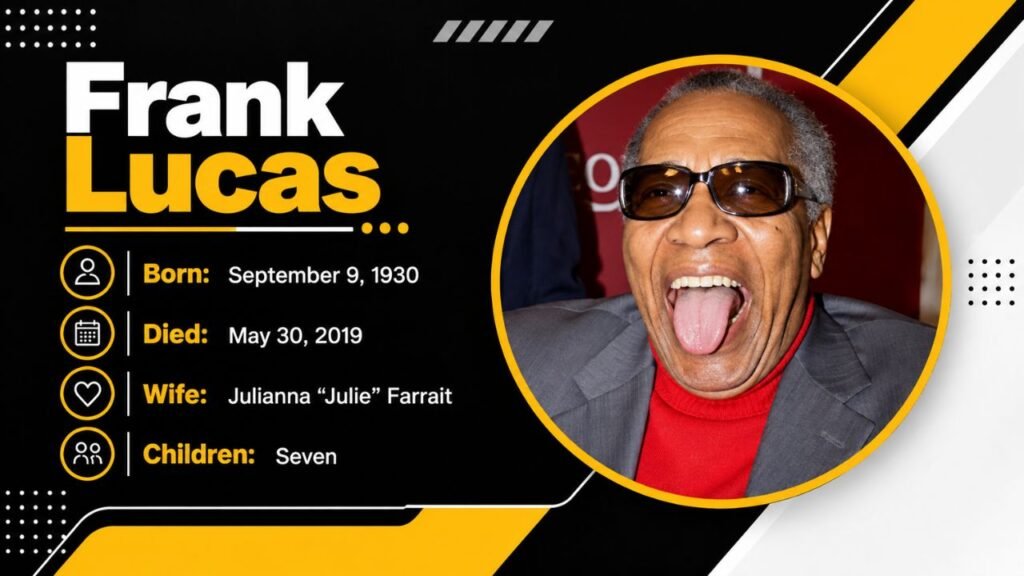
Lucas built a heroin business in the late 1960s and early 1970s by cutting out the Italian Mafia middlemen and bringing high-purity heroin directly from Southeast Asia. He marketed the product as “Blue Magic.” He was eventually convicted and sentenced to 70 years in prison, then turned government informant, helping convict more than 100 people. He died on May 30, 2019, at age 88. This article covers the real story of his rise and fall, the people around him, the NYPD corruption scandal that surrounded his case, and where the movie departs from the record.
Case Snapshot
| Detail | Information |
| Full name | Frank Lucas |
| Born | September 9, 1930, La Grange, North Carolina |
| Raised | Greensboro, North Carolina |
| Died | May 30, 2019, Cedar Grove, New Jersey, at age 88 |
| Known for | Heroin trafficking in Harlem and the East Coast, 1968 to 1975 |
| Brand | “Blue Magic,” marketed as 98 to 100 percent pure heroin |
| Mentor | Ellsworth “Bumpy” Johnson, Harlem crime boss |
| Key associates | Leslie “Ike” Atkinson, Vernon Lucas and other brothers, known as “The Country Boys” |
| Wife | Julie Farrait, originally from Puerto Rico |
| Arrest and raid | January 1975, Teaneck, New Jersey |
| Sentence | 70 years in prison, 1976 |
| Cooperation | Became a government informant; credited with more than 100 convictions |
| Second conviction | 1984, for attempting to trade heroin and cash; seven-year sentence |
| Final release | 1991 |
| Film | American Gangster (2007), directed by Ridley Scott, starring Denzel Washington and Russell Crowe |
Who Was Frank Lucas?
Frank Lucas was born in La Grange, North Carolina, on September 9, 1930, to Fred and Mahalee Lucas. The family was poor, and he grew up in Greensboro. Lucas later said that, as a boy, he watched the Ku Klux Klan murder his 12-year-old cousin, Obediah, for looking at a white woman. He said the event left him with a lifelong hatred of authority and the law.
As a teenager, Lucas turned to petty theft and robbery. Around age 15 or 16, he attacked a former employer over an affair with the man’s daughter. He hit the man in the head with a pipe, stole $400 from the safe and set the business on fire. His mother urged him to leave for New York City, fearing he would be lynched or sent to prison for life.
He arrived in Harlem in the late 1940s. He survived through pool hustling, burglary and armed robbery of local bars and shops. He eventually came under the wing of Ellsworth “Bumpy” Johnson, the most powerful Black gangster in Harlem, who controlled illegal gambling and narcotics in partnership with the Italian Mafia.
Lucas later claimed he had been Johnson’s personal driver and right-hand man for 15 years, and that he was at Johnson’s side when Johnson died of a heart attack in 1968. Historians and Johnson’s widow, Mayme Hatcher Johnson, disputed that account. Johnson was imprisoned at Alcatraz from 1954 to 1963, which makes a continuous 15-year partnership impossible. In her memoir, Harlem Godfather, Mayme Johnson said Lucas was a low-level enforcer and errand runner, and that “Flash” Walker was Bumpy’s real confidant.
The Blue Magic Empire, 1968 to 1975
When Bumpy Johnson died in 1968, Harlem’s drug trade was left without a dominant figure. Lucas moved to fill the gap by changing how heroin reached New York.
At the time, the Italian Mafia controlled the so-called French Connection. It imported heroin from Turkey, diluted it and sold it to Black dealers at inflated prices. Lucas bypassed that system by sourcing heroin directly from the opium producers of Southeast Asia’s Golden Triangle, which includes Thailand, Laos and Burma.
His key partner was Leslie “Ike” Atkinson, a former U.S. Army master sergeant and a relative by marriage. Atkinson ran Jack’s American Star Bar in Bangkok and had contacts within the American military in Vietnam and Thailand. Lucas traveled to Bangkok to meet him.
The most famous story about the operation is the “cadaver connection.” Lucas claimed he had a carpenter in North Carolina build 28 replicas of U.S. military coffins with false bottoms, and that 6 to 8 kilograms of heroin were hidden beneath the bodies of soldiers flown home from Vietnam. Atkinson and DEA agent Charles Lutz both denied the coffin story. Atkinson said he hid the heroin inside hollowed-out teakwood furniture and in the luggage of returning soldiers who owed him gambling debts.
The product was sold as Blue Magic. Street heroin in Harlem usually tested at 5 to 10 percent purity. Blue Magic was 98 to 100 percent pure. Because Lucas had removed the Mafia markups, he could sell better heroin for less, and he quickly took over the Harlem and New Jersey markets. Lucas later claimed he earned as much as $1 million a day at his peak. Officials also linked the higher purity to a sharp rise in overdose deaths in New York.
Lucas did not trust New York criminals. He relied instead on his brothers and cousins from North Carolina, known as “The Country Boys,” to run his stash houses and distribution. Those houses were guarded by armed relatives. Lucas also required female workers in the cutting and packaging operation to work completely naked, so they could not steal product in their clothing.
The Violence Behind the Legend
Federal prosecutors and NYPD detectives who investigated Lucas described a ruthless operator who was willing to use lethal violence to protect his business. They said he ordered the killings of suspected informants and disloyal associates.
The movie includes one famous murder, in which Lucas shoots a rival in front of a crowd. The real case is less clear. Harlem gangster Charles “Tango” Butler was murdered, but Lucas was never proven to be the shooter, and he did not carry out a public execution like the one in the film.
Lucas also kept no written ledgers. He was illiterate until he learned to read and write in prison. He tracked millions of dollars in cash, kilogram weights, buyer debts and offshore balances in his head and relied on his brothers for paperwork.
Downfall, Raid and Prosecution, 1971 to 1976
Lucas’s lifestyle drew attention he could not afford. On March 8, 1971, he attended the “Fight of the Century” between Muhammad Ali and Joe Frazier at Madison Square Garden with his wife, Julie Farrait. He wore a chinchilla fur coat worth more than $100,000 and a matching hat, and he sat ringside, closer to the action than Mafia bosses. Accounts say his wife later hid the coat because it drew so much unwanted police attention.
Essex County, New Jersey, prosecutor Richie Roberts and his special narcotics task force, known as the Z-Team, began tracking the surge in Blue Magic. Detectives Eddie Jones, Al Spearman and Benny Abruzzo were part of the team. Chemical analysis showed the heroin came from Asia, not from the Mafia’s usual European and Turkish channels.
In January 1975, a joint task force of DEA agents and NYPD officers raided Lucas’s home in Teaneck, New Jersey. They seized $584,000 in cash and financial records that pointed to accounts in the Cayman Islands. During the raid, Julie tried to throw suitcases of cash out of a bathroom window. She was arrested and later served five years in prison.
In 1976, Lucas was convicted on federal and state drug charges and sentenced to 70 years in prison. During his state trial, a mother gave emotional testimony about her son dying of a heroin overdose. Lucas was deeply affected and asked to meet Richie Roberts. He then agreed to become a government informant.
Informant, Second Conviction and Later Years, 1981 to 2019
Lucas’s testimony led to more than 100 convictions of major drug traffickers, Mafia associates and corrupt NYPD officers. In exchange, his sentence was reduced, and he entered the federal Witness Protection Program in 1981 after serving about five years.
He did not stay out of trouble. In 1984, he was arrested again for trying to trade heroin and cocaine, including a kilogram of heroin and $13,000 in cash. He received a seven-year sentence and was released in 1991.
Over time, Lucas and Richie Roberts developed a close relationship. Roberts left prosecution to become a criminal defense attorney, and he represented Lucas in the 1984 case. Roberts later became godfather to Lucas’s son, Ray, and helped pay for his education.
The federal government seized nearly everything Lucas had accumulated. That included apartment buildings in several states, a 3,000-acre cattle farm in North Carolina stocked with Black Angus cattle, luxury cars including Rolls-Royces and Mercedes-Benzes, and offshore accounts. After his final release, he lived in near-poverty on government assistance.
A serious car accident left him unable to use his legs, and he spent his final decades in a wheelchair. In later years he expressed deep regret for the damage his heroin trade caused to Black communities. He died of natural causes on May 30, 2019, in Cedar Grove, New Jersey, at age 88.
The Corruption Behind the Case
The movie’s detective, played by Josh Brolin, reflects a real scandal. In the late 1960s and early 1970s, the NYPD’s Special Investigations Unit became deeply corrupt. Officers were accused of extorting drug kingpins, stealing seized cash and selling confiscated heroin back onto the street.
When Lucas became an informant, he exposed officers who had taken bribes from him or worked with his rivals. His cooperation led to federal investigations and prison sentences for dozens of officers. Some accounts say several corrupt detectives took their own lives rather than face arrest.
Lucas’s rival, Harlem kingpin Nicky Barnes, was known as “Mr. Untouchable.” In the 1970s he formed a seven-man syndicate of major Black drug dealers called “The Council,” which cooperated with the Italian Mafia. Lucas refused to join. He kept his own organization, relying on family to protect it.
Fact vs. Fiction in American Gangster
American Gangster was directed by Ridley Scott and written by Steven Zaillian. It was inspired by Mark Jacobson’s 2000 New York magazine article, “The Return of Superfly,” which profiled an aging, wheelchair-using Lucas. Lucas and Richie Roberts were both on set at various times, and Denzel Washington studied Lucas’s North Carolina accent, mannerisms and posture closely.
| Aspect | In the movie | In real life |
| Lucas’s personality | A quiet, disciplined businessman with a strict moral code | Illiterate and notoriously ruthless, according to investigators; trial judge Sterling Johnson Jr. called the film “one percent reality and ninety-nine percent Hollywood” |
| Smuggling method | Heroin hidden in the coffins of dead soldiers returning from Vietnam | Lucas claimed this; Ike Atkinson denied it and said the drugs were hidden in furniture and soldiers’ luggage |
| Relationship with Bumpy Johnson | Quiet, loyal driver for 15 years | Johnson’s widow disputed the closeness and described Lucas as a low-level enforcer |
| Confrontation with Nicky Barnes | Lucas confronts Barnes in public over the Blue Magic name | Barnes said in 2007 that he never had such a confrontation and always bought from the Mafia |
| Richie Roberts | Russell Crowe’s character fights a bitter custody battle | Roberts had no children; NYPD detectives, not Roberts, arrested Lucas |
| The murder of “Tango” | Lucas shoots Tango in front of a crowd | Butler was killed, but Lucas was never proven to be the shooter |
| Lucas’s wife | Eva, played by Lymari Nadal as a former Miss Puerto Rico | Julie Farrait was not Miss Puerto Rico |
| Ending title cards | Claim Lucas’s testimony convicted three-quarters of New York’s DEA agents | More than 400 retired DEA agents sued Universal Studios for $50 million in 2008; no DEA agent was convicted on Lucas’s testimony |
Behind the Film
American Gangster was made on a budget of about $100 million and grossed more than $266 million worldwide. It earned two Academy Award nominations for Ruby Dee, for Best Supporting Actress, and for Best Art Direction. Denzel Washington was also nominated for Best Actor.
Timeline
| Date | Event |
| September 9, 1930 | Frank Lucas born in La Grange, North Carolina |
| Late 1940s | Arrives in Harlem and begins hustling and robbery |
| 1954 to 1963 | Bumpy Johnson imprisoned at Alcatraz |
| 1968 | Bumpy Johnson dies; Lucas moves to take over Harlem’s heroin trade |
| 1968 to 1974 | Blue Magic operation runs through Harlem, New Jersey and other cities |
| March 8, 1971 | Lucas attends the Ali-Frazier fight in a chinchilla coat |
| January 1975 | Raid on Lucas’s Teaneck, New Jersey home; $584,000 seized |
| 1976 | Sentenced to 70 years in prison |
| 1981 | Enters the Federal Witness Protection Program after cooperating |
| 1984 | Arrested again for attempting to trade heroin and cash |
| 1991 | Final release from prison |
| 2000 | New York magazine publishes “The Return of Superfly” |
| 2007 | American Gangster released |
| 2008 | More than 400 retired DEA agents file a $50 million defamation suit against Universal |
| May 30, 2019 | Frank Lucas dies in Cedar Grove, New Jersey, at age 88 |
Why the Story Still Resonates
● The gap between the legend and the record. The film made Lucas a folk hero, but the real case shows a violent drug trafficker.
● Heroin and its toll on Black communities. Lucas’s high-purity product is linked to a rise in overdose deaths, and he later expressed regret for the damage.
● Police corruption. His case exposed how deeply the NYPD’s narcotics unit had been compromised.
● Informants and the justice system. Lucas’s cooperation produced more than 100 convictions, but he returned to crime after his release, which raises questions about the deals made with informants.
Check Also: Jarrett Joyce | Mark Latunski | Pedro Lopez | Nichol Kessinger | steve witkoff | Louise Lucas | Willie Spence | Whitney Leavitt | Chad Daybell | Dan Osborn | Scott Laux | Dana White | Yella Beezy
Frequently Asked Questions
Yes, loosely. The film is based on the life of Frank Lucas and his prosecution by Richie Roberts, but it takes many liberties with the facts.
A Harlem heroin trafficker who built a business based on high-purity heroin sourced from Southeast Asia, and who was sentenced to 70 years in 1976.
Some events are real, such as the 1975 raid and Lucas’s cooperation with prosecutors. Others, including the coffin smuggling story and the public shooting, are disputed or dramatized.
He claimed he did. His associate Ike Atkinson denied it and said the heroin was hidden in furniture and the luggage of soldiers.
Yes. Denzel Washington played Frank Lucas, though the film exaggerates his public image and personal code.
No. Roberts never had children, and he was not the detective who arrested Lucas.
He was sentenced to 70 years in 1976. He cooperated with prosecutors, served about five years, and was released into witness protection. He was arrested again in 1984 and released in 1991.
He died of natural causes on May 30, 2019, in Cedar Grove, New Jersey, at age 88.