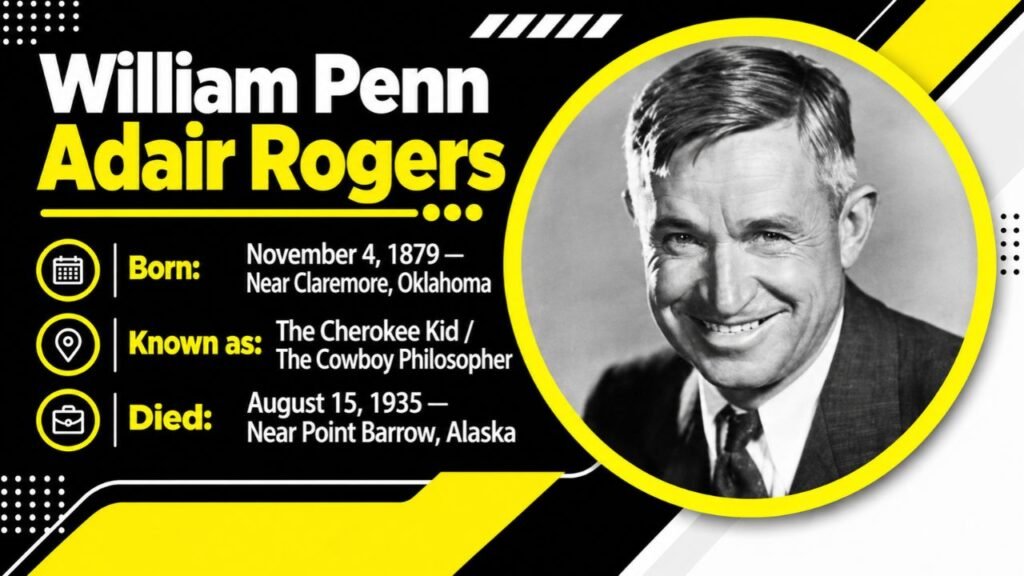
Will Rogers made America laugh at itself during the years between two world wars. He started as a trick roper from Indian Territory, and he became the most famous humorist in the country, with a newspaper column, a radio audience, and a film career that reached millions. People still ask who Will Rogers was, how he got so famous, and how he died. The answers show a man who combined frontier skill with a sharp sense of fairness, and who died suddenly at the height of his fame.
This article follows his life from a ranch near Claremore, Oklahoma, to a lagoon near Point Barrow, Alaska. It covers his early years, his rise on stage and screen, his columns and radio work, his marriage, his final flight, and what is new at the museum that honors him in 2026.
| Detail | Information |
| Full name | William Penn Adair Rogers |
| Nicknames | “The Cherokee Kid” and “The Cowboy Philosopher” |
| Born | November 4, 1879, near Claremore, Cherokee Territory (now Oklahoma) |
| Died | August 15, 1935, near Point Barrow (Utqiagvik), Alaska, age 55 |
| Known for | Trick roping, the Ziegfeld Follies, films, newspaper columns, radio |
| Spouse | Betty Blake Rogers, married in 1908 |
| Children | Four (one died at age two) |
| Famous opening line | “All I know is what I read in the papers.” |
Who Was Will Rogers?
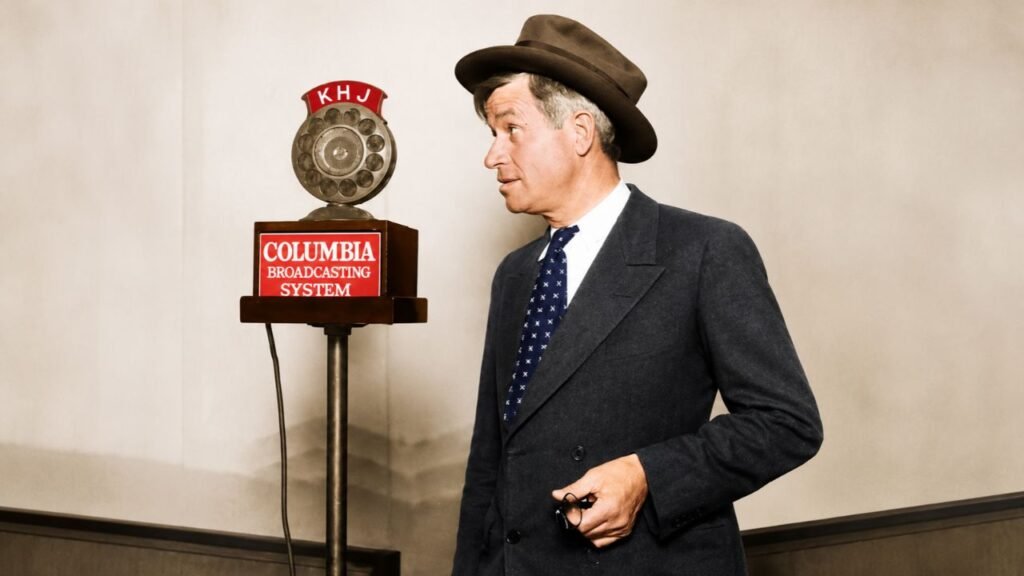
Will Rogers was an American entertainer, humorist, actor, radio personality, and newspaper columnist. His Cherokee heritage and his ranch upbringing shaped the plainspoken character he presented to the public. Fans called him the Cherokee Kid, and later the Cowboy Philosopher, because he combined rope tricks with dry commentary on politics and daily life.
He worked in nearly every major medium of his time. He performed in vaudeville, starred on Broadway, appeared in dozens of films, wrote a column that readers across the country followed, and spoke on the radio. Moreover, he made fun of both major parties, so he earned affection from people on every side of politics.
Early Life in Oklahoma
Ranch Roots
Will Rogers was born on November 4, 1879, on a ranch between Claremore and Oologah in Cherokee Territory. Both of his parents had Cherokee heritage, and his father, Clement, was a rancher and local leader. As a boy, he preferred horses and ranch work to school. He later joked that he spent ten years in the Fourth Reader.
Loss and Distance
His mother died when he was ten, and he and his father often clashed as young Will tried different ventures with mixed results. They began to repair the relationship after Will found success in vaudeville. However, Clement died in 1911, which ended any chance of a full reconciliation.
Travels Abroad
Rogers left home to see the world. In 1899, he appeared at the St. Louis Fair with the Mulhall Rodeo. Near the end of 1901, at age 22, he and a friend, Dick Parris, sailed to Argentina to work as gauchos. After about five months, he moved on to South Africa.
There, he worked on a ranch near Mooi River Station in Natal and performed as a rider and trick roper with Texas Jack’s Wild West Circus and the Wirth Brothers Circus. In 1904, he returned to the United States and appeared at the St. Louis World’s Fair, where he started to test his roping act on vaudeville stages.
Vaudeville, Broadway, and the Ziegfeld Follies
From Roping to Talking
At first, Rogers relied on rope tricks and horsemanship. Over time, however, he added relaxed remarks about the news, politicians, and people in the audience. Those jokes made his act different from other roping shows, and audiences began to come for the talk as much as the tricks.
Broadway Success
Rogers made his first appearance on a New York stage in 1905, and he appeared in The Wall Street Girl in 1912. Producer Florenz Ziegfeld noticed him, and Rogers joined Ziegfeld’s Midnight Frolic in 1915. A year later, he scored a breakthrough in the Ziegfeld Follies of 1916.
In 1934, he took on a dramatic role for the first time in a stage play, Eugene O’Neill’s Ah, Wilderness!
Films, Columns, and Radio
Motion Pictures
Samuel Goldwyn cast Rogers in the title role of Laughing Bill Hyde in 1918. He appeared in silent films first, but the arrival of sound suited his conversational style. His major hits included They Had to See Paris, A Connecticut Yankee (1931), and State Fair (1933). Two of his last films, Steamboat ‘Round the Bend and In Old Kentucky, reached theaters after his death in 1935.
The Newspaper Column
Rogers began weekly newspaper syndication in 1922, and in 1926 he started a daily feature called “Will Rogers Says.” His short columns reached an estimated 40 million readers. He also wrote regularly for The Saturday Evening Post and published several humor books.
Radio and Politics
On the radio and in lectures, Rogers teased Democrats and Republicans alike. He met presidents and other leaders, yet he kept his everyman style. He championed neighborliness, doubted foreign entanglements, and promoted aviation.
| Medium | Highlights |
| Vaudeville | Trick roping that grew into topical talk |
| Broadway | Ziegfeld’s Midnight Frolic (1915) and Follies (1916); Ah, Wilderness! (1934) |
| Film | Laughing Bill Hyde (1918); They Had to See Paris; A Connecticut Yankee; State Fair |
| Newspapers | Weekly column from 1922; daily “Will Rogers Says” from 1926 |
| Radio | Commentary and humor with a nonpartisan tone |
Marriage and Family
Behind the public image stood a devoted husband. Rogers met Betty Blake of Rogers, Arkansas, and the two wrote to each other while he toured. Betty hesitated at first because she worried about the uncertainty of show business, and she declined an early proposal in 1906. They married in 1908.
They had four children, and one of them died at age two. As his film career grew, the family settled in California, on a ranch in the Santa Monica hills area that today is a state historic park. Betty managed the home while Will traveled constantly.
After his death, Betty wrote Will Rogers: His Wife’s Story, published in 1941. She died of cancer in Santa Monica on June 21, 1944, and the family buried her beside her husband in Claremore.
Aviation and the 1935 Crash
A Friendship With Wiley Post
Rogers loved aviation and believed that flying would shape the future. He became close friends with the famed pilot Wiley Post, who set records for long-distance flight.
The Final Flight
In August 1935, Rogers and Post flew north from Seattle and traveled through Alaska toward Point Barrow. On August 15, they landed in a lagoon near Walakpa Bay, southwest of Point Barrow, to check their directions and the weather. Shortly after takeoff, at about 50 feet above the water, the engine lost power. The plane crashed into the shallow lagoon, and both men died.
The news shocked the country. Newspapers carried the story on their front pages, and mourners gathered across the nation. Rogers was 55 years old.
| Date | Event |
| August 1935 | Rogers and Post leave Seattle and fly through Alaska |
| August 15, 1935 | They land near Walakpa Bay to check directions |
| August 15, 1935 | The engine fails shortly after takeoff; the plane crashes |
| Afterward | Both men die; memorials mark the crash site |
Famous Quotes Attributed to Will Rogers
Many sayings circulate under his name, and historians cannot verify every one. These are among the best known:
- “All I know is what I read in the papers.”
- “I never met a man that I didn’t like.”
- “Even if you are on the right track, you’ll get run over if you just sit there.”
- “Never miss a good chance to shut up.”
- “Every time Congress makes a joke it’s law, and every time they make a law it’s a joke.”
His humor worked because it treated people with respect, even when it poked at power.
Legacy: How America Remembers Will Rogers
Statues of Rogers stand in the United States Capitol in Washington, D.C., and in Claremore, Oklahoma. The Will Rogers Memorial Museum in Claremore opened in 1938, and it holds his artifacts, films, and tomb. Route 66, which crosses Oklahoma, also carries the name Will Rogers Highway, and the road’s centennial in 2026 has renewed interest in him.
His Influence Today
Modern commentators often cite Rogers as an early example of a public figure who used humor to talk about politics without bitterness. Comedians, columnists, and radio hosts still draw on his style. Moreover, his focus on common sense and fairness gives him a place in conversations about American identity.
What Is New in 2026
Several developments in 2026 keep Will Rogers in the news:
- Museum expansion: The Will Rogers Memorial Museum is preparing for its largest expansion since 1938, adding a new 20,000-square-foot building and a space for traveling exhibits, according to FOX23.
- America’s 250th anniversary: The museum is hosting a pop-up exhibit called Rogers and the Republic, which explores his views on politics and American ideals.
- Route 66 centennial: The Oklahoma Historical Society used the anniversary for a live podcast recording at the museum in February, with the museum’s director and Rogers’s great-granddaughter as guests.
- Medallion Award celebration: The Claremore Museum of History is hosting the 2026 Will Rogers Medallion Award celebration for authors, actors, and fans of western culture.
I found no new biographical discoveries or major legal or historical disputes about Rogers in 2026.
Timeline
| Year | Event |
| 1879 | Born near Claremore, Cherokee Territory |
| 1890 | His mother dies |
| 1899 | Appears at the St. Louis Fair with the Mulhall Rodeo |
| 1901 | Travels to Argentina, then South Africa |
| 1904 | Returns to the United States; performs at the St. Louis World’s Fair |
| 1905 | First appearance on a New York stage |
| 1908 | Marries Betty Blake |
| 1915 | Joins Ziegfeld’s Midnight Frolic |
| 1916 | Breakthrough in the Ziegfeld Follies |
| 1918 | Stars in Laughing Bill Hyde |
| 1922 | Begins weekly newspaper column |
| 1926 | Starts daily column “Will Rogers Says” |
| 1934 | Appears in Ah, Wilderness! |
| August 15, 1935 | Dies in a plane crash near Point Barrow |
| 1938 | Memorial museum opens in Claremore |
Check Also: Frank Lucas | Nancy Guthrie | Jeffrey Dahmer | Lindsay Clancy | Matthew Farwell | Scott Colom | Dana White | Aileen Carol Wuornos | Pablo Escobar
Frequently Asked Questions About Will Rogers
He was an American humorist, vaudeville trick roper, actor, radio personality, and newspaper columnist known for plainspoken wit.
He was born on November 4, 1879, near Claremore, in Cherokee Territory, which is now Oklahoma.
The first nickname reflects his Cherokee heritage, and the second reflects his mix of cowboy skills and wise, humorous commentary.
He started with trick roping in Wild West shows and vaudeville, added jokes about the news, and then starred in the Ziegfeld Follies.
He often opened remarks with “All I know is what I read in the papers.”
He married Betty Blake in 1908. They had four children, and one died at age two.
He died on August 15, 1935, in a plane crash near Point Barrow, Alaska, with pilot Wiley Post. The engine lost power shortly after takeoff.
He was 55 years old.
He rests in Claremore, Oklahoma, at the Will Rogers Memorial Museum. His wife, Betty, is buried beside him.
Yes, and it is planning its largest expansion since 1938. Check the museum’s website for current hours and construction updates.