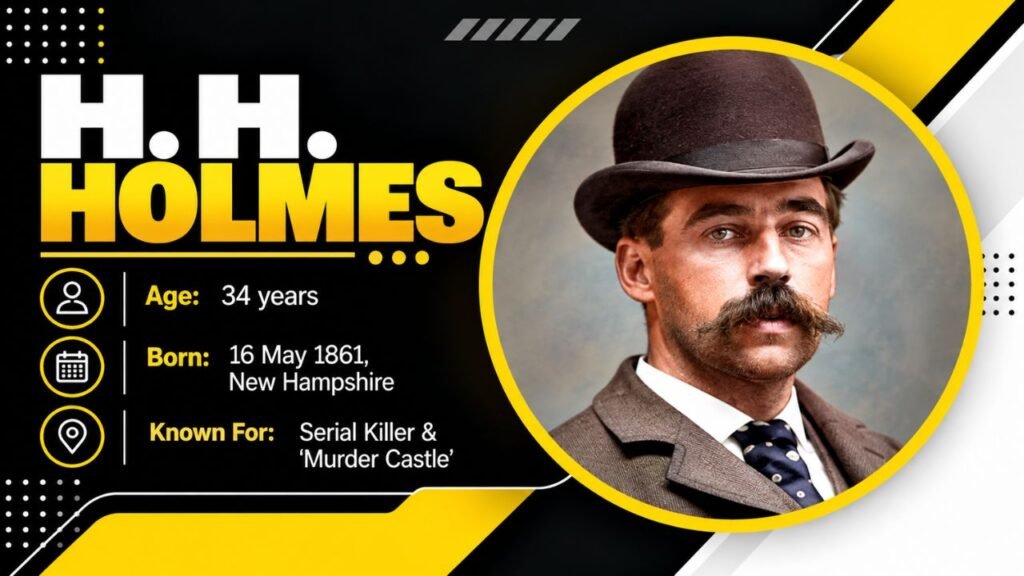
Ask almost anyone who knows a little American true crime to name the country’s first big serial killer, and you’ll hear the same answer: Herman Webster Mudgett, the man who renamed himself Henry Howard Holmes. He was hanged in Philadelphia more than 130 years ago, yet he’s still called the “Devil in the White City,” and the Chicago building he put up is still known as the “Murder Castle.” Books, TV series, podcasts, board games, and even video games keep returning to him, so every few months the searches spike again.
The real story is stranger than the legend, and messier too. H. H. Holmes was a proven fraudster, a bigamist, and a convicted killer. He was also the star of some of the most inflated newspaper stories of the 1890s, which is exactly why historians now sit down and sort what can be proved from what was made up to sell papers. Here’s a clear walk through his childhood, his Chicago hotel, his victims, his trial, his death, the 2017 opening of his grave, and where researchers stand today on how many people he really killed.
Case Snapshot
| Detail | Information |
| Birth name | Herman Webster Mudgett |
| Alias | Henry Howard Holmes, known as Holmes |
| Born | May 16, 1861, Gilmanton, New Hampshire |
| Died | May 7, 1896, hanged at Moyamensing Prison, Philadelphia |
| Age at execution | 34 |
| Occupation | Pharmacist, self-styled doctor, hotel owner, swindler |
| Convicted of | Murder of Benjamin Pitezel (1895) |
| Confession | Claimed 27 killings; only a handful are supported by evidence |
| Chicago base | Corner of 63rd Street and Wallace Avenue, Englewood |
| Burial | Holy Cross Cemetery, Yeadon, Pennsylvania |
| Exhumed | 2017, body identified through dental records and DNA |
| Spouses | Clara Lovering, Myrta Belknap, Georgiana Yoke |
Who Was Holmes?
Holmes wasn’t a gangster, a soldier, or a politician. He was a polished, well-dressed talker who used a medical degree, a drugstore, and one very large building to look like a rising Chicago businessman, all while running scam after scam behind the scenes. Neighbors saw a successful entrepreneur. Creditors saw a man who never quite paid his bills. The people who trusted him with their money, their jobs, or their lives found out he was something much worse.
Locals knew him as Dr H H Holmes, and even now people type h. h holmes into a search bar when they want the whole story in one place. His fame comes down to timing. Chicago was gearing up for the 1893 World’s Columbian Exposition, visitors were pouring in, and young women were arriving in the city looking for work. Holmes offered them rooms, jobs, and friendship, and several of the people who dealt with him later disappeared. A shining World’s Fair with a hidden predator in the background is the story Erik Larson turned into a bestseller in 2003.
H. H. Holmes Born: Childhood and Early Life
Holmes was born on May 16, 1861, in Gilmanton, New Hampshire, to Levi Horatio Mudgett and Theodate Page Price. The household was strict and religious. Plenty of retellings of the h h holmes childhood add dark touches, like classmates forcing him to touch a skeleton or the boy being cruel to animals. Most of those stories trace back to Holmes himself or to writers who came later, so it’s safer to file them under legend than fact.
What we can say is that Mudgett was clever, ambitious, and desperate to get out of a small town. He taught school as a teenager and married Clara Lovering in 1878 at just 17. Their son Robert arrived in 1880, but by then Mudgett’s eyes were already on bigger places than New Hampshire, and on a life that didn’t include his first family.
Medical School and the First Scams
After a short stay at the University of Vermont, Mudgett moved on to the University of Michigan and earned his medical degree in 1884. The degree was real, and it let him pass as a genuine physician and pharmacist for years. It also put him near bodies. Accounts from his student days say he took cadavers from the anatomy lab, disfigured them, and used them to fake accidental deaths, then claimed insurance money on policies he’d bought under false names.
Once he left Michigan he bounced between states and started calling himself Henry Howard Holmes. The new name helped him shake off debts, scandals, and a wife. By 1886, henry h holmes had landed in Chicago with a fresh identity and a plan to get rich.
H. H. Holmes Spouse: Three Marriages
One of the better documented facts about Holmes is that he was a serial bigamist. He never divorced his first wife, Clara Lovering. In 1887 he married Myrta Belknap in Illinois, and they had a daughter, Lucy. He kept that marriage at a distance from his business and was away from home often. Then in 1894, while traveling with the Pitezel family, he married a third woman, Georgiana Yoke, in Denver.
Ask historians about the h. h. holmes spouse question and the answer is usually the same. All three women were deceived, and none knew about the others until after his arrest. Georgiana Yoke later testified that she thought he was a respectable man traveling for work, and she was never charged.
Moving to Chicago: The Pharmacy and the Hotel
In 1886 Holmes got a job in Englewood, a growing neighborhood on Chicago’s south side, at a drugstore run by Elizabeth Holton, whose husband was seriously ill. When Dr. Holton died, Holmes took over the shop and before long bought the empty lot across the street. The drugstore gave him a respectable front. The lot was where he meant to build the place that would make him infamous.
H H Holmes Hotel Location
There’s no mystery about the h h holmes hotel location. It stood on the corner of 63rd Street and Wallace Avenue in Englewood, about six miles from the fairgrounds in Jackson Park. Construction started around 1887, and Holmes kept swapping out builders and workers, reportedly so that nobody could see the full layout. He also promised to pay them, and often didn’t.
What Did the Building Actually Look Like?
It was a three-story building with stores and offices on the ground floor and rooms upstairs. A big, oddly shaped structure with a corner turret, it soon got the nickname “the Castle” from locals. Holmes pushed it as the World’s Fair Hotel, although it was never completely finished. Later newspaper descriptions of the h. h. holmes hotel were far grander than the half-built reality.
The H H Holmes Murder Castle: Fact Versus Legend
The popular picture of the h h holmes murder castle is chilling. Hidden passages, sliding walls, trapdoors, soundproof rooms, gas chambers, a kiln big enough for a person, chutes sending bodies to the basement, and a dissection table where victims became skeletons for medical schools. Newspapers printed all of this in 1895 after his arrest, and writers have been repeating it ever since.
Modern historians are a lot more careful. Much of that “evidence” came from reporters chasing the most sensational angle, and Holmes made things worse by confessing and then changing his story. Nobody has solid proof that he trapped guests inside on a large scale, and nobody has a verified count of the bodies the building supposedly hid. A newer line of research says the building was mostly a swindler’s tool, one that helped him dodge creditors, buy goods on credit, and run insurance and furniture scams.
None of that means the h. h. holmes murder castle was harmless. Investigators did find strange features, including an oversized vault, a large basement, and oddly arranged rooms. The truth probably sits somewhere between the legend and the skeptics, and the building burned down before anyone could study it properly.
The Fire of 1895
In August 1895 a fire tore through the upper floors while Holmes was already in custody. Arson was suspected, and an insurance claim had already been filed, which fit his habits. What was left of the building was later torn down, a post office went up on the lot, and nothing of the original structure survives. That’s why you can’t tour the site today, and it’s a big reason the h h holmes castle is still a subject of guesswork.
The H H Holmes House Question
People sometimes search for the h h holmes house as if it were a separate address. It wasn’t. Holmes lived in a number of rented homes and hotels over the years, but the “house” they’re thinking of is the Englewood building.
Holmes and the 1893 World’s Fair
The World’s Columbian Exposition opened in May 1893 and drew millions of visitors. Holmes tried to cash in by renting rooms, selling goods, and hiring young women as clerks, stenographers, and assistants. Several women linked to him disappeared around that time, among them Emeline Cigrand and the sisters Minnie and Nannie Williams. Historians still argue over whether the fair gave him cover for crimes or simply supplied a steady flow of customers and victims.
H H Holmes Victims: Who Were They?
The question of who the h h holmes victims really were is where legend and evidence part ways most clearly. The claim that he killed more than 200 people has nothing behind it. These are the people most often connected to him.
| Victim | Year | Connection |
| Julia Conner (Smythe) | 1891 | Worked for Holmes and had an affair with him; disappeared around Christmas |
| Pearl Conner | 1891 | Julia’s young daughter; vanished with her mother |
| Emeline Cigrand | 1892 | Stenographer who worked at the Castle; last seen in Chicago |
| Minnie Williams | 1893 | Heiress with property in Texas; Holmes forged documents tied to her land |
| Nannie Williams | 1893 | Minnie’s sister; disappeared after visiting Chicago |
| Benjamin Pitezel | 1894 | Business associate; murdered in Philadelphia |
| Alice Pitezel | 1894 | Pitezel’s daughter; killed in Toronto |
| Nellie Pitezel | 1894 | Pitezel’s daughter; killed in Toronto |
| Howard Pitezel | 1894 | Pitezel’s son; killed near Indianapolis |
How Many People Did H H Holmes Kill?
If you’re wondering how many people did h h holmes kill, the honest answer is a range, not a number. In a confession printed in 1896, he claimed 27 murders, though some of the people he named turned out to be alive. Detectives and later historians can tie him with reasonable confidence to a smaller group, usually put between six and nine victims. Older estimates of 50, 100, or 200 came from newspaper headlines, not proof. The exact figure is still unknown, and careful researchers now avoid guessing beyond what the record supports.
The Pitezel Case: How the Scheme Fell Apart
What finally ended Holmes’s run started as an insurance plan. In 1894 he and Benjamin Pitezel, a longtime associate, agreed to fake Pitezel’s death so Holmes could collect a $10,000 life insurance policy, with a corpse standing in for Pitezel. Instead, Holmes killed Pitezel in Philadelphia in September 1894, staged the scene to look like an accident, and persuaded the insurance company to pay.
To stop Pitezel’s wife from learning the truth, Holmes told her Benjamin was alive and in hiding. He then took three of the children, Alice, Nellie, and Howard, on a long trip through several cities. Within weeks all three were dead.
The Detective Who Followed the Trail
Philadelphia detective Frank Geyer followed Holmes and the children from city to city using hotel registers and witness statements. His work eventually uncovered the bodies and linked Holmes to the deaths, and many accounts credit his persistence for turning a confusing insurance case into a murder prosecution. Holmes was arrested in Boston in November 1894, and the story quickly became national news.
The Trial and Conviction
Holmes’s trial for the murder of Benjamin Pitezel began in Philadelphia in late October 1895. Prosecutors laid out the insurance scheme, the identification of the body, the trail of the children, and Holmes’s own lies. He tried to act as his own lawyer for part of the trial, and it backfired. The jury convicted him in early November 1895, and he was sentenced to death.
While he waited to be executed, Holmes wrote a confession for a newspaper describing dozens of killings. It was a mix of truth, exaggeration, and what looks like pure fantasy. Since some of the people he claimed to have killed were later found alive, historians treat the confession as unreliable. He also reportedly claimed the devil had shaped his appearance, a strange detail that only fed the myth.
How Did H H Holmes Die? The Execution
On May 7, 1896, Holmes was hanged at Moyamensing Prison in Philadelphia, about a week before he would have turned 35. Reports say his neck didn’t break right away and that it took roughly 15 to 20 minutes for him to die. He reportedly asked for his grave to be covered in cement so nobody could dig him up.
When people ask how did h h holmes die, the plain answer is hanging, after his conviction for killing Benjamin Pitezel. He was never tried in Chicago, and he was never convicted of any of the Castle killings.
H. H. Holmes Died: The Final Hours
By most accounts his last hours were calm. He reportedly slept well the night before, ate a normal breakfast, and walked to the gallows without fuss. The date and method of his death are firmly established, and his body was released for burial.
H H Holmes Grave and the 2017 Exhumation
Holmes was buried at Holy Cross Cemetery in Yeadon, Pennsylvania, in a coffin filled with concrete and lowered deep into the ground. For well over a century, rumors said the h h holmes grave didn’t actually hold him, and that he’d escaped, lived abroad, or even been swapped out on the gallows. It made for a colorful theory, but there was little evidence behind it.
The H H Holmes Exhumed Story
In May 2017 the grave was opened. A team led by archaeologist Samantha Cox carried out the h h holmes exhumed project with the cooperation of descendants, and the results came out later that year. The team found a partly hardened layer of concrete, remains with a distinctive mustache, and teeth that matched dental records. DNA comparisons with a living relative backed up the identification.
What the H H Holmes Body Tells Us
Researchers were surprised by how well the concrete had preserved the h h holmes body. The identification put the “he escaped” rumor to rest and confirmed that the man who died at Moyamensing really was Holmes. It also gave historians a rare physical record of a century-old criminal case. After testing, the remains were reburied.
H H Holmes Jack the Ripper Theory
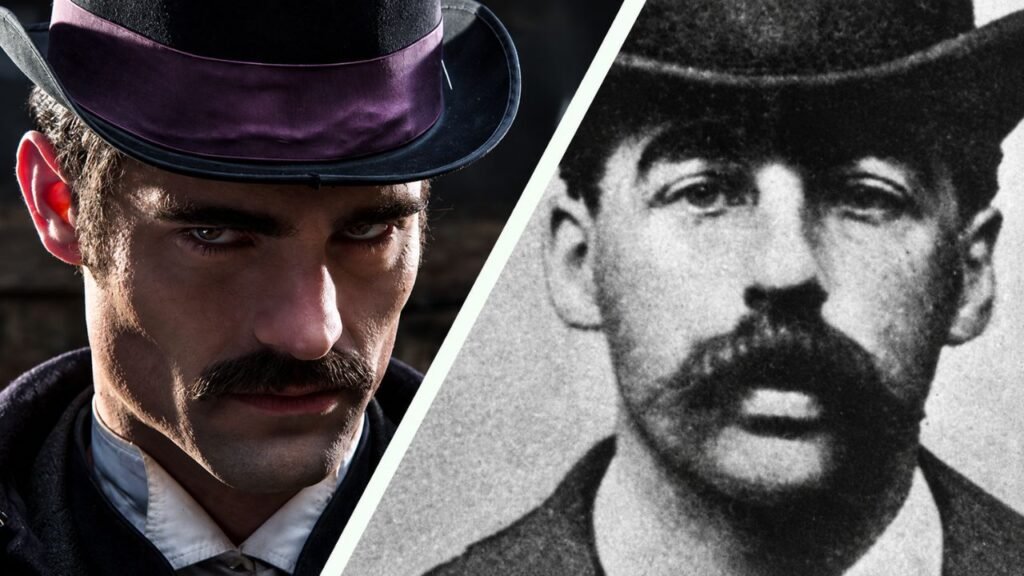
One of the most talked-about claims is the h h holmes jack the ripper theory. It says Holmes was behind the 1888 murders in London’s Whitechapel district. The idea got fresh attention in 2017, when a descendant pushed it in a book and a television documentary, pointing to handwriting comparisons and a diary said to be Holmes’s.
Historians reject it firmly. Records place Holmes in the United States during the Whitechapel killings, with business, legal, and personal activity documented in Chicago and elsewhere, and the handwriting comparisons have been widely criticized as unreliable. So when people ask was h h holmes jack the ripper, the accepted answer is no. The Ripper’s identity is still unsolved, and the Holmes link is treated as a fringe theory.
Dr. H. H. Holmes in Books, Movies, and Documentaries
Few criminals have been retold as often as dr. h. h. holmes. The best-known h h holmes book is Erik Larson’s “The Devil in the White City,” a long-running bestseller that has been talked about as a screen adaptation for years. Historian Adam Selzer’s biography, “The True History of the White City Devil,” takes a much more skeptical view of the legend.
The screen list is long too. Anyone searching for an h h holmes movie will likely land on the 2004 film about America’s first serial killer plus a few fictional takes, while the h h holmes documentary category covers episodes from true crime series, history channels, and streaming platforms. Most of them repeat the Murder Castle story in some form. The video game “The Dark Pictures Anthology: The Devil in Me” also borrowed heavily from the Holmes legend.
H. H. Holmes Portrait
Pictures matter in this story. The best-known h. h. holmes portrait shows a neatly dressed man with a mustache and a calm expression, usually reproduced in black and white. Another h h holmes portrait, often used in articles, comes from newspaper engravings made around the time of his trial. The mustache is part of why the 2017 identification felt so striking, since it was still visible on the remains.
Latest Updates on the Holmes Case
Interest in Holmes is still high in 2026. New documentary episodes, podcasts, and history features keep revisiting the story, and a major theme is how much of the Murder Castle myth came from 1890s newspapers rather than police records.
Earlier writers treated the legend as settled. Newer coverage leans on the strongest evidence, which points to the Pitezel killings and a small number of Chicago disappearances, and it treats claims of hundreds of victims as unsupported. The 2017 exhumation also remains the biggest physical development in the case, because it closed the door on the escape theory for good.
A Note on Similar Names
Searches for david h. holmes and david h holmes sometimes show up next to searches for the killer. They’re unrelated people with similar names, and the serial killer was never known by that name. If you’re looking for the Chicago hotel owner, search for Herman Mudgett or Henry Howard Holmes instead.
Timeline of Holmes’s Life
- 1861 – Herman Webster Mudgett born in Gilmanton, New Hampshire
- 1878 – Marries Clara Lovering at age 17
- 1884 – Graduates from the University of Michigan medical school
- 1886 – Arrives in Chicago and takes over a drugstore in Englewood
- 1887 – Marries Myrta Belknap and begins building the Englewood structure
- 1891 – Julia Conner and her daughter Pearl disappear
- 1893 – World’s Fair opens; Emeline Cigrand and the Williams sisters connected to Holmes vanish
- 1894 – Benjamin Pitezel killed; Pitezel children die; Holmes arrested in Boston
- 1895 – Convicted of Pitezel’s murder; hotel damaged by fire
- 1896 – Confession published; hanged on May 7
- 2017 – Grave opened and body identified
Why the Case Still Matters
The Holmes story matters for more than its shock value. It shows how early American police struggled with crimes that crossed city and state lines, when forensics barely existed and news traveled slowly. It also shows how newspapers could build a public image long before the facts were in, a lesson that still applies to true crime coverage today.
And the more graphic the legend grew, the less attention went to the people who actually died: the Conners, the Williams sisters, Emeline Cigrand, Benjamin Pitezel, and his children Alice, Nellie, and Howard. More and more historians argue that their names deserve more attention than the myths do.
Check Also: Charles Manson | Jeffrey Dahmer | Myra Hindley | Christa Pike
Frequently Asked Questions
He was Herman Webster Mudgett, a con man and killer hanged in Philadelphia in 1896.
He was born on May 16, 1861, in Gilmanton, New Hampshire.
He was hanged on May 7, 1896, for the murder of Benjamin Pitezel.
He confessed to 27, but evidence supports only about six to nine victims.
No. Records place him in the United States during the 1888 Whitechapel murders.
No. It burned in 1895 and was later demolished; nothing remains of it.
Yes. His grave was opened in 2017, and DNA and dental records confirmed his identity.
No. The 2017 exhumation confirmed he died by hanging in 1896.
Three: Clara Lovering, Myrta Belknap, and Georgiana Yoke, all while legally married.
Source: WikiPedia