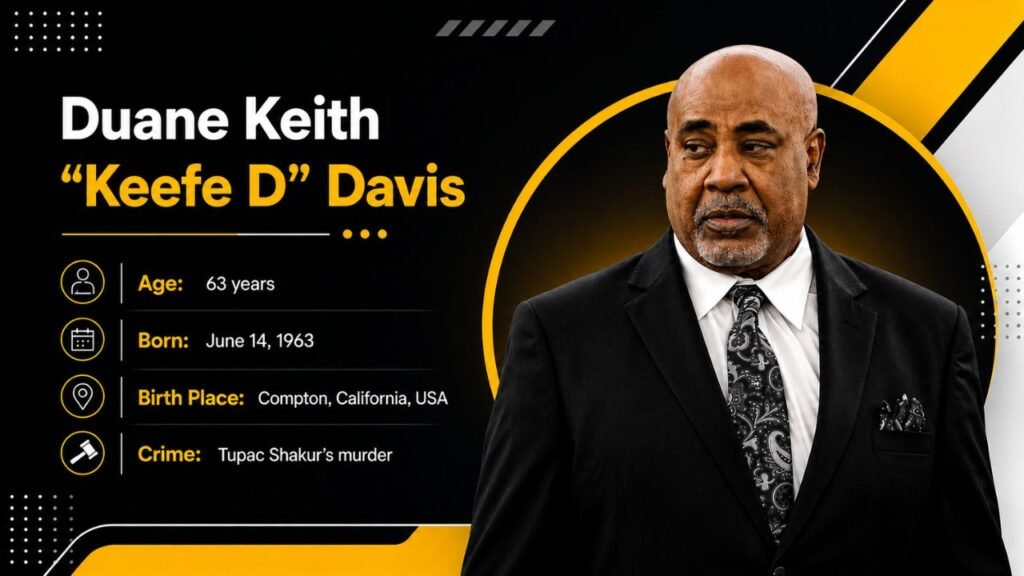
Duane Keefe D Davis – the former South Side Compton Crips “shot caller” – was found guilty of first-degree murder on August 31, 2026, for orchestrating the 1996 killing of rap icon Tupac Shakur. After almost 30 years of speculation, documentaries, and a tell-all memoir, a Las Vegas jury needed less than three hours to convict him.
Prosecutors said Davis supplied the gun and ordered the drive-by shooting after his nephew, Orlando Anderson, was beaten by Tupac’s entourage hours earlier at the MGM Grand. He is the first and only person ever charged in the case, and now faces 40 years to life in prison at his October 13, 2026 sentencing.
Quick Facts About Duane Keefe D Davis & Tupac Shakur Case
Before diving into the full story, here’s the case at a glance – from Tupac’s death in 1996 to Duane Davis’s conviction in 2026. It took police almost three decades to link the “shot caller” from Compton to the murder of the rapper he’d been quietly boasting about killing for years.
| Detail | Information |
| Victim | Tupac Shakur, shot Sept. 7, 1996; died Sept. 13, 1996 (age 25) |
| Convicted | Duane Keith “Keefe D” Davis |
| Born | June 14, 1963 |
| Gang affiliation | South Side Compton Crips (former “shot caller”) |
| Relation to case | Uncle of Orlando “Baby Lane” Anderson |
| Charge | First-degree murder with a deadly weapon |
| Indicted | September 2023 |
| Trial began | August 10, 2026 |
| Verdict | Guilty – August 31, 2026 |
| Jury deliberation time | Under 3 hours |
| Sentencing hearing | October 13, 2026 |
| Possible sentence | 40 years to life, no parole |
| Memoir | Compton Street Legend (2019) |
Court filings show Davis was arrested on September 29, 2023, outside his home in Henderson, Nevada, weeks after police executed a search warrant there on July 17, 2023. He had lived in that home for roughly a decade with his wife and four children, and his defense team later cited his age and a history of colon cancer while unsuccessfully seeking bail and, later, leniency during trial.
Who Is Duane “Keefe D” Davis?
Duane “Keefe D” Davis, 63 years old (full name Duane Keith Davis, born June 14, 1963) was a former “shot caller” in the South Side Compton Crips gang, based in Compton, California. He’s the uncle of Orlando “Baby Lane” Anderson.
He’s known for orchestrating the 1996 drive-by shooting that killed rapper Tupac Shakur in Las Vegas — he supplied the gun and directed the hit after his nephew was beaten by Tupac’s entourage earlier that night at the MGM Grand. He spent nearly 20 years publicly talking about his role in interviews, documentaries, and his 2019 memoir Compton Street Legend, before finally being arrested in September 2023 and convicted of first-degree murder on August 31, 2026.
Unlike most cold-case suspects, Davis wasn’t uncovered by new forensics – he spent nearly 20 years openly discussing his role in Tupac’s death, effectively narrating the same story investigators would eventually use to convict him.
Where Davis discussed the murder publicly:
- A 2008 proffer interview with the FBI and LAPD
- Netflix’s Unsolved: The Murders of Tupac and The Notorious B.I.G. (2018)
- Numerous podcasts and YouTube interviews
- His 2019 memoir, Compton Street Legend
By the time of his 2023 arrest, Davis was 60 years old and had been living a relatively quiet, family life in the Las Vegas suburb of Henderson for about ten years – a strange final chapter for a man who had spent two decades talking publicly about killing one of music’s biggest stars. Court records show he was also battling colon cancer, which went into remission before reportedly resurfacing during his time in custody, a detail his attorneys raised repeatedly while arguing for house arrest ahead of trial.
Davis’s Alleged Role in the Shooting
Nevada law doesn’t require someone to pull the trigger to be convicted of murder – planning, arming, or directing a killing is enough, which is precisely the legal theory that ties Davis directly to Tupac’s death despite him never being named as the shooter.
What prosecutors argued Davis did:
- Organized a retaliatory hit after his nephew was beaten
- Supplied the .40-caliber Glock used in the shooting
- Rode in the front passenger seat of the Cadillac
- Ordered the driver to make the U-turn toward Tupac’s car
Who Was Tupac Shakur?
Tupac Amaru Shakur (born Lesane Parish Crooks, June 16, 1971) was one of hip-hop’s most influential and commercially successful artists. Known as 2Pac, he blended poetic, politically charged lyrics about poverty and racism with the harder-edged Gangsta Rap sound of the 1990s. He was signed to Death Row Records, run by Marion “Suge” Knight, and became the label’s biggest star before his death at age 25 – the same label deal, and the same Suge Knight, who would put him in the passenger seat of the BMW on the night he was killed.
Before joining Death Row, Tupac first broke through as a member of the group Digital Underground and then launched a solo career with albums like 2Pacalypse Now and Strictly 4 My N.I.G.G.A.Z., quickly becoming known as much for his acting roles – including Juice and Poetic Justice – as for his music. His career was also shadowed by legal trouble and violence, including a 1994 shooting and robbery at a New York recording studio that he survived, and a widely publicized incarceration on sexual assault-related charges before he signed with Death Row.
Tupac’s rivalry with East Coast rapper The Notorious B.I.G. and Bad Boy Records became one of the defining, and most damaging, storylines of 1990s hip-hop, fueling a bicoastal feud that many believe contributed to the tense atmosphere surrounding both of their eventual murders. It’s also the same feud that would later fuel decades of speculation about whether that rivalry – rather than the street-gang conflict Duane Davis was actually convicted over – was the real motive behind his death.
When Did Tupac Die? Full Timeline
That question of motive comes into focus on the night of September 7, 1996 – the night Tupac’s path finally crossed with Duane Davis’s crew. Tupac’s death unfolded over six agonizing days rather than in a single moment: he was shot that night, and doctors fought to keep him alive on life support before he ultimately succumbed to his injuries. The timeline below lays out exactly how those six days played out.
| Date | Event |
| Sept. 7, 1996 | Attends Tyson vs. Seldon fight at MGM Grand, Las Vegas |
| Sept. 7, 1996 (night) | Assaults Orlando Anderson in MGM Grand lobby with entourage |
| Sept. 7, 1996, ~11:15 PM | Shot 4 times in drive-by at Flamingo Rd. and Koval Ln. |
| Sept. 7–13, 1996 | On life support in medically induced coma |
| Sept. 13, 1996 | Dies of respiratory failure and cardiac arrest, age 25 |
The shooting: A white Cadillac pulled beside Tupac’s BMW at a red light. A backseat passenger opened fire, hitting Tupac in the chest, arm, and thigh; Suge Knight was grazed but survived.
Tupac was rushed to the University Medical Center of Southern Nevada, where surgeons worked to control severe internal bleeding and even removed one of his lungs in an effort to save him. Despite the surgery, his condition continued to decline over the following days, and his mother, Afeni Shakur, ultimately made the decision to take him off life support once doctors determined there was no realistic chance of recovery.
His murder went unsolved for the next 27 years – and the man riding shotgun in that white Cadillac, Duane “Keefe D” Davis, spent much of that time hiding in plain sight, talking about the case in public while never being charged.
Who Killed Tupac Shakur? The Conspiracy Breakdown
The Four Men in the Cadillac
This is where Tupac’s story and Duane Davis’s story fully merge. Four men were riding in the white Cadillac that pulled alongside Tupac’s BMW that night, and Davis is the only one still alive today. The other three all died within a few years of the shooting, which is a major reason the case stayed unsolved for so long. The table below shows where each man sat and what ultimately happened to him.
| Occupant | Seat | Role/Fate |
| Duane “Keefe D” Davis | Front passenger | Orchestrated hit, supplied gun; convicted 2026 |
| Terrence “T-Brown” Brown | Driver | Died in later years |
| DeAndrae “Dre” Smith | Back seat | Possible shooter; died in later years |
| Orlando “Baby Lane” Anderson | Back seat | Alleged shooter; killed in 1998 gang shootout |
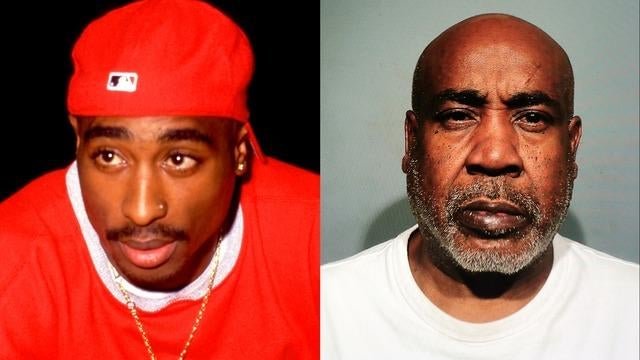
Who Actually Pulled the Trigger?
Davis’s account shifted over the years – in 2008 he told police his nephew Anderson fired the gun, though other tellings pointed to Smith. Prosecutors sidestepped the question entirely, arguing the identity of the shooter didn’t matter since Davis planned and armed the hit.
Davis is the only surviving occupant of the Cadillac, which is exactly why he became the only person ever charged – and why his own story became the centerpiece of the case against him.
Did Diddy Kill Tupac? Fact vs. Folklore
No discussion of Duane Davis’s case is complete without addressing the rumor his own words helped fuel for years: that Sean “Diddy” Combs was secretly behind Tupac’s murder.
Where the Rumor Started
A violent mid-90s rivalry existed between Death Row Records (Tupac, West Coast) and Bad Boy Records (Sean “Diddy” Combs and The Notorious B.I.G., East Coast). Keefe D’s crew reportedly provided security for Bad Boy when they visited California, forming the basis of the rumor.
Keefe D’s Claim
In his 2008 FBI interview, Davis alleged Diddy offered him $1 million to kill Tupac and Suge Knight out of fear and business rivalry.
The Legal Reality
Despite decades of headlines, no law enforcement agency has ever tied Diddy to Tupac’s murder with actual evidence. The FBI did look into Keefe D’s claim but came up empty-handed, and prosecutors ultimately built their entire case around straightforward gang retaliation instead. Here’s how the claim actually stacks up against the facts.
| Claim | Status |
| Diddy charged or indicted | Never |
| Diddy named an official suspect | Never |
| FBI investigation into claim | Conducted, found zero corroborating evidence |
| Prosecution’s actual theory at trial | Gang retaliation, not a Bad Boy conspiracy |
| Diddy’s response | Repeatedly and vehemently denies involvement |
Bottom line: There is no evidence establishing Diddy killed Tupac or ordered his murder – the claim rests solely on Davis’s uncorroborated statements, the same statements that ultimately helped convict Davis himself of the crime.
The Path to Trial
Given how openly Davis talked about the murder for years, the real mystery of this case was never “who did it” – it was why prosecutors took so long to act. Despite his public confessions for years, prosecutors needed independent corroboration before charging him, since his 2008 statements were made under a proffer agreement that limits their direct use in court.
Key milestones:
- 2023: Las Vegas police execute new search warrants on Davis’s home
- September 2023: Grand jury indicts Davis on murder with a deadly weapon
- November 2023: Davis pleads not guilty
- 2025: Trial delayed to allow defense time to review decades of evidence
- August 10, 2026: Trial begins in Las Vegas
The Prosecution’s Strategy
Prosecutors Binu Palal and Marc DiGiacomo largely let Davis convict himself, turning nearly 20 years of his own boasting into the state’s key evidence against him.
Evidence presented:
- Audio/video clips of Davis discussing the murder across years of media
- His 2019 memoir, entered as evidence
- A personal scrapbook of news articles about Tupac’s death, found at his home
- Gang-expert testimony describing Davis’s “shot caller” status
The Defense’s Strategy
Attorney Michael Sanft flipped the state’s own strategy around, arguing Davis was a broke, aging ex-gangster who fabricated his role in Tupac’s death to sell books and land media deals.
Key defense points:
- No DNA, fingerprints, or 1996 police records placing Davis at the scene
- No evidence Davis ever called shots before or after this incident
- Claimed his own client’s statements were exaggerated fiction
The Tupac Trial Verdict: August 31, 2026
Thirty years after Tupac’s death, the two men’s stories finally reached a legal conclusion. After closing arguments concluded Monday, the jury deliberated under three hours before reaching a unanimous decision.
Verdict: Guilty of first-degree murder with the use of a deadly weapon – the first and only conviction ever secured in Tupac’s murder.
Courtroom Reactions
The verdict brought an emotional release after nearly 30 years of waiting, and the reactions inside the courtroom reflected just how personal this case remained for Tupac’s family. Prosecutors were embraced by relatives moments after the reading, while Davis himself stayed largely composed. The table below captures how each side responded.
| Person | Reaction |
| Sekyiwa “Set” Shakur (Tupac’s sister) | Cried, embraced prosecutors |
| Tupac’s family/supporters | Hugged, one raised a fist outside court |
| Duane Davis | Stayed stoic; demanded his phone back; said he’d appeal |
| Defense attorney Michael Sanft | Criticized jury for deliberating “too fast” |
Sentencing: What’s Next for Duane Davis
Judge Carli Kierny scheduled Davis’s sentencing for October 13, 2026, the final step in a case that connects directly back to that night at the MGM Grand three decades earlier. Guilty of first-degree murder with the use of a deadly weapon – the first and only conviction ever secured in Tupac’s murder.
Sentencing range:
- Minimum: 40 years
- Maximum: Life without parole
- Davis’s age: 63 – either sentence likely means he dies in custody
Davis has stated he plans to appeal, meaning the legal chapter of Tupac’s case may not be fully closed even now.
Why Did This Case Take Nearly 30 Years?
Tupac’s murder became one of the most famous cold cases in American history largely because the man who eventually confessed to it, Duane Davis, kept talking for years without facing charges. Davis’s 2008 statements to the FBI were made under a proffer agreement, a legal protection that limited how directly prosecutors could use his own words against him, while the deaths of the three other men allegedly in the Cadillac – Anderson in 1998, and Brown and Smith in later years – wiped out every other witness who could confirm or contradict his story.
It ultimately took a fresh look at the case by Las Vegas police in the early 2020s, including a July 2023 search warrant on Davis’s Henderson home, to compile his own scattered public statements into a single, prosecutable narrative. Combined with the sheer complexity of reconstructing physical evidence from a 1996 crime scene, these factors explain why it took investigators almost three decades to turn Davis’s own boasting into the murder charge that finally connected him to Tupac’s death in a court of law.
Tupac’s Legacy
Tupac’s catalog remains foundational to hip-hop, and his influence has only grown in the 30 years since his death. For his family, the conviction closes a painful chapter – but doesn’t undo the loss of an artist who died at just 25.
The Duane Davis verdict doesn’t rewrite that legacy so much as complete it. For nearly three decades, Tupac’s life story ended with a question mark – an unsolved murder that fans, journalists, and his own family had to live alongside his music. With Davis’s conviction, that story finally has a legal ending to match its cultural one, even as Tupac’s records, lyrics, and influence continue to shape hip-hop long after the case that once overshadowed them has closed.
Read About: Lindsay Clancy | Mackenzie Shirilla | Hannah Wesche
FAQ
A former South Side Compton Crips “shot caller” and uncle of Orlando Anderson. Convicted in 2026 of orchestrating Tupac Shakur’s murder.
Shot on September 7, 1996; died from his injuries on September 13, 1996, at age 25.
Legally, Duane Davis, for planning and arming the hit. The actual shooter – Orlando Anderson or DeAndrae Smith – remains disputed; both are now deceased.
No. He’s never been charged or named a suspect; the claim comes only from Davis’s uncorroborated statements.
40 years to life without parole. Sentencing is set for October 13, 2026.
Yes – the other three men allegedly in the car are all deceased.
He was 63 years old at the time of his August 2026 conviction, having been born June 14, 1963.
He lived a relatively quiet life in Henderson, Nevada, a Las Vegas suburb, with his wife and four children for about a decade before his 2023 arrest.
He was shot four times – twice in the chest, once in the arm, and once in the thigh.
Yes, Netflix’s Unsolved: The Murders of Tupac and The Notorious B.I.G. (2018) covers both cold cases, and Duane Davis appeared in it discussing his alleged role.
Yes, he told the judge immediately after the verdict that he intends to appeal his first-degree murder conviction.
Source: BBC News