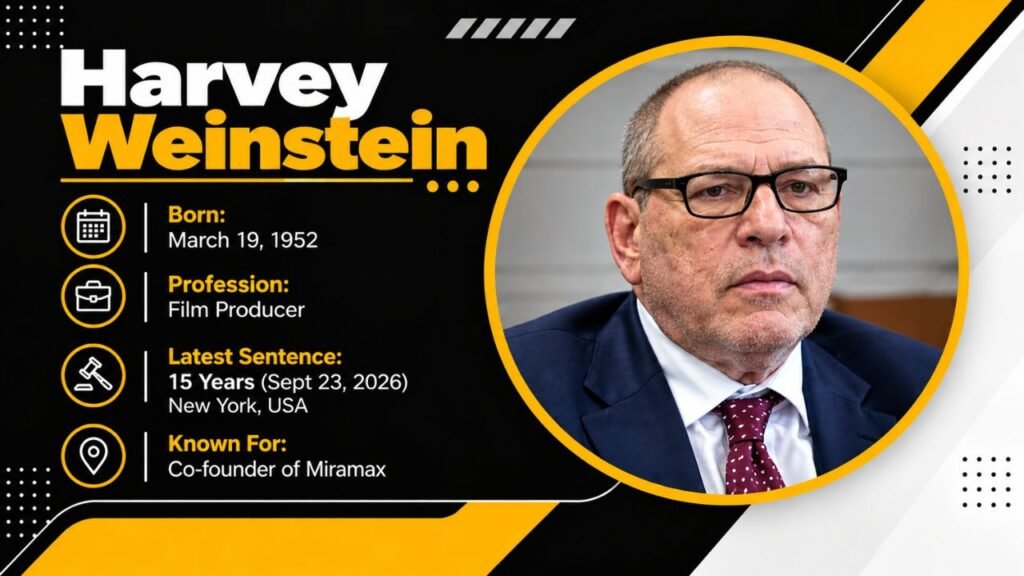
Fifteen more years. That was the message a Manhattan judge delivered to Harvey Weinstein on Wednesday. He’s 74. Back in the nineties, a single phone call from him could get a movie made or sink it, and that life is long gone. The articles that ended it ran almost nine years ago, and the legal process they set off still hasn’t finished.
The sentencing is only the latest twist. Between the first accusations and this week’s ruling, Weinstein has been convicted, sentenced, convicted again in another state, saved by an appeals court, retried, partly acquitted and sentenced once more. Few defendants in American history have taken a route this crooked.
This piece sorts through it all: the man and his rise, the allegations, the trials, the sentence, his health and living situation, his money and what he leaves behind in film. It also flags what remains unsettled, because a good deal still is.
Case Snapshot
| Detail | Information |
| Who | Harvey Weinstein, 74, former film producer |
| Company history | Co-founded Miramax, later The Weinstein Company |
| Newest ruling | 15-year sentence on Wednesday, September 23, 2026 |
| Presiding judge | Curtis Farber |
| Conviction behind it | Criminal sexual act involving Miriam Haley, from a 2006 incident |
| Requests to the judge | Defense: 9 years. Manhattan DA: 20 years |
| First New York sentence | 23 years (2020), later overturned |
| California sentence | 16 years (2023) |
| Public accusers | More than 80 women since 2017 |
| Custody | New York City jails, moving between Rikers Island and Bellevue Hospital |
| What’s next | Defense says it will appeal the conviction and the sentence |
Who Is Harvey Weinstein?
Before 2017, most people knew the Weinstein name from the opening credits. He and his brother Bob started Miramax in the late 1970s, and for about thirty years the studio more or less defined what an indie movie could be. Pulp Fiction, The English Patient, Shakespeare in Love, The Crying Game, Chocolat. All Miramax. The trophies came right along with them.
In 2005 the brothers broke away and launched The Weinstein Company. The hits didn’t stop: The King’s Speech, Silver Linings Playbook. Harvey dabbled in television as well, and Project Runway was one of the results.
Then there was Oscar night, his natural habitat. Every year he turned up with a pack of nominees and a reputation for running the sharpest campaign in town. It cut both ways. Studio heads respected him and were a little scared of him, too. Young actors and filmmakers looked at him and saw the guy who could make things happen for them. When one person has that much say over that many careers, the balance of power tilts hard, and that tilt is the thread running through almost every accusation that came later.
Where He Started
Movies weren’t where he began. Born in 1952, Weinstein spent the seventies in upstate New York promoting concerts and booking bands, hustling for every date, the kind of work that favored whoever pushed hardest and refused to quit. He brought that habit along when he and Bob moved into film distribution and started Miramax.
Then came 1989. sex, lies, and videotape cost very little, earned a great deal, and is widely seen as the spark behind the modern indie boom. Miramax stopped being an unknown company practically overnight.
The playbook from there was to buy strange, risky films the big studios didn’t want and sell them with the volume of a summer tentpole. People mocked his awards-season operation and envied it in roughly equal measure. He lobbied, hosted, leaned on voters and treated every campaign like an election. Competitors grumbled, then copied him. The way studios chase Oscars today owes a lot to what he did.
October 2017: The Stories That Brought Him Down
Two investigations, both published in October 2017, started it. The New York Times and The New Yorker each reported accusations of sexual harassment and assault reaching back decades. They wrote about quiet payouts, signed confidentiality agreements and a workplace where employees learned to say nothing. Within days his own company had pushed him out, and the Academy of Motion Picture Arts and Sciences had voted to expel him.
More than 80 women have accused him publicly of assault or harassment since then. Some are actresses and models whose faces you’d know. Many more are names you wouldn’t: assistants, junior staffers and production workers with little room to say no to the man who controlled who got hired. Weinstein denies ever raping anyone and maintains that his encounters were consensual.
All of it fed into #MeToo, and the movement went on to bring down powerful men in entertainment, media, politics and business. His case is often treated as its first chapter, and every trial since has doubled as a test of how courts handle accusations that are decades old.
Timeline: How the Case Unfolded
The order matters here, so this is the sequence:
- October 2017: The two investigations run. Within days he’s fired from The Weinstein Company and expelled from the Academy.
- 2018: He’s arrested in New York on rape and criminal sexual act charges. The Weinstein Company goes bankrupt the same year.
- February 2020: A Manhattan jury finds him guilty of a criminal sexual act involving Miriam Haley and of third-degree rape involving Jessica Mann. On the most serious charge, predatory sexual assault, it finds him not guilty.
- March 2020: The sentence is 23 years in a New York prison.
- December 2022: A different jury, this time in Los Angeles, convicts him of rape and two counts of sexual assault tied to a 2013 incident involving an Italian actress and model.
- February 2023: The California judge adds 16 years.
- April 2024: The New York Court of Appeals overturns the 2020 conviction because jurors had heard testimony unrelated to the charges. A new trial is ordered.
- 2025: Second trial in Manhattan. He’s found guilty again, this time on a first-degree criminal sexual act involving Haley.
- September 23, 2026: Judge Farber imposes 15 years.
With this much back and forth, it’s no wonder people keep typing “Is Harvey Weinstein in jail?” into search engines. The honest answer depended on the year.
Behind Bars: Where Weinstein Is Being Held
Yes, he’s still locked up, with no bail and no release in sight. Since 2020 he has mostly been held in the New York City jail system, apart from short spells in state prisons upstate. When the 2020 conviction was tossed in 2024, he was sent back to city custody until the retrial.
His health has been a constant complication. Filings from his legal team list a long series of conditions: cancer, diabetes, extensive coronary artery disease, reduced blood flow to the heart, obstructive sleep apnea, thyroid problems, obesity, chronic back and leg pain, anemia and high blood pressure. People close to him have also said he has been diagnosed with leukemia, and he has undergone heart procedures while in custody.
The upshot has been repeated emergency moves between Rikers Island, where he’s mostly lived in the jail’s infirmary rather than among general inmates, and Bellevue Hospital’s prison ward in Manhattan. This summer he was hospitalized at Bellevue with severe breathing trouble linked to pneumonia. Once he recovered enough, he went back to custody. His attorneys have also sued the city’s Department of Correction, claiming he did not receive proper medical treatment.
Given that he also owes the California sentence, and an appeal is underway, his location may keep shifting among a state prison, Rikers and Bellevue depending on his health and on the appeals.
Fighting Over the Verdict: California, the Reversal and the Retrial
The California Conviction
While New York’s case bounced around the appeals system, California wrapped up its own. A Los Angeles jury found him guilty in December 2022 of rape and two counts of sexual assault involving a 2013 incident with an Italian actress and model. The judge added 16 years the following February.
Don’t file that under footnotes. Different accuser, different evidence, different jurors, so it never depended on how New York turned out. When New York’s top court wiped out the first conviction, Weinstein stayed in prison. The California sentence just kept running alongside whatever New York decided next.
The 2024 Reversal
The April 2024 ruling from New York’s Court of Appeals caught plenty of people off guard, so precision matters. The judges did not declare Weinstein innocent. They didn’t say the accusations were false, either. Their problem was with fairness at trial. The trial judge, they concluded, shouldn’t have let jurors hear from women whose allegations weren’t among the charges being decided.
His defense read it as proof of what they’d been arguing from the start. Prosecutors and the women involved read it as a reset button: everything had to be done over. Haley, whose account sat at the center of both trials, agreed to take the stand again.
That choice gave the retrial a significance beyond one defendant. Could an accuser stay the course after a reversal? Would a fresh jury, without the material the appeals judges had objected to, land in the same place?
The Retrial and Its Split Verdicts
Round two didn’t play out like round one. On the count involving Haley, jurors were unanimous: guilty, for the same conduct behind the 2020 verdict. On a separate count involving a Polish model who was 19 at the time, they voted not guilty.
Getting there was rough. After several days of deliberation, the foreperson said another juror had threatened them. The judge didn’t press on. He declared a mistrial on the third-degree rape charge involving Jessica Mann. Prosecutors said they would try it again, and Mann has said she’s ready to keep going.
Neither side got a clean victory. Weinstein’s lawyers called the whole thing unfair and vowed to appeal. Supporters of the prosecution countered that a brand-new jury, starting from zero, had landed on the same guilty verdict for Haley’s allegation.
A Quick Note on Terminology
Years into a story like this, it gets hard to keep allegations, convictions, reversals and acquittals apart, but they aren’t interchangeable. Dozens of women have gone public. Only some of their accounts turned into criminal charges, and those charges ended in convictions, acquittals, one mistrial and one conviction that was later overturned. Weinstein disputes the accusations, says the encounters were consensual, and is entitled to appeal.
These aren’t technical footnotes. They’re what the courts have spent almost a decade trying to sort out.
Sentencing Day: Who Said What
Going in, the defense was asking for nine years and the Manhattan DA’s office for twenty. Judge Curtis Farber picked fifteen, landing in the middle of the two requests, although the law allowed him to go as high as twenty-five.
The count stems from 2006, when Miriam Haley was working as a production assistant on Project Runway. It closes out, for the time being, the New York portion of a fight that began with his original conviction in 2020 and has now run longer than six years.
Assistant District Attorney Nicole Blumberg was the one pushing for more time. Her pitch was simple: no remorse. In her telling, Weinstein hadn’t budged an inch, and he’d gone right on sniping at the women who accused him. A podcast appearance, she said, proved it.
Then Weinstein spoke. Sorry for what Haley had endured, he said. And yet he came back, once more, to the position he has held from the start: no rape, nothing illegal.
Haley had the last word. She told the judge that the hearings and trials, stretched over so many years, had chipped away at her sense of safety, and that speaking up is something she will live with for a long time.
Bragg spoke to reporters outside the courthouse once it was over. For survivors, he said, the day mattered, and he thanked Haley for testifying at two separate trials. On Weinstein’s side, the lawyers are already preparing an appeal, so no one was calling Wednesday final.
The Lawyers Running the Case
Judge Curtis Farber ran the retrial and set the fifteen-year term. The case was brought by Manhattan District Attorney Alvin Bragg’s office, and Bragg personally thanked Miriam Haley outside the courthouse. Assistant District Attorney Nicole Blumberg made the argument for twenty years, telling the judge that Weinstein hadn’t shown genuine remorse.
Weinstein’s defense team sits on the other side. Its lawyers requested nine years, have called the retrial unfair, and plan to appeal both the verdict and the sentence. They can point to precedent in their own case: a similar appeal succeeded in 2024.
What a 15-Year Sentence Actually Means
A number like fifteen sounds simple, but the arithmetic in Weinstein’s case isn’t. Because the judge could have imposed as many as 25 years, this sentence sits well below the limit, and closer to what the defense wanted than what the DA sought..
Age and health matter here too. He’s 74 and his lawyers have described a long list of medical conditions, so a lengthy sentence carries a different weight than it would for someone younger. People who back the prosecution say those factors have no bearing on how serious the crimes were. His defense says they are central to whether the punishment fits. By choosing fifteen years over twenty, the judge appears to have given the defense some credit.
Weinstein Appeal: What Comes Next
The next big moment is the appeal. His lawyers say they’ll fight both the retrial conviction and the fifteen-year term, and they have a track record to point to: the 2024 reversal showed that New York’s top court will overturn a Weinstein verdict when it spots a flaw.
But the landscape is different now. A separate California conviction stands on its own, and prosecutors have said they want to try the Jessica Mann count again. Winning in New York wouldn’t automatically open a cell door.
For the women who’ve testified, each new hearing means more waiting and more time on the stand. For Weinstein, whose health is fragile, it could mean the rest of his life moving in and out of custody. Whichever way it goes, this story won’t be leaving the news cycle soon.
Harvey Weinstein’s Wife and Family
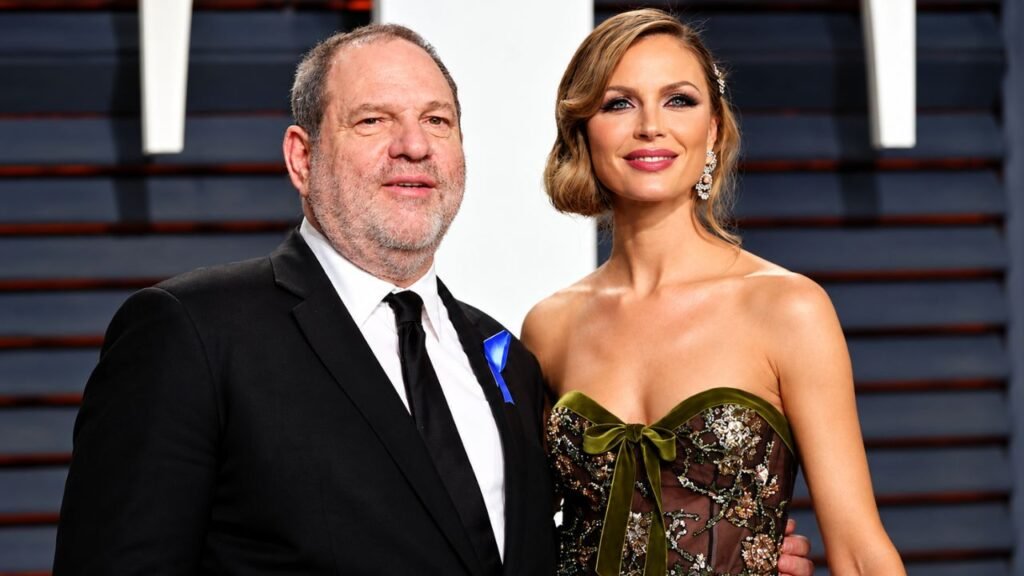
The wife most people know about is Georgina Chapman, the British designer who co-founded Marchesa. They married in 2007 and have two children. For years she was a regular at his side on red carpets.
Autumn 2017 ended that. Within days of the first reports, Chapman said she was leaving. Her kids came first, she said. The divorce was finalized over the following years. He’d been married once before, to Eve Chilton, and they have children too.
Since then his family has mostly stayed out of the spotlight, popping up only when it brushes against the case.
Harvey Weinstein Net Worth: How Much Is Left?
“Harvey Weinstein net worth” is a hugely popular search, and the honest response is that no one outside his private circle knows. Numbers online are scattered. Some outlets claim tens of millions, some show a negative balance, and estimates of his peak wealth go as high as $300 million or more.
The direction is clearer than the total. Since 2017, that fortune has melted away. Settlements, growing legal bills, the collapse of his company into bankruptcy in 2018 and the loss of any earning power in film have each taken a bite.
With so much disagreement, the fairest summary is that he went from a nine-figure fortune to a picture dominated by debt, legal fees and lost income, whatever the precise number.
The Other People in the Case: Accusers, Attorneys and the Judge
| Name | Role | Where things stand |
| Harvey Weinstein | Defendant | Serving a 15-year New York term plus California’s sentence; appeal planned |
| Miriam Haley | Accuser in the New York case | Testified in both trials; spoke at sentencing |
| Jessica Mann | Accuser | Testified in 2020 and 2025; a rape count involving her ended in mistrial |
| Curtis Farber | Judge | Imposed the 15-year sentence |
| Alvin Bragg | Manhattan District Attorney | Led the prosecution; thanked Haley outside court |
| Nicole Blumberg | Assistant District Attorney | Argued for 20 years |
| Georgina Chapman | Former wife | Left in 2017; marriage ended in divorce |
Who Is Miriam Haley? A Brief Look at the Accuser in the New York Case
It’s easy for a case this long to turn entirely into a story about the accused, with the studio empire, the courtroom fights and the money all pulling attention his way. But the New York conviction rests on one woman’s account.
Miriam Haley was a production assistant on Project Runway at the time of the 2006 incident behind the conviction. She testified at the 2020 trial and, after that verdict was thrown out, agreed to testify again in 2025. At this week’s sentencing she spoke to the court herself, describing how the years of proceedings had shaken her sense of safety. Her account is the thread that runs through both New York trials.
Why the Case Matters Beyond Hollywood
Part of the reason this case travels far beyond a Manhattan courtroom is what Weinstein’s work meant to the industry, and what it means now.
There’s no easy way to put this: Weinstein’s films changed American movies for a generation. Through Miramax and The Weinstein Company he produced or distributed Pulp Fiction, Good Will Hunting, The English Patient, Shakespeare in Love, Chicago, Gangs of New York, The King’s Speech, Silver Linings Playbook and The Artist, plus dozens of others. Several won Best Picture. His campaign methods became the template for how modern awards seasons work.
Celebrating any of that has become complicated. Since 2017, many in Hollywood have openly distanced themselves from him, even though the movies remain part of film history. The awkwardness comes back every awards season, whenever one of his older productions is mentioned.
Where Things Stand
Weinstein’s case remains one of the most closely watched legal sagas in recent American life. It runs through some of Hollywood’s most celebrated films, a movement that changed workplaces around the world and years of courtroom battles in two states.
A new fifteen-year sentence is on the books, and an appeal is already promised. For today, the essentials are plain. He’s in custody, the fortune he once controlled has collapsed, and the reckoning that began in 2017 is still working its way through the courts.
Read More Stories: Shannon Crawley | Aileen Wuornos | Albert Anastasia
Frequently Asked Questions
Yes. He’s held in New York City custody, moving between the infirmary at Rikers Island and Bellevue Hospital’s prison ward.
Fifteen years. Judge Curtis Farber issued it on September 23, 2026, for the criminal sexual act conviction involving Miriam Haley.
The defense asked for nine years. The Manhattan District Attorney’s office asked for twenty.
More than 80 have publicly accused him of assault or harassment since 2017. His criminal convictions involve a smaller number of specific cases in New York and Los Angeles.
Pulp Fiction, Shakespeare in Love, The English Patient, The Crying Game, Chocolat, The King’s Speech and Silver Linings Playbook, among others.
In New York custody, with his health problems regularly sending him to Bellevue.
Source: WikiPedia