There’s a small handful of names from the old Mafia era that still stop people mid-scroll, and Albert Anastasia is one of them. Back in his day, people called him “The Mad Hatter” and “The Lord High Executioner” – nicknames he earned the hard way, over three decades spent as one of the most feared men organized crime ever produced. Then, one October morning in 1957, it ended fast. Ten seconds of gunfire in a barbershop chair, and that was it. What makes this story stick around so long after the fact is simple: nobody was ever convicted. That single unanswered question – who actually killed him – is why people are still typing “Albert Anastasia death” into search bars and arguing about it on true-crime forums today.
What follows is the story pieced together from court records, old newspaper coverage, and decades of writing on the American Mafia – how a runaway deckhand turned into the head of Murder, Inc., what his marriage and home life actually looked like, the mistakes that quietly turned allies into enemies, the killing itself, and the theories about who was behind it that have never quite been put to rest.
Who Was Albert Anastasia?
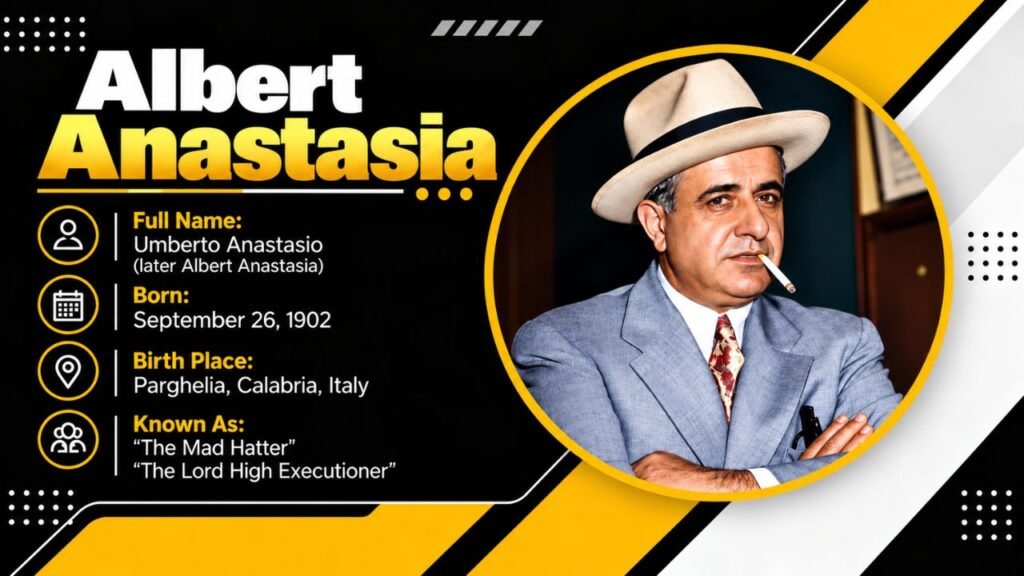
He came into the world as Umberto Anastasio on September 26, 1902, in a little coastal town called Parghelia, tucked into the Calabria region of Italy (a few sources say it was nearby Tropea instead). His dad worked on the railways and passed away not long after World War I ended, which left his mother raising something like a dozen kids more or less alone. There wasn’t much reason to stick around after that, so a few of the boys headed off to sea to earn a living.
Anastasia couldn’t have been older than fifteen when he signed on as a deckhand aboard an Italian merchant ship. The ship pulled into Brooklyn at some point, and that’s when he and his brother Anthony – who’d later pick up the nickname “Tough Tony” – jumped off and just… stayed. Illegally, at first. They found their footing on the New York docks, and that waterfront world ended up shaping the rest of Anastasia’s life; it’s where his power base sat for the next forty years.
Even young, he had a way of ending up in trouble. By 1921 he’d been convicted of killing a fellow dockworker and was sentenced to die for it, spending around eighteen months on death row at Sing Sing before finally landing a retrial. And here’s where a pattern starts that would follow him for the rest of his career: the whole case just fell apart. Witnesses went missing. Others suddenly couldn’t recall what they’d seen. He was let go. Soon after, he dropped “Anastasio” for “Anastasia” – some say to keep the family name clear of whatever was coming next.
Albert Anastasia – Case Profile
| Attribute | Details |
| Full Name | Umberto Anastasio (later Albert Anastasia) |
| Born | September 26, 1902, Calabria, Italy |
| Died | October 25, 1957 (age 55), New York City |
| Cause of Death | Gunshot wounds, barbershop assassination |
| Nicknames | The Mad Hatter, The Lord High Executioner, The One-Man Army, The Earthquake |
| Spouse | Elsa Bargnesi (married 1937) |
| Children | 4 |
| Criminal Organization | Murder, Inc.; Mangano/Anastasia crime family (later Gambino crime family) |
| Predecessor as Boss | Vincent Mangano |
| Successor as Boss | Carlo Gambino |
| Resting Place | Green-Wood Cemetery, Brooklyn, New York |
| Prior Convictions | Murder (1921, later overturned); illegal firearm possession (1923); tax evasion (1955) |
Albert Anastasia’s Rise Through the Mafia
His start in the business was about as basic as it gets: he was muscle. Through the 1920s, he worked as bodyguard and enforcer for Mafia boss Vincent Mangano, at exactly the moment New York’s Italian gangs were organizing themselves into what became the “Five Families” – a structure people still reference today. He was right in the middle of the Castellammarese War in 1930 and 1931, and by most accounts, he had a hand in killing boss Giuseppe “Joe the Boss” Masseria in ’31, one of the hits that basically decided that whole conflict.
That same stretch of years is when his name got tied permanently to Murder, Inc. – the crew that carried out contract killings for Mafia bosses nationwide, running under Lucky Luciano’s larger network. Anastasia helped get it off the ground and eventually took full control of it, and the ease with which he’d order – or personally carry out – a hit gave him a reputation that made other gangsters nervous just being around him.
By 1951, he’d made it all the way to the top of his own family. That’s the year Vincent Mangano simply disappeared, never to be found, and while nothing was ever proven, just about everyone assumed Anastasia was responsible. With Mangano gone, he stepped into the boss role – the same family that would, years down the line, carry the name of the man who took over after him: Carlo Gambino.
Marriage and Family Life
Strange as it sounds given everything else, Anastasia’s domestic life came across as almost normal. He married Elsa Bargnesi in 1937, and the pair raised four kids together. People who knew him – and writers who’ve dug into his life since – tend to bring up the same detail: whatever chaos he was running during the day, he kept a pretty steady routine at home, often making a point of being back with his family come evening.
There’s also a stretch, 1942 through 1944, where he served in the U.S. Army in a labor role tied to the wartime docks – service that reportedly smoothed his way toward becoming a citizen. So publicly, he looked like any other family man. Privately, he was steering one of the deadliest operations the country’s criminal underworld had ever seen. That contradiction is still one of the things people find hardest to square when they read about him.
Warning Signs and a Widening Circle of Enemies
His violence didn’t stay confined to rival gangsters. In 1952, a clothing salesman by the name of Arnold Schuster helped police track down and arrest a wanted bank robber. Once his part in it made the papers, Anastasia reportedly lost it – the idea of an ordinary citizen helping police just set him off – and had Schuster killed, even though the man had absolutely nothing to do with organized crime. Even his fellow bosses thought that was crossing a line. It cost him some standing, since plenty of them figured a killing like that would only bring unwanted heat down on the whole operation.
Legal trouble kept piling on from there. In 1954, tax authorities came after him once he’d built himself a ridiculously lavish cliffside mansion in Fort Lee, New Jersey – a home that simply didn’t line up with what he was claiming to earn. He was found guilty of tax evasion in 1955 and did roughly a year in prison for it.
Meanwhile, cracks were spreading through the Mafia’s ruling Commission. Anastasia had backed Frank Costello, the Commission’s most powerful figure at the time, but Costello had a rival in Vito Genovese, who was quietly lining up support – reportedly from Meyer Lansky, and, far more troubling for Anastasia, from his own underboss, Carlo Gambino. When Genovese finally moved against Costello in 1957, Costello lived through an attempt on his life but stepped down from leadership anyway. And that left Anastasia standing alone, more exposed than he probably realized.
The Barbershop Assassination
The morning of October 25, 1957, started out unremarkable enough. Anastasia left his mansion in Fort Lee and headed into Manhattan for a haircut and shave, something he did regularly at the barbershop inside the Park Sheraton Hotel. At some point his bodyguard stepped out – to park the car, or run a short errand, depending on the account – leaving Anastasia by himself in the barber’s chair, eyes closed, facing a wall of mirrors.
Two masked men walked in and opened fire, letting off somewhere around ten shots at close range. Some versions of the story say a stunned Anastasia lunged at his attackers but actually went after their reflections in the mirror instead of the men themselves. Either way, he went down and didn’t get back up.
The gunmen simply walked back out onto the street and disappeared into the crowd. No weapon was ever found. Nobody was ever arrested. Nobody was ever charged with anything.
Who Killed Albert Anastasia?
Nearly seventy years later, this is still the part of the story nobody can nail down for certain. No court ever confirmed who was behind it. Investigators at the time, and organized-crime historians ever since, have mostly landed on two names for who gave the order. Vito Genovese, the man pushing for control of the Commission, and Carlo Gambino, Anastasia’s own underboss. Who ended up gaining the most from the whole thing. Within days, Gambino had taken over the family outright – and it wasn’t long before. It carried his name instead, a name that’s stuck to this day.
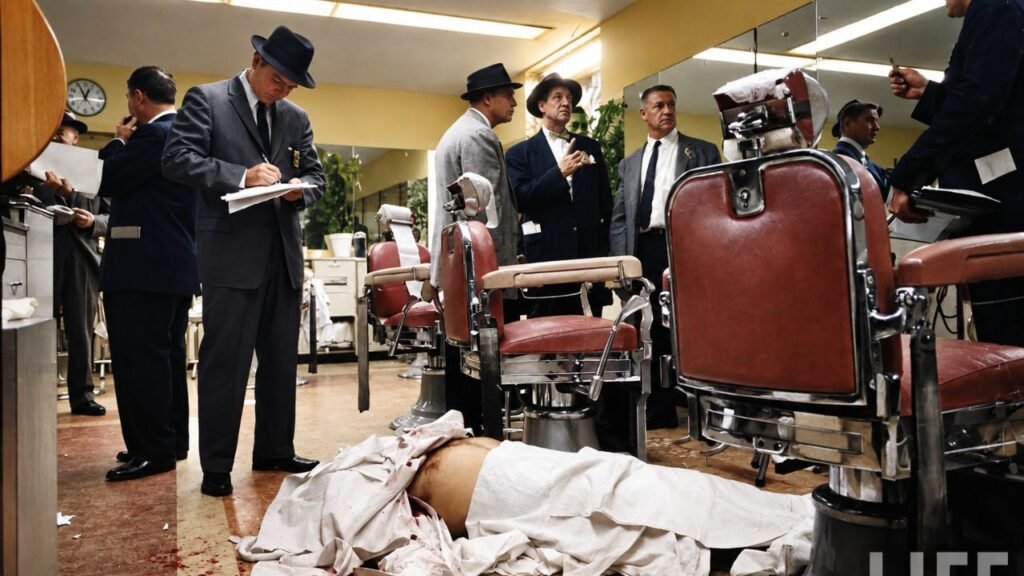
Pinning down who actually fired the shots is even murkier. Law enforcement has, over the decades, linked the hit to a crew connected to rival. Boss Joseph Profaci, with the actual job apparently handed to a young Joe Gallo and a few of his associates. Sometimes referred to, half-jokingly, as the “barbershop quintet.” None of it was ever proven in front of a judge or jury. Officially, the Albert Anastasia murder still sits among the biggest unsolved hits in American Mafia history.
Aftermath and the Fall of an Era
His death did a lot more than end one man’s career – it reshuffled the entire New York Mafia. Carlo Gambino, the one who came out of it with the most, moved quickly to lock down control, and he ended up leading what became the single most influential of the Five Families for close to two decades. Eventually the whole organization carried his name for good.
The killing also brought a lot more law-enforcement pressure down on organized crime across the country. Just weeks later came the now-famous Apalachin Meeting raid, when police stumbled onto a gathering of top mob bosses from all over. A sit-down that, by most accounts, was called at least partly to work through the mess left behind by Anastasia’s death.
He was laid to rest at Green-Wood Cemetery in Brooklyn, buried under the name he was born with, Umberto Anastasio. His wife, Elsa, and their four kids were left to carry on without him. Tied forever to a name that had become inseparable from one of the darkest chapters in American organized-crime history.
Why the Albert Anastasia Case Still Gets Attention
A big part of why this story hasn’t faded is exactly what makes it so frustrating. There was never a trial, never a conviction, never a real, official answer. The image of one of the most feared killers in the country getting gunned down mid-shave, caught completely off guard and unarmed. Has become one of the most referenced moments in Mafia history. It shows up in documentaries, in books, even in a well-known nod on The Sopranos decades later.
Then there’s the bigger picture of who he actually was – a teenager who jumped ship in Brooklyn with nothing to his name, clawed his way into becoming one of the most feared men in the American underworld through raw violence and intimidation, only to be taken down by the exact kind of betrayal he’d built his whole career on. The men standing closest to him, his own underboss included, are widely believed to be the ones who set the trap that finally got him.
Case Timeline
| Date | Event |
| 1902 | Umberto Anastasio born in Calabria, Italy |
| ~1917 | Jumps ship in Brooklyn with brother Anthony; settles in New York |
| 1921 | Convicted of murder, sentenced to death; later wins retrial and is released after witnesses disappear |
| 1930–31 | Plays a role in the Castellammarese War and the killing of Joe Masseria |
| 1937 | Marries Elsa Bargnesi |
| 1942–1944 | Serves in the U.S. Army |
| 1951 | Becomes boss of the Mangano crime family after Vincent Mangano’s disappearance |
| 1952 | Orders the killing of Arnold Schuster, damaging his standing among other bosses |
| 1954–1955 | Tried and convicted of tax evasion; serves roughly a year in prison |
| 1957 (spring) | Vito Genovese moves against rival boss Frank Costello |
| October 25, 1957 | Anastasia shot and killed in the Park Sheraton Hotel barbershop |
| Days later | Carlo Gambino takes control; family later renamed the Gambino crime family |
| November 1957 | Apalachin Meeting raid exposes a nationwide gathering of Mafia leadership |
Fallout for the Brittany Gosney Family
In court, James’s father, Lewis Hutchinson, talked about the grief he’d been carrying since his son’s death. The two Brittany Gosney kids who survived were placed in the custody of Butler County Children’s Services, and prosecutors made sure to point out the trauma these kids had gone through – not just watching the abuse happen inside the Brittany Gosney house, but living through everything that came after it too. The case also put Ohio’s child-welfare system under a harsh spotlight, mainly because of how much prior history there already was with this family long before any of this happened. Even now, it gets brought up whenever people talk about how a controlling, coercive relationship can spiral into violence against children.
What the Case Exposed About Mafia Power Struggles
Setting the killing itself aside, this case became something of a case study in how organized crime actually polices itself. The fact that Anastasia was taken out by his own underboss – someone who knew the operation inside and out – raised uncomfortable questions about how little loyalty actually meant at the top of these organizations.
It’s now a case people point to when talking about the fragile power balance inside the Commission, how quickly alliances shifted once one boss looked weak, and how law enforcement’s own pressure on men like Frank Costello indirectly helped set the stage for Anastasia’s downfall, much like in the wider Genovese-Gambino-Costello power struggle of 1957.
Read Also: Al Capone | Caleb Flynn | Shannon Crawley
FAQ
An Italian-American mobster, born Umberto Anastasio, who helped start the contract-killing crew Murder, Inc. and eventually rose to run what became known as the Gambino crime family.
Nobody was ever charged. Most accounts from historians and law enforcement point to rival boss Vito Genovese and Anastasia’s own underboss, Carlo Gambino, as the ones behind the order, with the actual shooters believed to be tied to a crew under Joseph Profaci – including a young Joe Gallo. Officially, it’s still unsolved.
He was shot dead on the morning of October 25, 1957, inside the barbershop of the Park Sheraton Hotel in Manhattan.
Elsa Bargnesi, whom he married in 1937. Together they had four children.
He co-founded and ran Murder, Inc., worked his way up as a top enforcer under the Mangano crime family, and took over as boss in 1951 once Vincent Mangano vanished.
No. Despite years of digging and no shortage of theories, nobody was ever formally charged, let alone convicted.
Carlo Gambino stepped into control within days, and before long the family carried his name – becoming the Gambino crime family, which he led for close to twenty years.
Source: WikiPedia