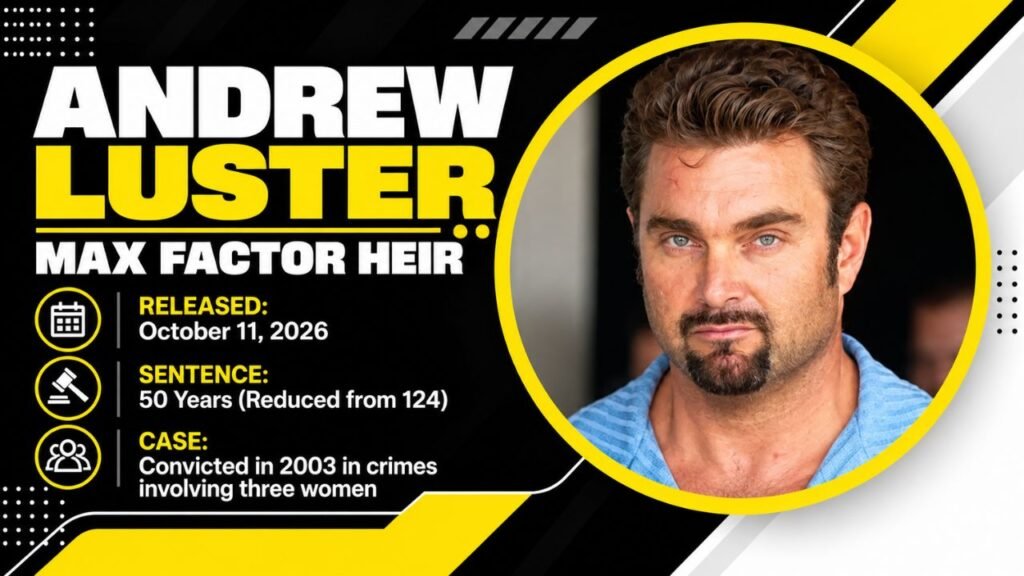
Few California criminal cases have combined old Hollywood money, a courtroom escape and a cross-border manhunt the way the case against Andrew Luster did. On October 11, 2026, the 62-year-old great-grandson of cosmetics founder Max Factor Sr. walked out of a California prison after serving about twenty years for drugging and raping three women. His original sentence, handed down in 2003, was 124 years. The news became public on October 20, and officials in Glendora, where he now lives, responded with open alarm.
The case took more than two decades to reach this point, moving from a 2000 arrest and a Ventura County trial through a flight to Mexico, a recapture by bounty hunter Duane “Dog” Chapman, a successful habeas petition that wiped out the 124-year term, and a resentencing to 50 years. Along the way it pulled in a prosecutor’s office that fought his release at every turn, three survivors who attended parole hearings, and a change in California law that arrived too late to affect him.
Case Snapshot
| Detail | Information |
| Full name | Andrew Stuart Luster |
| Age | 62 in 2026 (born December 15, 1963, Las Vegas); 36 at his 2000 arrest |
| Charges | 86 felony counts involving three women, including rape, sodomy and oral copulation |
| Drug used | GHB |
| Verdict | Guilty on all counts, returned in absentia, January 2003 |
| Original sentence | 124 years in prison |
| Resentenced | 50 years, April 16, 2013 (48 years for the rapes, 2 for drug counts) |
| Victims | Three women |
| Offense period | October 1996 to July 2000 |
| Family link | Great-grandson of Max Factor Sr. |
| Captured | June 2003, Puerto Vallarta, Mexico, by Duane “Dog” Chapman |
| Released | October 11, 2026 |
| Release conditions | Lifetime sex offender registration; three years of parole; no contact with victims |
| Prosecuting office | Ventura County District Attorney (Erik Nasarenko) |
| Current residence | Glendora, California |
Who Is Andrew Luster?

Andrew Stuart Luster is a Southern California man who, before 2000, was known mainly for his family name. He was not a celebrity, an executive or a public figure in any ordinary sense. His mother was the adopted daughter of Freda Factor, the daughter of Max Factor Sr., which made Luster the great-grandson of the makeup pioneer who built a cosmetics empire serving Hollywood studios. He became widely known because of what prosecutors proved he did to three women, and because of how dramatically he tried to avoid answering for it.
The “Max Factor heir” label sticks to nearly every headline about him, but it can mislead. He was a descendant of the founder, not the owner of the company, and by the time of his trial the business had long since left the family’s hands. His own wealth was largely spent or lost afterward, through legal costs, civil judgments and bankruptcy.
Before any of that reached a courtroom, though, a single report to police set off an investigation that would unravel years of conduct he had recorded himself.
Andrew Luster Arrested: The 2000 Investigation
The story of Andrew Luster’s arrest begins in July 2000, when a college student told police she had been raped at his home. Detectives obtained a search warrant for the property and found video recordings that showed Luster drugging and assaulting her. Additional tapes at the residence showed two other women being abused. Investigators determined he had used GHB, a date-rape drug, to leave his victims unconscious.
Prosecutors charged him with 86 felony counts covering the three women between October 1996 and July 2000. Because the recordings documented the assaults, and because prosecutors said Luster gloated about the crimes on film, the defense faced a difficult task in arguing that the encounters were consensual.
Quick timeline of the arrest phase:
- Oct. 1996 to July 2000 – Period of the offenses charged against Luster
- July 2000 – College student reports rape; police search his home and find video recordings
- July 2000 – Luster arrested; additional tapes show two other victims
- 2000 to 2002 – Case builds toward a Ventura County jury trial on 86 counts
The Trial and the Escape to Mexico
Luster’s trial began in late 2002, but it did not follow the usual path. About two weeks into proceedings, he persuaded the judge to relax the conditions of his bail so he could visit his lawyer in Los Angeles over the holidays. Instead of returning, he paid someone to smuggle him across the border into Mexico.
The trial went on without him. In January 2003 the jury returned guilty verdicts on all counts in his absence, and the judge imposed a sentence of 124 years in prison. The FBI issued a federal warrant for unlawful flight to avoid prosecution that same month. For roughly six months, Luster remained out of reach, hiding in Mexico while a sentence that would have kept him locked up for life sat unserved.
That flight mattered for years afterward. Because he had fled, California courts refused to hear his direct appeals, applying a long-standing rule that fugitives forfeit the right to appeal. The state supreme court and the U.S. Supreme Court both declined to overturn that ruling.
Andrew Luster and Dog the Bounty Hunter: The Capture
The manhunt ended in June 2003 in Puerto Vallarta, Mexico, where bounty hunter Duane “Dog” Chapman and his team located and detained Luster. The arrest turned into an international story for an unusual reason: Mexican police arrested both Luster and Chapman, because bounty hunting is not legal in Mexico. Luster was ultimately handed over to American authorities and returned to California to begin serving his sentence. It is worth remembering that the chase was only one chapter. The case itself was about three women, and about the recordings that proved what happened to them.
Andrew Luster Case: Stage-by-Stage Breakdown
| Stage | What Happened |
| July 2000 | Arrest after a student reports rape; search warrant uncovers video recordings |
| Late 2002 | Trial begins in Ventura County on 86 counts |
| Dec. 2002 | After bail conditions are loosened, Luster flees to Mexico |
| Jan. 2003 | Jury convicts in absentia; 124-year sentence imposed; FBI warrant issued |
| June 2003 | Captured in Puerto Vallarta by Duane “Dog” Chapman; returned to the U.S. |
| 2009 | Luster files a petition for habeas corpus |
| April 2012 | Habeas petition granted |
| March 11, 2013 | Ventura County Superior Court vacates the 124-year sentence, not the convictions |
| April 16, 2013 | Judge Kathryne Stoltz resentences Luster to 50 years |
| 2024 | Becomes parole eligible; early parole denied after victims oppose |
| 2025 | Parole denied again; California reclassifies drug-facilitated assault as a violent felony |
| Oct. 11, 2026 | Released from prison |
| Oct. 20, 2026 | Release becomes public; Glendora officials react |
A note on “Andrew Luster net worth” searches: This is a commonly searched term, but it is a bit misleading. Luster’s family connection to Max Factor suggests great wealth, yet there is no confirmed current figure. Two of his victims won civil lawsuits ordering him to pay a total of about $40 million, and he reportedly sold most of his property and declared bankruptcy afterward. No reliable reporting describes his present finances.
Evidence categories at the center of the case:
- Video recordings found during the 2000 search of Luster’s home
- Recordings showing three separate victims
- Evidence that GHB was used to incapacitate the victims
- Testimony from the survivors
- Records of his flight and the January 2003 federal warrant
Andrew Luster Sentence Reduced: From 124 Years to 50
Because the original verdict and sentence were issued while Luster was absent, the case took an unusual route back to court. In 2009 he filed a habeas corpus petition, which was granted in April 2012. On March 11, 2013, the Ventura County Superior Court vacated the 124-year sentence, though not the convictions, on a procedural ground: the trial judge had failed to state specific reasons for ordering the terms to run consecutively.
On April 16, 2013, Judge Kathryne Stoltz resentenced Luster to 50 years, made up of 48 years for the rapes and two years for drug-related charges. That decision cut his exposure by more than half and set the clock for everything that followed. The District Attorney’s Office has said it fought to preserve the original sentence at every opportunity, and that drugging women, assaulting them and filming it calls for the strongest penalties.
Andrew Luster Released: Why He Is Free and What the Rules Are
Luster became eligible for parole in 2024. At every hearing, his three victims attended to oppose his release, and prosecutors argued that he remained a highly dangerous offender. The District Attorney’s Office succeeded in blocking early parole in both 2024 and 2025. According to the office, he then reached his maximum confinement date under the reduced 50-year term, and he was released on October 11, 2026.
Some Glendora-area officials have pointed instead to Proposition 57, the 2016 California ballot measure that expanded early-parole consideration, as having sped up his release. Reports differ on how much that law played a role, and readers should treat the District Attorney’s explanation, which centers on the 2013 sentence reduction and the maximum confinement date, as the clearest official account available.
One further detail has drawn attention. In 2025, California amended its law to classify drug-facilitated sexual assaults as violent felonies, which requires offenders to serve a greater share of their sentences. The District Attorney noted that the change came too late to affect Luster, who was sentenced and resentenced years earlier.
Luster’s conditions after release:
- Lifetime sex offender registration
- Three years of parole supervision
- A prohibition on contacting any of his victims
- Residence in Glendora, California, as confirmed by the state’s Megan’s Law registry
I’m not publishing a street address, and anyone who finds one should not seek him out or harass him.
The Other Names in the Case
Andrew Luster’s release closes a long chapter, but the people tied to the case are worth keeping straight.
| Name | Role | Status |
| Andrew Stuart Luster | Convicted offender | Released October 11, 2026; on parole; lifetime registrant |
| Three survivors | Victims | Attended parole hearings; opposed release; two won civil judgments totaling about $40 million |
| Duane “Dog” Chapman | Bounty hunter | Captured Luster in Puerto Vallarta in 2003 |
| Erik Nasarenko | Ventura County District Attorney | Fought to preserve the original sentence and block parole |
| Judge Kathryne Stoltz | Resentencing judge | Imposed the 50-year term on April 16, 2013 |
| Anthony Wold | Ventura County prosecutor | Opposed parole at the 2025 hearing |
Who Were the Victims? A Brief Look at the Survivors
It is easy, in a case this heavy with celebrity-adjacent detail, to lose sight of the people at the center of it. Three women were drugged and assaulted, and they have had to relive it at hearing after hearing. They have not sought public attention, and I am not naming them. They attended parole hearings over the years to oppose release, and two later pursued civil lawsuits that resulted in judgments against Luster totaling about $40 million. Whatever one thinks of the law and the timeline, they are the fixed point the entire case revolves around.
Why the Case Matters Beyond California
Beyond the specific facts of who did what, the Luster case became an example of a broader, recurring tension in American courts: how much a procedural mistake should matter when the evidence of guilt is overwhelming. His long sentence was vacated not because anyone doubted the recordings but because a judge failed to explain on the record why the terms ran consecutively. That single omission shortened his time in prison by decades.
The case also illustrates how the law around drug-facilitated assault has changed. California now treats such crimes as violent felonies, a reclassification that reflects a view that knocking someone unconscious with a drug and assaulting them is among the most serious offenses. Because that change came in 2025, it could not reach a sentence set in 2003 and revised in 2013.
Finally, the fugitive story kept the case in public memory. A courtroom escape, a Mexican beach town and a famous bounty hunter made it a television staple, including an Investigation Discovery episode of Guilty Rich and the 2020 book Murder of Innocence by James Patterson with Max DiLallo. Luster’s release is the latest chapter, and it is unlikely to be the last one written about how a man given 124 years came to be living in Glendora.
Check Also: Jarrett Joyce | Mark Latunski | Pedro Lopez | Nichol Kessinger
Frequently Asked Questions
He’s the Max Factor heir convicted in 2003 of drugging and raping three women, and released from prison in October 2026.
Yes. He is the great-grandson of Max Factor Sr., though he did not own the company.
He is 62 and turns 63 in December 2026. He was born December 15, 1963.
July 2000, after a college student reported a rape and a search of his home uncovered video recordings.
86 felony counts involving three women, including rape, sodomy and oral copulation, after he used the drug GHB.
Yes. He escaped to Mexico in late 2002, two weeks into his trial, after a judge loosened his bail conditions.
Bounty hunter Duane “Dog” Chapman, in Puerto Vallarta, Mexico, in June 2003.
October 11, 2026. The news became public on October 20.
Prosecutors say he reached his maximum confinement date. Some local officials also point to Proposition 57.
California’s Megan’s Law registry lists him in Glendora, California.
Source: WikiPedia