Last updated: 20 October 2026
Tommy Robinson is one of the most recognisable and most polarising figures in modern British public life. To his supporters, he is a fearless citizen journalist and free speech campaigner who speaks for people they believe the political establishment ignores. To his critics, including most of the mainstream press, anti-racism groups and many politicians, he is a far-right agitator whose rhetoric about Muslims and immigration has fuelled division and, at times, disorder. He rejects the “far-right” label and describes himself as a journalist and campaigner.
This article sets out the facts of his life and career: his real name and background, the English Defence League, his criminal convictions and prison terms, his large online following, the Unite the Kingdom rallies of 2025 and 2026, and the harassment trial that began this week. It tries to explain what is established, what is disputed, and what each side says.
Quick Facts
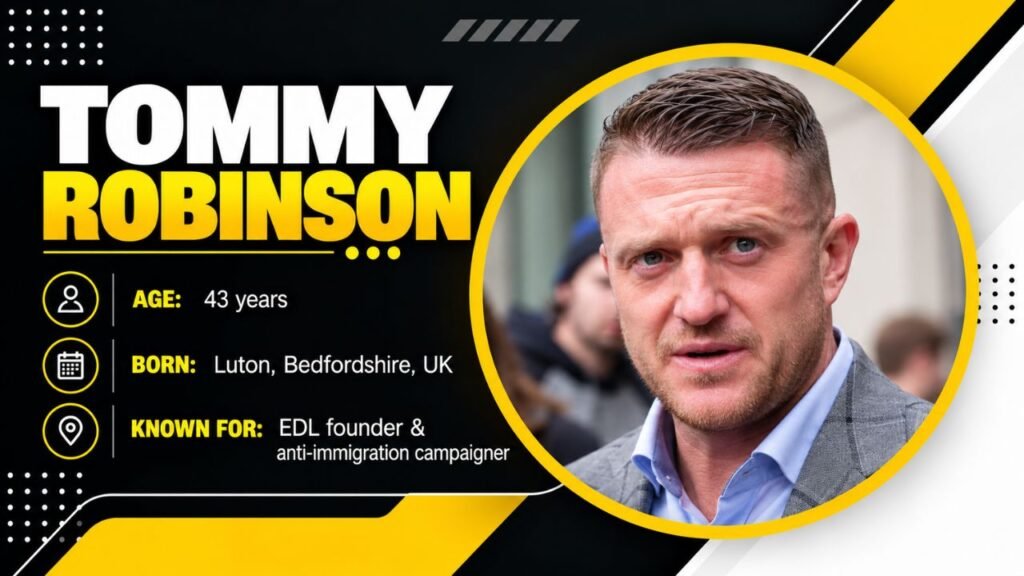
Real name: Stephen Christopher Yaxley-Lennon (born Stephen Christopher Yaxley) Born: 27 November 1982, Luton, Bedfordshire Known for: Founding the English Defence League (EDL) in 2009; anti-Islam and anti-immigration campaigning; online media work Age: 43 Current legal situation: On trial at Southwark Crown Court, London, from 19 October 2026, on two counts of harassment causing fear of violence. He has pleaded not guilty. Most recent major event: The Unite the Kingdom march in central London on 16 May 2026
Early Life and Background
Stephen Yaxley-Lennon was born in Luton, a town north of London with a large and long-established Muslim community and a history of industrial decline. He grew up in a working-class family. He worked as an engineer at Luton Airport and was, by his own account, a keen supporter of Luton Town Football Club.
The name “Tommy Robinson” is not his legal name. It was borrowed from a well-known figure in the Luton Town supporters’ scene, and Yaxley-Lennon began using it in public as he became active in street politics. Over the years it has become so well known that his own name is now far less familiar to the public than the alias.
Before he became a public figure, he had a number of run-ins with the law. Over the years, reports have noted convictions for assault and other offences. Those earlier cases are an important part of the background, because critics point to them when questioning his credibility, while supporters argue they have little to do with his work now.
From the BNP to the English Defence League
Yaxley-Lennon was briefly a member of the British National Party (BNP) in the mid-2000s. He has said he left because he disagreed with its racial politics, and he has repeatedly said he is not a racist. Critics note the BNP link anyway and argue that his later campaigning drew on similar themes.
The turning point came in 2009. After a protest against soldiers returning from Afghanistan with the Royal Anglian Regiment in Luton, in which a small group of Islamist demonstrators shouted abuse at the troops, a local backlash took shape. Out of that reaction came the English Defence League, which Robinson co-founded and led. The EDL described itself as a protest movement against what it called Islamist extremism. Critics said, then and now, that it was a vehicle for hostility to Muslims in general, and that its demonstrations were often accompanied by football hooligan networks and violence.
The EDL organised marches in towns and cities across England, often drawing large police operations and counter-demonstrations. Its public image was dominated by arrests, clashes and the reputations of some of its followers. In October 2013, Robinson announced that he was leaving the EDL, saying the group had become too difficult to steer away from extremism. He appeared at a press conference alongside Maajid Nawaz of the counter-extremism think tank Quilliam. The move surprised many, and some of his critics doubted it was sincere. Robinson returned to activism shortly afterwards, but this time without an organisation of his own.
Pegida UK, the Press and the Move Online
After leaving the EDL, Robinson took part in other efforts. In 2016 he helped launch the British branch of Pegida, the German-born anti-Islamisation movement, before handing over the leadership. 2018 he also worked as an adviser to the UK Independence Party (UKIP) under Gerard Batten, an association that caused a deep split inside that party and eventually ended.
In 2019 he stood as an independent candidate for the North West England seat in the European Parliament elections. He did not win, and he did not receive enough support to keep his deposit.
The more lasting change was the way he reached the public. He built an audience on social media and through video, presenting himself as an independent reporter who goes to places and subjects that the mainstream media, in his view, avoids. He has worked with outlets such as Rebel Media and, more recently, produced his own content on X.
His relationship with the big technology companies has been turbulent. He was banned from Twitter in 2018 and from Facebook and Instagram in 2019 for violating rules on hate speech. His X account was restored in November 2023 after Elon Musk took over the platform. Since then, he has built up a huge following there, and Musk has publicly backed him on several occasions.
The Convictions and Prison Sentences
Robinson’s legal record is long and is central to any honest account of him. These are the main points.
Assault and public order. He has convictions dating from the 2000s, including a violence-related conviction in 2005 and a conviction in 2011 connected to a street disturbance involving the EDL.
Travel on a false passport. In 2012 he was jailed after using another person’s passport to travel to the United States.
Mortgage fraud. In 2014 he was sentenced for mortgage-related fraud. He was released in 2015 after serving part of that sentence in custody.
The libel case, 2021. In a civil case, Robinson was sued by Jamal Hijazi, a Syrian refugee who had been filmed being bullied at his school in Huddersfield in 2018. Robinson had published claims about him that the High Court found to be false and defamatory. Robinson lost and was ordered to pay damages and costs. As part of the case, the court also made an order restricting what he could say about the matter.
Contempt of court, 2024. In October 2024, Robinson admitted ten breaches of that earlier High Court order. The breaches centred on his showing of a film, “Silenced”, at a rally in Trafalgar Square in July 2024. A judge sentenced him to 18 months in prison. The sentence was later cut on appeal and he was released in late May 2025, after about seven months in custody. His supporters again called it political persecution. The court’s position was that he had deliberately and repeatedly defied a court order, and that contempt of court is a matter of law, not of free speech.
The 2024 Riots and the Current Harassment Trial
In late July 2024, three young girls were murdered in an attack in Southport, Merseyside. In the days that followed, false claims about the attacker’s identity spread widely online, and riots broke out in towns and cities across England. Some critics and politicians accused Robinson and other online figures of inflaming tensions, which he has denied. He had left the UK for Cyprus shortly before the attack, a point that was raised in court this week.
Separately, in the early days of August 2024, Robinson was involved in a confrontation with two journalists from the Daily Mail and MailOnline, Andrew Young and Jacob Dirnhuber, who had published stories relating to him and his family. The Crown Prosecution Service later authorised charges against him of harassment causing fear of violence, in relation to posts, direct messages and a phone call between 5 and 7 August 2024. He entered not guilty pleas in July 2025.
Robinson’s side of the story, as set out in court, is that his own family had been put in danger by the newspaper’s actions. He has described the case on social media as “lawfare” and has thanked Elon Musk for helping to fund his legal costs, which he says have reached around £400,000.
Two points matter here. First, Robinson is presumed innocent and no verdict has been given. The jury was told at the start to put aside any views about him. Second, anyone reading about the case should wait for the verdict and the judge’s rulings before drawing conclusions. This article will be out of date as soon as the trial ends.
Unite the Kingdom: The Rallies of 2025 and 2026
Robinson’s biggest public events in recent years have been the “Unite the Kingdom” marches in central London.
September 2025. A march and rally drew a very large crowd, with police estimates running to well over 100,000 people, one of the biggest right-wing demonstrations in Britain in decades. Elon Musk addressed the crowd by video link. There were clashes with police, with bottles and other objects thrown at officers, and a number of arrests.
May 2026. A second march took place on Saturday 16 May, running from Holborn to Parliament Square. The Metropolitan Police deployed around 4,000 officers, alongside a separate pro-Palestinian demonstration marking Nakba Day and the FA Cup final in the same city on the same day. Police estimated about 60,000 people attended, fewer than the previous year, according to reporting at the time. Dozens of arrests were reported. Robinson told the crowd to prepare for a “battle of Britain” and urged them to “get involved” in local politics. The government also refused entry to eleven foreign activists ahead of the event.
Supporters see the rallies as a peaceful, patriotic show of public anger over immigration, crime and free speech. Critics point to the extreme rhetoric from some speakers and marchers, and to the arrests and clashes. The march was not affiliated with Reform UK, and its leader Nigel Farage has kept a distance from Robinson.
What Does Tommy Robinson Believe?
Robinson’s core message has stayed fairly consistent for more than fifteen years, although the emphasis has shifted.
His main themes are opposition to what he calls the Islamisation of Britain, strong criticism of mass immigration and of illegal Channel crossings, claims that the authorities and mainstream media have ignored or covered up crimes by some ethnic or religious groups, and a belief that free speech is under threat.
His campaigning has focused heavily on the grooming gang scandals in towns such as Rotherham, Rochdale and Telford. Independent inquiries and prosecutions have shown that these crimes were real and that institutions failed victims, often for fear of appearing racist. Supporters of Robinson say he drew attention to the issue before others did. Critics reply that he exploits the victims’ suffering to target an entire community, and that the facts of the cases are more complex than he suggests. A national inquiry into grooming gangs was announced by the government in 2025.
He says he is not anti-Muslim but opposed to extremism, and he has increasingly framed his cause in Christian and national terms. His critics, including many Muslim and community organisations, say his statements regularly target Muslims as a group, and that this contributes to hostility and fear.
Why Is Tommy Robinson So Controversial?
There are several reasons why he stays in the headlines.
His supporters say the case for him rests on four points. They see him as someone willing to go to prison for reporting what he believes the authorities want hidden. Argue that police and the courts treat him more harshly than others. They believe the media mislabels people who raise concerns about immigration. And they say he speaks for people who feel unrepresented.
His critics say the case against him rests on a different set of facts. He has a long criminal record, including violence, fraud and repeated contempt of court. Courts have found against him in the Hijazi libel case. His rhetoric about Muslims is seen as inflammatory. And the events around his rallies, and the unrest of summer 2024, show that his online influence can have real consequences for public order and for the people he targets.
Both sides agree on one thing: he has an unusual ability to mobilise crowds and attention. A man who started in a small Luton protest group now fills the centre of London and has the public support of one of the world’s richest people.
Tommy Robinson, Elon Musk and the Role of Social Media
No account of Robinson today is complete without his relationship with social media. Being banned from the major platforms once cut off his main audience. The return of his X account turned that around, and his posts regularly reach millions of people.
Musk has promoted Robinson’s content, spoken at his rally and, according to Robinson himself, helped pay for his legal defence. Supporters welcome this as a defence of free speech. Opponents argue that it gives reach to a person who has been found in contempt of court more than once, and that it shows the influence of a few wealthy individuals on British politics.
The UK government and regulators have in turn been debating how far online platforms should be held responsible for content that could incite violence or harassment, a debate that has become more urgent since the riots of 2024.
What Happens Next?
The most immediate question is the outcome of the harassment trial, which is expected to conclude in the coming days. If he is found not guilty, supporters will cite it as vindication, and he will likely renew his claim that he is a target of the legal system. If he is convicted, he faces possible further prison time, and the case will probably intensify the argument over. How the law should deal with online campaigners and the journalists they criticise.
Beyond the trial, Robinson has told his supporters to become politically active. Whether that means a new party, backing existing ones or simply continuing to organise marches is unclear. Mainstream parties have so far refused to be associated with him, but the size of his rallies means politicians are watching closely.
Whatever the outcome, the story of Tommy Robinson says a lot about modern Britain. The debates on immigration, policing, free speech, the role of the press, and the power of social media to create and break public figures.
Complete Latest Conclusion
Tommy Robinson’s story runs from a Luton protest group in 2009 to one of the biggest political rallies Britain has seen in recent years. It involves arrests, prison terms, bans and comebacks, and a large online following that regularly sets the national conversation. Supporters see a man speaking uncomfortable truths and paying the price. Critics see a person whose words and actions have harmed communities and undermined the justice system.
What is not in dispute is that he matters. Understanding the facts of his career, and the difference between what the courts have decided and what each side claims, is the best way to follow the debate. With a verdict in the harassment trial expected soon, the next chapter is only days away.
This article is based on court reports, major news coverage and public records up to 20 October 2026. It does not suggest guilt in any ongoing proceedings. Robinson is presumed innocent until a jury decides otherwise.
Check Also: Jarrett Joyce | Mark Latunski | Pedro Lopez | Nichol Kessinger
Frequently Asked Questions About Tommy Robinson
His real name is Stephen Christopher Yaxley-Lennon. He was born Stephen Yaxley and later used the name Yaxley-Lennon.
He was born on 27 November 1982, which makes him 43.
Tommy Robinson co-founded the EDL in Luton in 2009. He left the group in October 2013.
Yes. He has served several prison sentences over the years, including for assault. Travelling on a false passport, mortgage fraud and contempt of court. His most recent term was an 18-month sentence for contempt of court in October 2024, and he was released in May 2025.
He is on trial at Southwark Crown Court on two counts of harassment causing fear of violence against two MailOnline journalists in August 2024. He has pleaded not guilty and the trial began on 19 October 2026.
It is a large march and rally organised by Robinson in central London. The first took place in September 2025 and the second on 16 May 2026.
Musk has publicly backed Robinson, addressed his September 2025 rally by video, and Robinson has said Musk helped pay his legal costs.
Robinson describes himself as an independent journalist. Many media organisations and critics reject that description and call him an activist, and the courts have treated him as a member of the public in contempt cases.
Source: WikiPedia