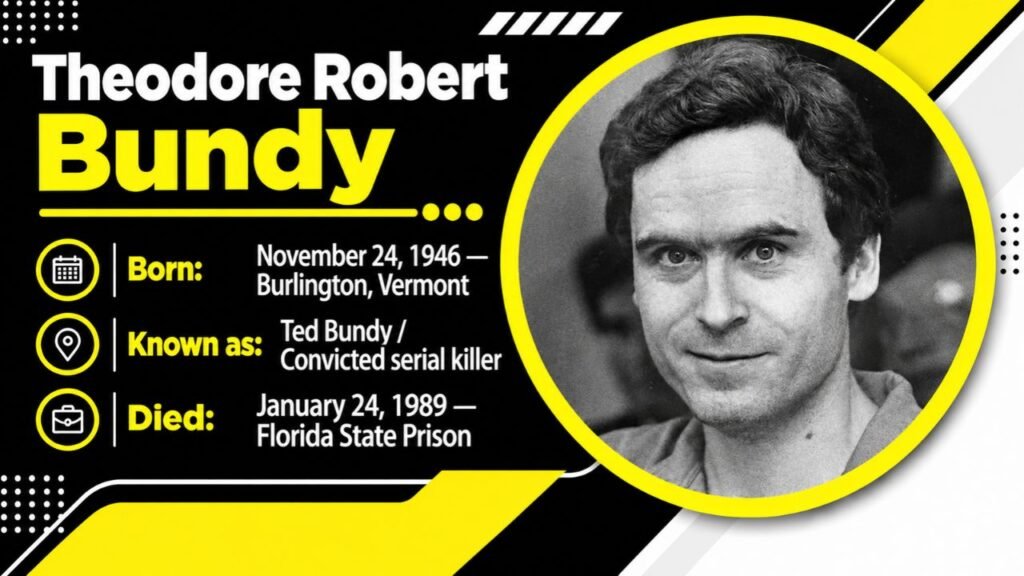
Few American criminals have drawn as much attention as Ted Bundy. He was a law student, a political volunteer, and a crisis hotline worker, and he used that polished image to hide one of the deadliest murder sprees of the twentieth century. Police in seven states struggled to link his crimes, and when they finally caught him, he escaped twice. Readers still ask how many people Ted Bundy killed, how he stayed free for so long, and how he died. The honest answers start with the women and girls he took from their families.
This article follows the case from his birth in 1946 to his execution in 1989. It covers his early life, the victims, the escapes, the trials, the confessions, and the changes that his crimes forced on American law enforcement.
| Detail | Information |
| Full name | Theodore Robert Bundy (born Theodore Robert Cowell) |
| Aliases | Chris Hagen, Kenneth Misner, “Officer Roseland,” Richard Garber |
| Born | November 24, 1946, Burlington, Vermont |
| Died | January 24, 1989, Florida State Prison, age 42 |
| Cause of death | Execution by electric chair |
| Confessed murders | 30, across seven states |
| Estimated total | 50 to 100 or more, according to many investigators |
| Active period | 1974 to 1978 (earlier crimes suspected) |
| States involved | Washington, Oregon, Utah, Colorado, Idaho, California, Florida |
Who Was Ted Bundy?
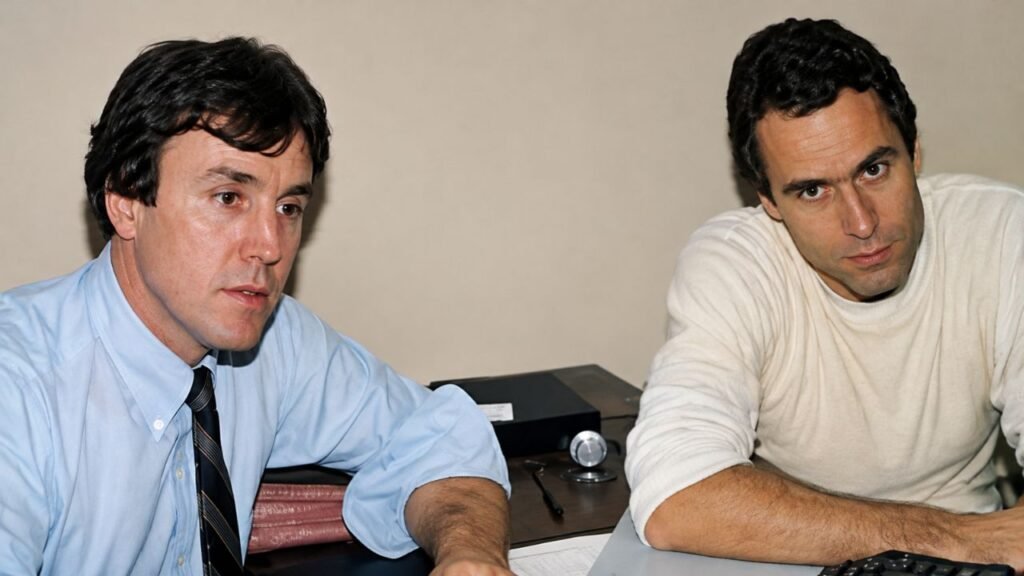
Ted Bundy was an American serial killer, kidnapper, and rapist who targeted young women across the country in the mid-1970s. He was articulate, well dressed, and good-looking, and he used those traits to lower his victims’ guard. He often approached women in daylight while he faked an injury or posed as an authority figure.
Police of that era expected a violent offender to look obviously disturbed or isolated. Bundy fit none of that, because he studied psychology, volunteered for a state political campaign, and attended law school. As a result, detectives in different states took years to realize that the same man was behind the disappearances.
His capture, two escapes, televised trials, and 1989 execution made him a national figure. Moreover, the failures in the investigation pushed the FBI to build the Violent Criminal Apprehension Program, known as VICAP.
Ted Bundy’s Early Life
Birth and Family Secrets
Ted Bundy’s mother, Eleanor Louise Cowell, was 22 and unmarried when she gave birth to him in 1946 at a home for unwed mothers in Burlington, Vermont. In that era, an out-of-wedlock birth carried heavy stigma. Therefore, the family hid the truth. Bundy grew up believing that his grandparents, Samuel and Eleanor Cowell, were his parents and that his mother was his older sister.
His father’s identity remains unclear. His birth certificate named one man, his mother later named another, and a family rumor pointed to someone else. Biographers have never settled the question.
Accounts differ about when he learned the truth. One version says he found his birth certificate at age 14, and another says a cousin told him during a family dispute. In either case, relatives say he resented his mother for lying.
His Grandfather and Stepfather
His grandfather, Samuel Cowell, had a reputation for rage and cruelty, according to relatives. His grandmother suffered from depression and fear of leaving home. In 1950, his mother moved with young Ted to Tacoma, Washington, and in 1951 she married Johnny Bundy, a hospital cook, who adopted Ted.
Johnny tried to bond with his stepson through camping trips and scouting. However, Ted looked down on him as working-class and uncultured, and he kept his distance.
Teenage Warning Signs
At Woodrow Wilson High School, teachers saw a quiet, neat student. Privately, according to the case file, he watched women through windows at night, stole expensive goods for the thrill, and faced at least two arrests as a teen for burglary and auto theft. When he turned 18, the courts sealed and then erased his juvenile record, so adult investigators never saw it.
Education, Love, and Reinvention
The Breakup That Changed Him
In 1967, Bundy fell in love with a University of Washington classmate, Diane Edwards, whom books often call Stephanie Brooks. She came from a wealthy California family and had the poise and status he wanted. In 1968, she ended the relationship because she found him unfocused and lacking ambition.
Criminologists often describe the rejection as a turning point. It humiliated him, and he later fixated on young women who resembled her, with long hair parted in the middle.
The Respectable Mask
After the breakup, Bundy rebuilt his image. He returned to the University of Washington, switched to psychology, and graduated with honors in 1972. He joined the Washington State Republican Party and worked on Governor Daniel Evans’s re-election campaign, and the state party chairman, Ross Davis, saw him as a rising star.
In 1971, he took a job at the Seattle Crisis Clinic, where he worked beside Ann Rule, a former police officer who later became a crime writer. Rule noted that he talked suicidal callers through their darkest hours. That contrast still disturbs people who study the case.
Elizabeth Kloepfer and Diane Edwards
In 1969, Bundy began dating Elizabeth Kloepfer, a divorced mother and university secretary. She gave him stability, emotional support, and money, but he lied to her, cheated on her, and hid his nights from her. In late 1973, he also won back Diane Edwards and proposed. Then, in early 1974, he abruptly dropped her without explanation.
Ted Bundy Victims: The Pacific Northwest (1974)
In 1974, women began vanishing from college campuses in Washington and Oregon. Bundy used a pattern of fake injuries, such as an arm sling or a cast, to ask for help, and he took victims at night and in daylight.
| Date | Victim | Age | Location |
| January 4, 1974 | Karen Sparks (survived) | 18 | Seattle, WA |
| February 1, 1974 | Lynda Ann Healy | 21 | Seattle, WA |
| March 12, 1974 | Donna Gail Manson | 19 | Olympia, WA |
| April 17, 1974 | Susan Elaine Rancourt | 18 | Ellensburg, WA |
| May 6, 1974 | Roberta Kathleen Parks | 22 | Corvallis, OR |
| June 1, 1974 | Brenda Carol Ball | 22 | Burien, WA |
| June 11, 1974 | Georgann Hawkins | 18 | Seattle, WA |
| July 14, 1974 | Janice Ann Ott | 23 | Lake Sammamish, WA |
| July 14, 1974 | Denise Marie Naslund | 19 | Lake Sammamish, WA |
Karen Sparks survived a brutal attack in her apartment, but she suffered permanent injuries. Lynda Healy, a university student who read weather reports on morning radio, disappeared from her home a month later. Investigators found the skulls of several victims, including Healy, Rancourt, Parks, and Ball, on Taylor Mountain in 1975.
The Lake Sammamish Abductions
On July 14, 1974, thousands of people crowded Lake Sammamish State Park near Issaquah. Witnesses saw an attractive young man in white clothes with his arm in a sling, who called himself “Ted” and asked women for help with his sailboat. Janice Ott vanished around midday, and Denise Naslund vanished about four hours later.
The two daytime disappearances terrified the region. King County police released a composite sketch and details of his brown Volkswagen Beetle. Even so, detectives did not yet connect the pieces.
Utah, Colorado, and Idaho (1974 to 1975)
In August 1974, Bundy entered the University of Utah College of Law, and the Washington disappearances stopped. New ones began around Salt Lake City.
| Date | Victim | Age | Location |
| October 2, 1974 | Nancy Wilcox | 16 | Holladay, UT |
| October 18, 1974 | Melissa Smith | 17 | Midvale, UT |
| October 31, 1974 | Laura Aime | 17 | Lehi, UT |
| November 8, 1974 | Carol DaRonch (survived) | 18 | Murray, UT |
| November 8, 1974 | Debra Kent | 17 | Bountiful, UT |
| January 12, 1975 | Caryn Campbell | 23 | Snowmass, CO |
| March 15, 1975 | Julie Cunningham | 26 | Vail, CO |
| April 6, 1975 | Denise Oliverson | 24 | Grand Junction, CO |
| May 6, 1975 | Lynette Culver | 12 | Pocatello, ID |
| June 28, 1975 | Susan Curtis | 15 | Provo, UT |
Melissa Smith was the daughter of Midvale Police Chief Louis Smith. Searchers found her body in the Wasatch Mountains nine days after she vanished, and Laura Aime’s remains turned up in Provo Canyon.
The Carol DaRonch Escape
On November 8, 1974, at a shopping mall in Murray, Utah, Bundy approached 18-year-old Carol DaRonch while he posed as “Officer Roseland.” He claimed someone had tried to break into her car and told her to come to the station. She got into his Volkswagen, but when he tried to handcuff her, she fought back, opened the door, and escaped onto the road. A passing driver helped her, and the handcuffs became key evidence.
Later that same night, 17-year-old Debra Kent disappeared from a high school parking lot in Bountiful. Investigators found a key at the scene that fit the handcuffs used on DaRonch. In 2015, officials identified a bone fragment as Kent’s, and her family finally received closure after 40 years.
The First Arrest and Conviction
The Granger Traffic Stop
At 2:30 a.m. on August 16, 1975, Utah Highway Patrol Officer Bob Hayward noticed a tan Volkswagen Beetle moving slowly through a Granger neighborhood with its lights off. When Hayward turned on his emergency lights, the driver sped away. Hayward cornered him at a gas station and arrested him.
A search of the car revealed a ski mask, a pantyhose mask with eye holes, a crowbar, handcuffs, rope, trash bags, and an ice pick. Detective Jerry Thompson recognized that these items matched the DaRonch attack and other local cases.
The Kidnapping Trial
In February 1976, Bundy faced trial in Salt Lake City for the DaRonch kidnapping. DaRonch picked him out of a lineup, and Bundy waived his right to a jury. On March 1, 1976, Judge Stewart Hanson Jr. convicted him and sentenced him to one to fifteen years in prison.
The Two Escapes
Colorado extradited Bundy to face charges for Caryn Campbell’s murder. He then made his first escape and, months later, a second.
| Escape | Date | What happened |
| Pitkin County Courthouse, Aspen | June 7, 1977 | Acting as his own lawyer, he used the law library and jumped from a second-floor window; police recaptured him six days later |
| Garfield County Jail, Glenwood Springs | December 30, 1977 | After weeks of weight loss, he squeezed through an opening in his cell ceiling, entered the jailer’s apartment, and walked out |
After the second escape, he traveled by train, bus, and plane to Florida.
A note on dates: the case file you provided lists the first escape as June 9, 1977. Several news and library sources, including ABC News and the Denver Public Library, put it on June 7, so this article uses that date.
The Florida Attacks (January to February 1978)
Bundy rented a room near Florida State University in Tallahassee under the name Chris Hagen. He lived on stolen credit cards and food stamps.
The Chi Omega Attacks
Early on January 15, 1978, he entered the Chi Omega sorority house through a rear door with a faulty lock. He killed Margaret Bowman, 21, and Lisa Levy, 20, and he severely injured Karen Chandler and Kathy Kleiner, who survived after a car’s headlights startled him and he fled. About an hour later, he attacked another FSU student, Cheryl Thomas, who survived with permanent hearing and balance problems.
The Murder of Kimberly Leach
On February 9, 1978, Bundy abducted 12-year-old Kimberly Diane Leach from her middle school in Lake City, Florida. Searchers found her remains seven weeks later in a hog shed at Suwannee River State Park. She was one of his youngest victims.
How Police Caught Ted Bundy
At 1:30 a.m. on February 15, 1978, Pensacola Patrolman David Lee spotted a stolen orange Volkswagen. When Lee stopped it, Bundy fought him and tried to grab his gun. Lee fired a warning shot and subdued him. Officers found stolen identification belonging to female FSU students in the car, and they realized they had captured an FBI Ten Most Wanted fugitive.
Trials and Sentences
The Chi Omega Trial in Miami (1979)
In June 1979, a Miami jury heard the Chi Omega case, one of the first American murder trials that television broadcast nationally. A forensic dentist, Dr. Richard Souviron, matched evidence on Lisa Levy’s body to casts of Bundy’s teeth, and the jury accepted that testimony. On July 24, 1979, jurors convicted him of both murders. Judge Edward Cowart sentenced him to death twice, and he told Bundy to take care of himself, calling the case a tragic waste.
The Kimberly Leach Trial and the Courtroom Marriage
In January 1980, Bundy stood trial in Orlando for Leach’s murder, and the jury found him guilty. During the penalty phase, he used a Florida rule that treated a declaration of marriage in open court as legally binding. While he questioned defense witness Carole Ann Boone, he proposed, and she accepted. They married right there in the courtroom.
Boone gave birth to a daughter in 1981, conceived while Bundy was on death row. Boone divorced him in 1986 after she accepted his guilt, and she moved away with the child. Out of respect for their privacy, this article does not name the daughter or share where they live.
Death Row, Confessions, and Execution
Helping the Green River Investigation
Bundy spent nine years at Florida State Prison in Raiford. During that time, Washington detectives Robert Keppel and Dave Reichert interviewed him to learn how a serial killer thinks, and they used his insights while they hunted the Green River Killer, Gary Ridgway.
The Confessions
When his appeals ran out in early 1989, Bundy began to confess to FBI behavioral analyst Bill Hagmaier and state detectives. Investigators believe he hoped to delay his execution. Official lists vary, but the case file records 30 confessed killings, while some outlets say 28.
| State | Confessed victims |
| Washington | 11 |
| Utah | 8 |
| Colorado | 3 |
| Florida | 3 |
| Oregon | 2 |
| Idaho | 2 |
| California | 1 |
| Total | 30 |
How Many People Did Ted Bundy Kill?
Ted Bundy confessed to 30 murders, but many investigators believe the true number is between 50 and 100 or higher. He hinted that his crimes started years before 1974. Police have long suspected a link to the 1961 disappearance of 8-year-old Ann Marie Burr in Tacoma, though Bundy never confessed to it, and no one has proven it.
The Execution
| Detail | Information |
| Place | Florida State Prison, near Starke |
| Date and time | January 24, 1989, 7:16 a.m. |
| Method | Electric chair |
| Last words | He asked two people to give his love to his family and friends |
| Crowd outside | More than 2,000 people, many of them cheering |
| After his death | Cremated; his ashes went to the Cascade Mountains in Washington, as he requested |
Ted Bundy’s Psychology
State psychiatrists and FBI analysts studied him for years. They described a man with antisocial personality disorder and psychopathy, with no remorse, shallow charm, constant lying, and an inflated sense of his own intelligence. In prison tests, his IQ measured between about 124 and 136, which is superior but not the genius level that popular media often claims.
Method vs. Signature
Investigators separate his methods from his deeper motives. His methods included fake injuries, impersonating police officers, night break-ins, and moving victims to remote sites. His signature, which met his psychological needs, centered on a type of victim and on control. Those distinctions now appear in profiling textbooks.
Legacy: What the Case Changed
VICAP
Police in Washington, Oregon, Utah, and Colorado could not easily compare missing-person reports and suspect descriptions. That failure showed the danger of fragmented communication. In response, the FBI created VICAP, a national database that helps agencies connect violent crimes across jurisdictions.
Forensic Dentistry
The Chi Omega trial also strengthened the role of forensic odontology in American courtrooms. Although experts today debate the reliability of some bite mark methods, the case remains a landmark in the history of forensic evidence.
Timeline
| Year | Event |
| 1946 | Born in Burlington, Vermont |
| 1951 | Adopted by Johnny Bundy |
| 1968 | Diane Edwards ends their relationship |
| 1972 | Graduates from the University of Washington with honors |
| 1974 | Pacific Northwest abductions; moves to Utah |
| 1975 | Colorado murders; first arrest in Granger, Utah |
| 1976 | Convicted of aggravated kidnapping |
| June 7, 1977 | First escape, Aspen |
| December 30, 1977 | Second escape, Glenwood Springs |
| January 15, 1978 | Chi Omega attacks |
| February 9, 1978 | Kimberly Leach abducted |
| February 15, 1978 | Arrested in Pensacola |
| 1979 | Sentenced to death in Miami |
| 1980 | Sentenced to death in Orlando; marries in court |
| January 24, 1989 | Executed |
Check Also: Frank Lucas | Nancy Guthrie | Jeffrey Dahmer | Lindsay Clancy | Matthew Farwell | Scott Colom | Dana White | Aileen Carol Wuornos | Pablo Escobar
Frequently Asked Questions About Ted Bundy
He was an American serial killer who murdered young women between 1974 and 1978 and confessed to 30 killings.
He confessed to 30 murders in seven states, though many investigators believe the real total is 50 to 100 or more.
Utah Highway Patrol Officer Bob Hayward stopped him in 1975, and Pensacola Patrolman David Lee arrested him in 1978 after he escaped twice.
Twice, both in Colorado: from the Pitkin County Courthouse on June 7, 1977, and from the Garfield County Jail on December 30, 1977.
Florida executed him in the electric chair on January 24, 1989, at 7:16 a.m.
Yes. He married Carole Ann Boone in a Florida courtroom in 1980, and she divorced him in 1986.
Tests measured it between about 124 and 136.
Many experts link his fixation to his 1968 breakup with Diane Edwards, though no single event explains his crimes.
It is the FBI’s Violent Criminal Apprehension Program, a database that helps police connect violent crimes across jurisdictions. It grew out of the failures that Bundy’s case exposed.
His ashes went to the Cascade Mountains in Washington, according to his written request.